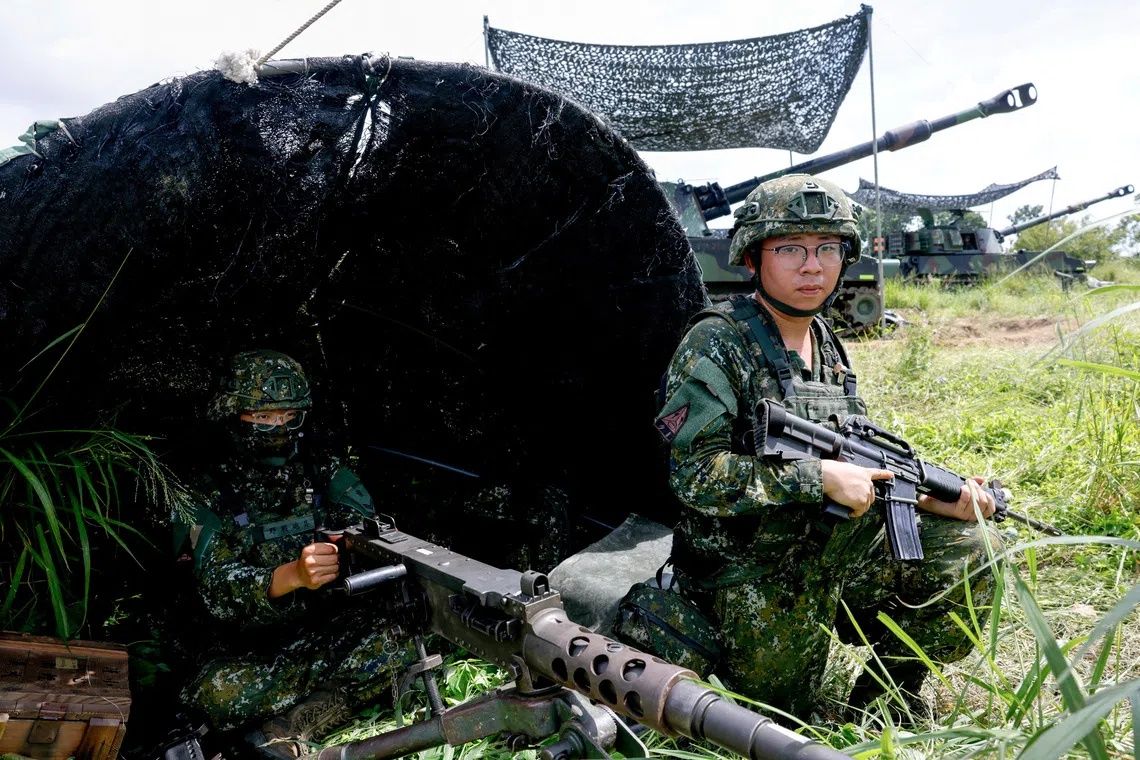
Taiwan has commenced its most comprehensive military exercise in decades, signalling a significant shift toward more realistic combat preparation as tensions with Beijing escalate. The ten-day Han Kuang exercise, which began on Wednesday after activation by an underground command centre in Taipei, represents a marked departure from the heavily choreographed drills of previous years. Defence officials characterised the operation as a fundamental rethinking of how the island's armed forces would function in a genuine wartime environment, where plans often unravel and commanders must improvise under extreme duress.
At the operational level, the drills introduce what military planners call the "backbrief" mechanism—a technique adopted from United States armed forces doctrine. Under this approach, junior officers receiving orders must restate the mission parameters and intended outcomes back to their commanding officers before proceeding. This seemingly straightforward communication safeguard addresses a persistent vulnerability in Taiwan's command structure: the gap between what senior officers intend and what subordinates actually understand. By institutionalising this feedback loop, Taiwan aims to prevent the catastrophic misalignments that plague organisations under stress, particularly during initial combat operations when the fog of war obscures intentions and dissolves traditional chains of command.
The military has mobilised more than 20,000 personnel across the exercise, including approximately 5,000 reservists, to simulate the multifaceted challenges Taiwan would face in a conflict scenario. Critically, the drills incorporate combat-readiness manoeuvres that extend beyond traditional naval and air force operations. Fighter jets will be dispersed from their normal bases to reduce vulnerability to strikes, while emergency naval deployments will test the ability of maritime forces to maintain operational coherence when infrastructure becomes compromised. These elements reflect Taiwan's assessment of how a Chinese attack might unfold: rapid strikes designed to disable centralised command structures and degrade logistical networks that modern militaries depend upon.
For the first time, Taiwan is deliberately degrading mobile internet speeds across the island to test how civilian populations and government agencies would maintain communications during a conflict. This innovation acknowledges a critical blindspot in previous exercises: most Taiwanese have never experienced an environment where digital connectivity—the nervous system of modern society—becomes unreliable. By throttling bandwidth systematically, authorities can observe how public morale, government operations, and emergency responses deteriorate when citizens cannot access real-time information or coordinate through social media. The implications extend beyond military readiness into the psychological and social dimensions of warfare, areas where Taiwan's largely prosperous, digitally dependent population faces genuine uncertainty.
The drill's focus on command centre vulnerability reflects Taiwan's reading of Chinese military strategy. Intelligence assessments suggest Beijing's opening moves in any conflict would target the physical infrastructure supporting Taiwan's decision-making apparatus—command centres, ports, ammunition depots, and defence manufacturing facilities. The exercise will simulate the wartime relocation of a major arsenal and mobilise civilian factories into the defence supply chain, testing whether Taiwan could sustain industrial production despite disruption. This integration of civilian capability into military operations acknowledges that modern conflict cannot be confined to military institutions; it necessarily extends into society itself.
Defence officials have explicitly characterised these changes as movement away from what they termed "laboratory-like" exercises conducted in controlled environments. The new approach introduces "unexpected scenarios" designed to disorient commanders and force real-time decision-making without the benefit of rehearsal. One senior official stated that participants would face "bottom-line conditions," language suggesting exposure to worst-case assumptions rather than optimistic projections. This methodological shift responds to persistent criticism that Taiwan's military had become too comfortable with predictable drill patterns, allowing officers and units to perform well during exercises while potentially struggling with genuine operational chaos.
The introduction of embedded reporters and formal mechanisms for countering disinformation represents an acknowledgement that information warfare—the battle for narrative control—constitutes a critical domain in modern conflict. Taiwan recognises that China likely intends to use propaganda and false reporting to demoralise the population, confuse the command structure, and shape international perceptions during any conflict. By testing how Taiwan's military and government would manage wartime communications, the exercise addresses vulnerabilities that cannot be addressed through hardware or tactical doctrine alone. The emphasis on how Taiwan's entire population should conceptually approach warfare reflects a shift from purely military thinking toward a comprehensive national defence posture.
The escalation of exercise realism occurs against a backdrop of intensifying Chinese military activity. Taiwanese officials have documented increasing incursions by Chinese aircraft into Taiwan's air defence identification zone, practice blockade scenarios, and expansion of amphibious warfare capabilities. Beijing's military modernisation and strategic posturing have created an environment where Taiwan's previous assumption—that military conflict remained unlikely despite political tensions—no longer holds credibility. For Malaysian policymakers and defence planners across Southeast Asia, Taiwan's evolving approach to military readiness signals that the region must prepare for more volatile and unpredictable great power dynamics.
The Han Kuang exercise will conclude on August 14 after testing civilian resilience across multiple domains, from earthquake response to hypothetical invasion scenarios. This integrated approach reflects an understanding that survival in modern conflict depends not on military victory alone but on maintaining social cohesion, government function, and public morale despite cascading crises. Taiwan's willingness to subject its population to temporary internet restrictions and its military to unsimulated chaos represents a maturation of strategic thinking about what preparation for conflict actually requires. For a society that has enjoyed decades of peace, this shift toward existential realism carries profound psychological implications that extend far beyond the military domain into the fundamentals of national identity and collective purpose.

