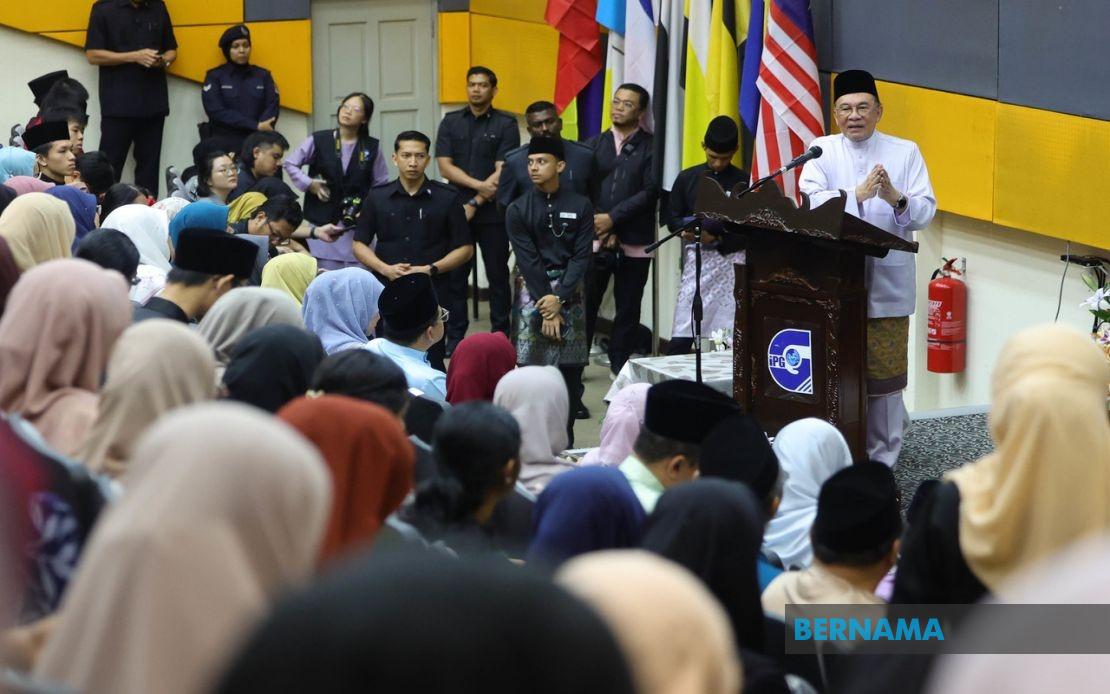
Prime Minister Datuk Seri Anwar Ibrahim has pinpointed a troubling paradox at the heart of Malaysia's governance challenges: the barriers to meaningful reform emanate not from a dearth of resources, technical capability, or professional know-how, but from the deliberate obstruction by influential actors who benefit from the status quo. Speaking at the Technical Education Campus of the Institute of Teacher Education in Bandar Enstek, Anwar underscored that entrenched resistance to administrative overhaul, particularly from elite circles invested in preserving corrupt systems, represents the most formidable impediment to national transformation.
The Prime Minister's remarks reflect a sobering assessment grounded in his three years navigating the machinery of government. Rather than the typical explanations offered for slow reform—inadequate funding, technological gaps, or insufficient expertise—Anwar has identified something more systemic and psychologically rooted: an unwillingness among certain constituencies to relinquish comfortable arrangements that have become normalised over decades. This observation carries particular weight coming from a leader who campaigned on a platform of institutional renewal and anti-corruption, yet has encountered sustained friction from within the bureaucratic apparatus itself.
Anwar's framing of the challenge speaks to a phenomenon familiar across developing democracies: the distinction between formal commitment to reform and the lived resistance of those positioned to lose from genuine change. When administrative systems are restructured, accountability mechanisms tightened, and transparency requirements imposed, the privileges long enjoyed by insiders become visible and vulnerable. The Prime Minister acknowledges that modernising governance structures inevitably creates discomfort among beneficiaries of the previous arrangement, particularly those whose status derived not from competence but from proximity to power and resources.
The reference to individuals who are "modern in their attire and lifestyle" yet resist substantive institutional change hints at a specific category of obstacle: cosmopolitan elites who embrace surface-level modernisation while protecting the underlying networks of patronage and rent-seeking that sustain their influence. This distinction matters because it suggests that the problem cannot be solved through technological adoption or international best-practice frameworks alone. The impedance is cultural and volitional—rooted in preferences rather than ignorance.
The government's dual commitment to strengthen governance mechanisms while combating corruption inevitably generates friction, Anwar acknowledged, precisely because these initiatives are not universally popular. Any serious anti-corruption programme necessarily threatens those who have benefited from murky procurement practices, discretionary resource allocation, and unaccountable decision-making. In Malaysia's context, where patronage networks have historically structured access to civil service positions, business contracts, and licensing arrangements, systematic transparency threatens entrenched power configurations that extend beyond government into connected commercial spheres.
Anwar's invocation of religious, cultural, and civilisational imperatives for continuous institutional improvement attempts to reframe reform as a moral and existential necessity rather than a technocratic preference. This rhetorical strategy positions resistance to change as not merely obstructionist but ethically indefensible—a deviation from principles that transcend political ideology. By anchoring reform in broader value systems, Anwar seeks to elevate the reform agenda beyond partisan dispute and bureaucratic turf-protection.
The challenge articulated by the Prime Minister reflects a structural tension within democratic governance in newly industrialising nations: the simultaneous requirement to modernise state institutions and manage the political costs of displacing entrenched interests. Malaysia's civil service, like those across Southeast Asia, contains layers of informal practice, unwritten protocols, and understood arrangements that coexist with formal rules. Genuine reform threatens this dual system, inevitably triggering defensive responses from stakeholders whose influence derives from navigating informal channels rather than excelling within formal frameworks.
For Malaysian observers, Anwar's candid assessment suggests that the reform programme will likely proceed incrementally rather than through dramatic transformation. Resistance embedded within government structures themselves constrains the pace and scope of change, even when political will exists at the highest level. The Prime Minister's public articulation of these obstacles signals both frustration with implementation delays and an attempt to mobilise external pressure—from civil society, the business community, and the general public—to overcome internal resistance.
The implications extend beyond administrative efficiency or corruption metrics. Malaysia's economic competitiveness in an increasingly scrutinised global environment depends upon demonstrable institutional integrity and transparent governance frameworks. Foreign investors, development partners, and international organisations increasingly condition engagement on governance standards. Internal resistance to reform thus carries tangible economic consequences, potentially constraining Malaysia's positioning within regional and global markets.
Anwar's remarks also carry implications for how subsequent administrations will approach institutional change. By publicly identifying resistance and obstruction, the government establishes a record of attempted reform that can shape historical interpretation of this period. Simultaneously, by framing obstacles as inevitable rather than exceptional, Anwar sets realistic expectations for the pace of transformation, potentially forestalling criticism that reform remains incomplete.
The conversation at the teacher education institution itself merits attention, as it suggests deliberate engagement with younger cohorts less socialised into existing arrangements. Institutions that train educators occupy a multiplier role in societal value formation, making them strategic venues for articulating reform narratives and cultivating receptiveness to institutional change among future leaders. This choice of venue indicates that Anwar's strategy encompasses not merely overcoming current resistance but cultivating future constituencies predisposed toward reform-oriented governance.
Ultimately, the Prime Minister's diagnosis identifies a human rather than technical problem: the gap between the capacity to reform and the willingness to do so among those positioned to implement change. Closing this gap requires sustained political commitment, incremental institutional restructuring that reduces defensibility of corrupt practices, and gradual replacement of actors invested in the old system with those committed to new standards. Malaysia's reform trajectory will depend significantly upon how effectively these multiple strategies intersect over the coming years.

