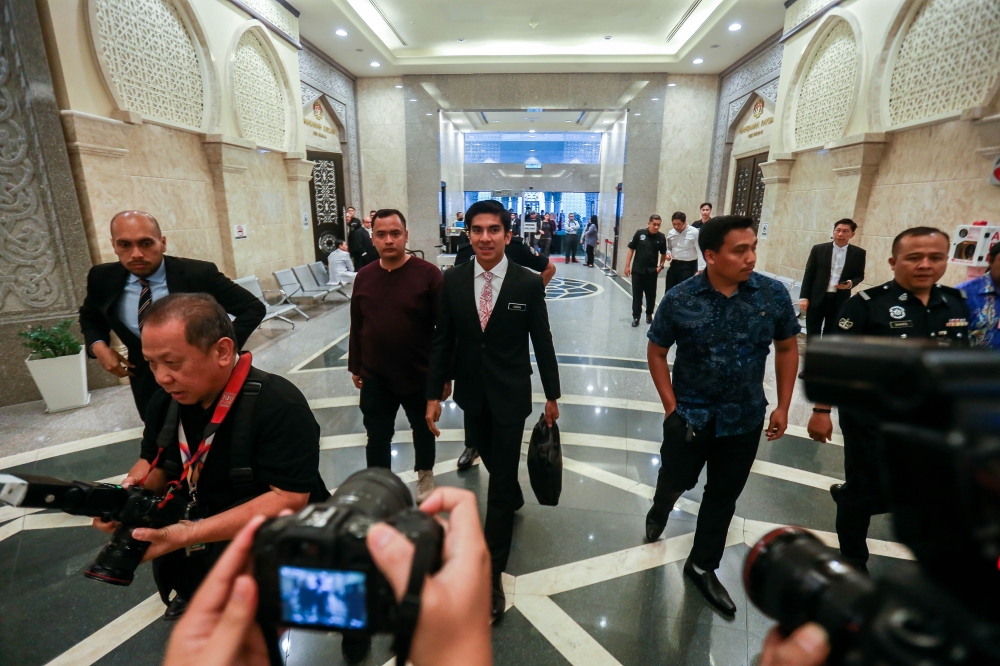
Muar Member of Parliament Syed Saddiq Syed Abdul Rahman made an early appearance at the Palace of Justice in Putrajaya on Monday morning, arriving well ahead of the Federal Court hearing that would determine a pivotal moment in his political career. Accompanied by family members and his fiancée, the prominent politician faced a day of intense scrutiny as crowds began assembling outside the courthouse to witness what many observers considered a watershed moment in Malaysian politics.
The convergence of supporters and media at the Palace of Justice underscored the significant public interest surrounding Syed Saddiq's case. As a relatively young and visible figure within Malaysian politics, his political fortunes have long attracted attention from those tracking the country's evolving political landscape. The presence of family members and his fiancée at his side suggested a deeply personal dimension to proceedings that extended beyond typical courtroom proceedings, signalling the weight of consequences that hung in the balance.
Federal Court rulings carry particular significance within Malaysia's legal hierarchy, representing the final arbitration on matters of constitutional importance or substantial legal complexity. The decision the court would deliver held implications not merely for Syed Saddiq's personal circumstances but potentially for broader questions of political accountability and the application of electoral law in the Malaysian context. Such high-level judicial pronouncements often reverberate through political circles, shaping strategies and precedents for years to come.
The gathering of crowds outside the courthouse reflected a broader pattern of public engagement with high-stakes political and legal proceedings in Malaysia. When prominent political figures face significant court decisions, particularly those involving potential consequences for their parliamentary positions or political standing, public curiosity intensifies. This phenomenon illustrates how Malaysian voters and observers closely monitor developments affecting their elected representatives, viewing such proceedings as part of the ongoing assessment of political leadership and integrity.
Syed Saddiq's position as the Muar MP represents a constituency that has entrusted him with legislative responsibilities and representation in Parliament. Any Federal Court ruling affecting his status therefore carries implications for his constituents and their democratic representation. This constituency dimension adds another layer to the political significance of the hearing, as voters consider how court decisions might influence their parliamentary representation and the continuity of advocacy on local issues.
The early arrival and presence of supporters demonstrated the mobilization capacity that Syed Saddiq commands within his political sphere. Politicians with dedicated support bases often find that significant court dates attract their followers, who view their presence as a form of solidarity during challenging moments. This visible show of support can serve multiple functions, from demonstrating political viability to sending signals to other political actors about the strength of factional support within broader political movements.
Federal Court proceedings at this level typically involve substantial legal arguments and matters of sufficient complexity or constitutional importance to warrant the court's attention. The fact that Syed Saddiq's case had reached this apex of the judicial hierarchy suggested that foundational legal questions remained unresolved or that previous court decisions required clarification or reversal. Such appeals often involve technical legal arguments alongside broader questions about the interpretation of statutes and constitutional provisions governing electoral conduct and political life.
The political environment in Malaysia in mid-2024 continued to evolve as various factions within and across party lines jockeyed for position and influence. For a figure like Syed Saddiq, whose political trajectory had included notable shifts in allegiances and repositioning within different political groupings, significant legal developments could either accelerate or impede his political momentum. Court decisions affecting prominent political figures often create ripple effects throughout party structures and coalition arrangements.
The presence of his fiancée at the Palace of Justice highlighted how legal proceedings affecting public figures inherently intersect with their personal lives and relationships. The scrutiny and uncertainty accompanying high-stakes court cases inevitably extends beyond the individual defendant to touch those in their immediate circles. For families and intimate partners, such occasions represent moments where personal relationships and public responsibilities collide in visible, often stressful circumstances.
As observers awaited the Federal Court's determination, questions circulated within political commentary about potential outcomes and their ramifications. Would the ruling affirm previous decisions, reverse them, or chart new legal territory? What did the composition and questioning patterns of the court during proceedings suggest about the likely direction of adjudication? Such speculations occupy Malaysian political discourse when major rulings hang pending, as stakeholders position themselves for various potential outcomes.
The timing of the hearing in July 2024 placed it within a broader calendar of political activity and public interest in Malaysian governance. Federal Court decisions made during this period would likely be analyzed within the context of prevailing political conditions, coalition dynamics, and the strategic positioning of various political actors. Major court rulings often serve as markers in the political timeline, providing clarity or creating new uncertainty about the landscape of Malaysian politics for the months ahead.

