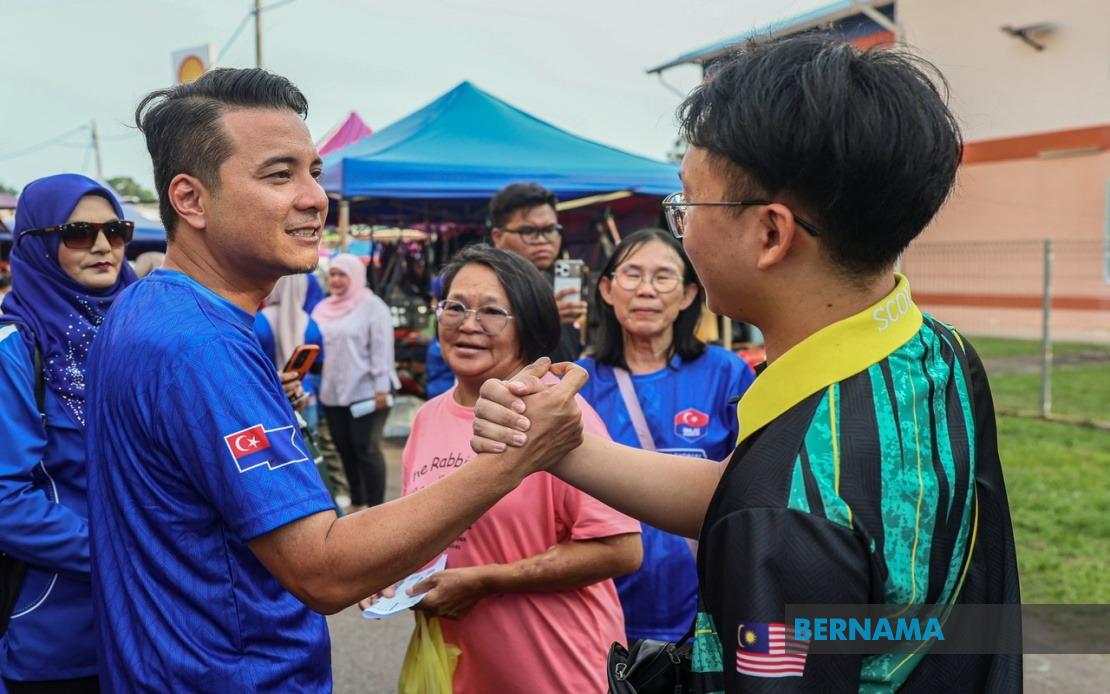
Barisan Nasional candidate Syed Hussien Syed Abdullah is staking his campaign for the Mahkota state constituency on an economic model designed to give Kluang residents the financial security of urban employment without forcing them to abandon rural living. The strategy, framed as a "Work in the City, Live in the Countryside" ecosystem, reflects a growing recognition among Malaysian politicians that young voters increasingly seek the material benefits of metropolitan centres coupled with the quality-of-life advantages of smaller towns. At its core, the proposal hinges on improving public transport infrastructure, particularly the Electric Train Service, which would enable seamless daily commuting between Kluang and Johor's major industrial and commercial hubs.
The vision directly addresses a widespread demographic challenge facing Malaysia's secondary cities: young talent exodus. As Kluang-based professionals flock to Kuala Lumpur, Selangor, and central Johor for better-remunerated positions, local economies hollow out and properties depreciate. Syed Hussien's approach inverts this narrative by positioning Kluang not as a satellite dependent on external opportunity, but as a residential base for knowledge workers whose livelihoods remain tethered to broader regional growth. By improving transport connectivity rather than attempting to relocate employers, the strategy appears pragmatic rather than utopian—a critical distinction for voters fatigued by unfulfilled electoral promises.
The candidate has explicitly tied his constituency-level plans to the broader Johor Economic Transformation Plan, the state-level development roadmap introduced by Menteri Besar Datuk Onn Hafiz Ghazi. This framing situates Mahkota within a comprehensive provincial growth strategy rather than positioning it as an isolated political promise. The JETP's ambition to stimulate balanced economic development across all ten districts in Johor provides institutional scaffolding for Syed Hussien's local initiatives, suggesting that transport improvements and industrial expansion would flow from state-level commitments rather than depending solely on constituency-level advocacy. For Malaysian voters increasingly sceptical of politicians who overpromise, anchoring campaign pledges to established state development frameworks carries credibility.
On the ground campaign operations reveal a strategic shift in how BN is approaching this contest. Rather than concentrating resources in the final weeks before polling day, Syed Hussien indicated that sustained grassroots engagement has already reached over half of Mahkota's localities, with canvassers expecting to complete coverage within four to five days of his statement. This suggests a move away from seasonal campaigning towards what party operatives characterise as continuous constituency engagement. The dual approach combining digital outreach with face-to-face voter contact reflects recognition that different voter cohorts—particularly younger residents—demand multiple communication channels rather than traditional single-medium campaigns.
Language represents another dimension of Syed Hussien's positioning. His fluency in Mandarin has been noted as a practical advantage for engaging the state's Chinese community, though the candidate has been careful not to oversell linguistic facility as a substitute for substantive engagement. This rhetorical caution matters because Malaysian politics has historically suffered from tokenistic appeals to minority communities that collapse under scrutiny. By emphasising that "sincerity, mutual respect and fair treatment of all communities" transcend language capability, Syed Hussien is attempting to reset expectations for communal relations beyond performative gestures. For a coalition that has struggled with perceptions of neglecting minority concerns, this reframing carries some tactical value.
Young voters occupy the strategic centre of Syed Hussien's political calculus. Rather than deploying populist inducements to mobilise younger electors—a temptation that has derailed many Malaysian politicians—his approach centres on cultivating what he describes as political maturity and responsible civic participation. This framing reflects a broader elite anxiety about generational voting patterns: younger Malaysians have demonstrated volatility and responsiveness to perceived insincerity, abandoning parties that treat them as voting blocs to be manipulated rather than citizens with complex political interests. By consciously positioning BN as committed to fostering a "healthier and more progressive political culture," Syed Hussien is attempting to inoculate against perceptions of cynicism that typically attach to establishment parties among younger demographics.
The Mahkota contest itself has become a three-way competition. In addition to Syed Hussien representing BN, voters will choose between Pakatan Harapan's Dr Ahmad Zuhan Md Zain and Bersama's Abd Hamid Ali. This fragmentation creates opportunity for the frontrunner: a candidate who can consolidate their core support might win with a plurality rather than requiring outright majority backing. Syed Hussien's recent electoral performance provides such a base. In the 2024 by-election following the previous seat holder's passing, Syed Hussien secured a substantial 20,648-vote majority—a dramatic improvement over the 5,166-vote margin that Barisan Nasional's Datuk Sharifah Azizah Syed Zain retained in the 2022 general election. This trajectory suggests that BN has significantly strengthened its institutional position in the constituency during the interim period.
The broader Johor election encompasses 172 candidates contesting 56 state seats, making it one of the largest sub-national contests in Malaysia's recent electoral calendar. The concentration of political competition in a single state reflects the continued importance of Johor's economic heft and demographic scale within Malaysian politics. As a manufacturing and petrochemical powerhouse straddling the Singapore border, Johor's economic direction carries implications for the entire country's growth trajectory. Syed Hussien's focus on transportation infrastructure and balanced regional development thus transcends parochial constituency interests, speaking instead to questions about whether Malaysia's development model can distribute opportunity more equitably across its geography.
Polling is scheduled for July 11, with early voting commencing on July 7. The timing places the election in the middle of Malaysia's annual monsoon season, with implications for voter turnout that campaigns have begun factoring into their ground operations. The compressed campaign period—typical for Malaysian by-elections and state contests—means that candidates like Syed Hussien must rapidly consolidate advantages while remaining flexible enough to respond to emerging issues or opponent initiatives.

