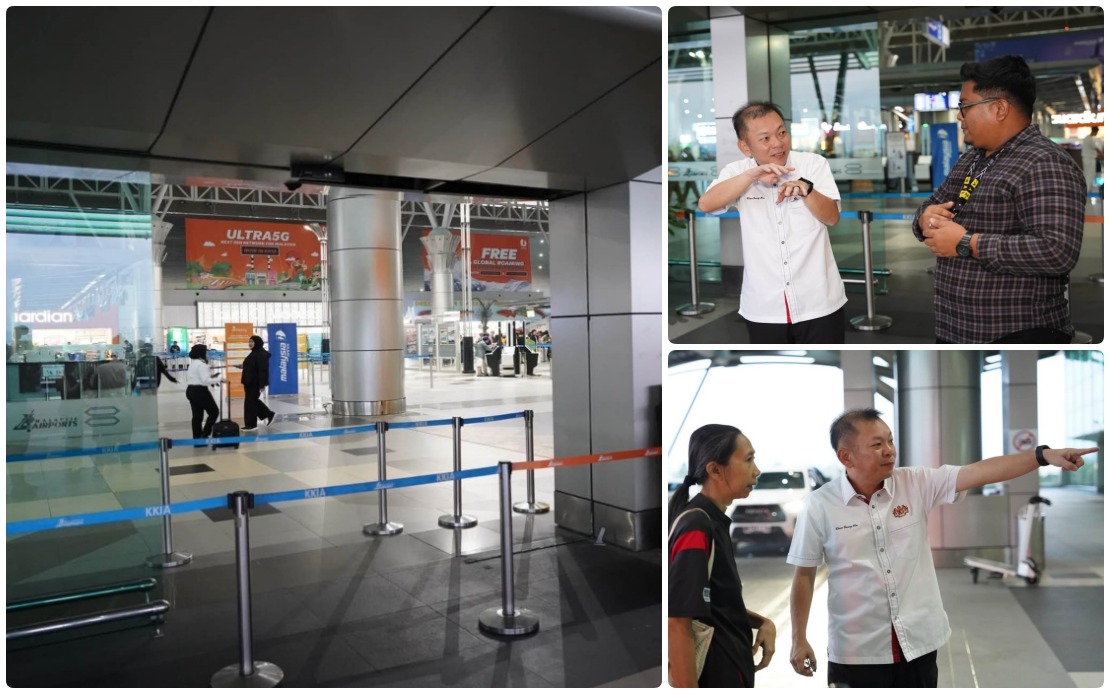
A female motorist was hospitalised with minor injuries after her sports utility vehicle careened out of control and smashed through the glass entrance doors at the departure hall of Kota Kinabalu International Airport on Wednesday afternoon. The collision occurred at 4:20 pm at the kerbside area on Level 3 of Terminal 1, shattering the entrance structure and leaving the vehicle severely damaged. The incident drew immediate response from airport personnel, who secured the scene and ensured the injured driver received prompt medical attention without disruption to the broader operations of the facility.
The impact of the vehicle was concentrated on the glass door infrastructure at the main entrance, with the force sufficient to destroy the panels completely. Fortunately, no passengers or airport staff members were struck by the vehicle or struck by flying debris, sparing the airport from a potentially more serious humanitarian crisis. The victim, who experienced the full brunt of the collision from within the vehicle cabin, was extracted and transported to a hospital nearby for examination and treatment. Emergency response teams mobilised swiftly, demonstrating the airport's preparedness for such incidents.
Kota Kinabalu District Police Chief ACP Shahrudin Mat Husain confirmed the incident when reached for comment, noting that police officers were investigating to establish the precise sequence of events leading to the loss of vehicle control. At this stage, authorities have not disclosed whether mechanical failure, driver error, or environmental factors contributed to the accident. The investigation remains ongoing, with the Royal Malaysia Police handling the formal inquiry into the circumstances surrounding the crash.
Airport management responded with efficiency, mobilising cleaning and maintenance crews to clear the affected area rapidly. By 6:00 pm, the damaged vehicle had been removed from the entrance, and all debris associated with the collision had been swept away. Repair works on the entrance door system began immediately thereafter, with technicians assessing the structural integrity of the installation and replacing damaged components. This swift action ensured that passenger flow through the terminal experienced minimal friction, with alternative access points and operational automatic doors absorbing traveller traffic throughout the afternoon and evening.
Deputy Minister of Agriculture and Food Security Datuk Chan Foong Hin, who coincidentally arrived at the airport shortly after the incident, observed the response firsthand and commended the coordination displayed by airport authorities. In remarks posted to social media, he emphasised the professionalism demonstrated by KKIA management and all personnel involved in managing the emergency situation. He noted that the swift intervention prevented any wider operational disruption, allowing the airport to maintain its normal service capacity for the travelling public.
Malaysia Airports, the operator of the terminal facility, issued an official statement confirming that airport operations sustained no interruption despite the vehicular incident. The airport operator highlighted that Aviation Security and Customer Service teams responded within minutes of the accident, immediately summoning ambulance services for the injured driver. The removal of the vehicle and restoration of the physical infrastructure occurred on an accelerated timeline, enabling the airport to return to fully normal conditions by early evening. Malaysia Airports noted that it is cooperating fully with police investigators and has placed the case file at the disposal of the Royal Malaysia Police for their formal examination.
The incident underscores the robust safety protocols embedded within major airport facilities across Malaysia. While such collisions are relatively uncommon at international airports, they represent potential hazards that require comprehensive emergency management protocols. The absence of additional casualties in this instance reflected both the particular circumstances of the crash and the rapid response capability of ground personnel positioned throughout the terminal. Terminal design features, including the positioning of glass doors and the configuration of kerbside access points, also played a role in containing the impact to a localised area rather than permitting the vehicle to penetrate deeper into the passenger processing zone.
For travellers using Kota Kinabalu International Airport over the following days, the incident should pose minimal disruption. Repair works on the entrance doors are expected to progress swiftly, with replacement glass structures sourced and installed according to airport design specifications. The departure hall continues to function normally with alternative entry points, and signage has been deployed to direct passengers around the affected entrance. Airport authorities have indicated that services will return to their standard configuration upon completion of restoration work.
The accident also raises broader considerations regarding vehicular safety at airport boundaries, where private vehicles frequently operate in close proximity to large numbers of pedestrians and airport infrastructure. Most international airports worldwide maintain stringent traffic management protocols at kerbside areas, including speed restrictions and barriers designed to prevent uncontrolled vehicle ingress into terminal buildings. The circumstances of this incident will likely prompt airport authorities to review whether any additional safety measures might further reduce the likelihood of comparable occurrences. Such reviews form a standard component of airport risk management in the aftermath of any significant operational incident, regardless of the ultimate cause.

