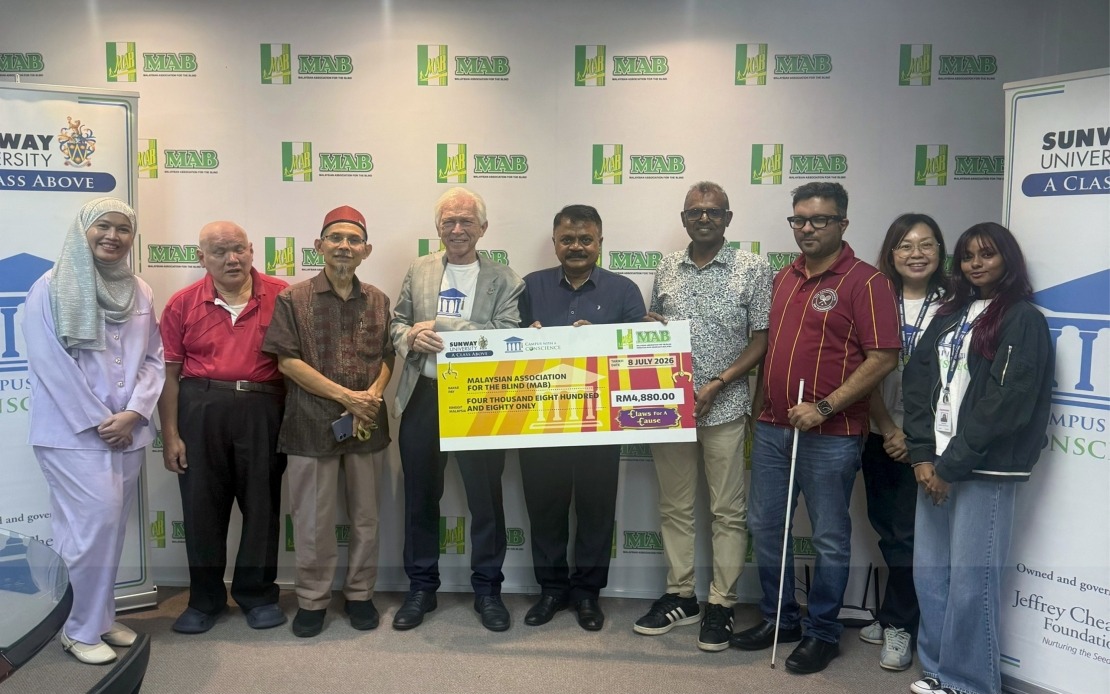
Sunway University has successfully channelled community spirit into concrete assistance for vulnerable groups by raising RM4,880 for the Malaysian Association for the Blind through its week-long "Claws For A Cause" campus initiative, executed in partnership with entertainment company Space Panda. The fundraising drive demonstrates how Malaysian higher education institutions are increasingly leveraging creative engagement strategies to advance social welfare objectives while fostering student involvement in charitable work.
The campaign functioned through a modified claw machine game placed on campus, transforming a recreational activity into a vehicle for charitable contribution. Throughout the week, both students and university staff participated in the game, with proceeds directed entirely to support MAB's programmes serving individuals with visual impairments. This approach reflects a broader trend in Malaysian universities toward experiential fundraising that generates both financial resources and heightened awareness of social causes among the campus community.
Sunway University President and Vice-Chancellor Professor Sibrandes Poppema framed the initiative within the institution's broader mission philosophy, emphasizing that educational excellence alone represents insufficient justification for university existence in contemporary society. He articulated that the university's identity as a mission-driven institution obligates engagement with community challenges through multiple channels including education, research, innovation, and direct social participation.
Poppema's statement highlights a philosophical shift evident across Malaysian tertiary institutions, whereby universities increasingly position themselves as anchors within their surrounding communities rather than isolated academic enclaves. This perspective aligns with international trends in higher education toward embedded social responsibility and stakeholder engagement as fundamental institutional characteristics rather than peripheral add-ons to core academic missions.
The collaboration between Sunway University and Space Panda exemplifies how industry partnerships can amplify social impact when commercial entities align their resources with charitable objectives. Space Panda's involvement extended beyond simple sponsorship to active participation in campaign conceptualization and execution, suggesting emerging possibilities for deeper public-private collaboration in Malaysian social service delivery.
Space Panda's leadership articulated the company's conviction that modest individual contributions, when aggregated through collective participation, accumulate into meaningful community benefit. This philosophy carries particular resonance for Malaysian corporations increasingly expected by consumers and stakeholders to demonstrate authentic commitment to social welfare beyond superficial corporate social responsibility messaging.
The Malaysian Association for the Blind serves as critical infrastructure supporting persons with visual disabilities across employment, education, rehabilitation, and advocacy domains. The organization's work addresses gaps in systematic government provision while complementing statutory social services. Resources generated through grassroots fundraising campaigns like Sunway's initiative provide MAB with operational flexibility and funding predictability that government allocations sometimes cannot guarantee.
The initiative was formally positioned under Sunway University's established "Campus With A Conscience" programme, indicating institutional commitment to embedding social consciousness within regular campus operations rather than treating charitable activities as occasional departures from normal university routines. This programmatic approach suggests that Sunway views social engagement as integral to student formation and university identity rather than an optional supplementary activity.
For Malaysian readers, the initiative demonstrates practical methodologies through which educational and commercial institutions can mobilize resources for social support without requiring substantial financial commitment from participants. The claw machine mechanism proved effective because it maintained entertainment value while channelling engagement toward charitable outcomes, suggesting potential replicability across other Malaysian universities and commercial entities seeking community engagement opportunities.
The success of this campaign also underscores persistent funding challenges confronting Malaysian charitable organizations serving vulnerable populations. While government allocations and corporate donations remain important, grassroots fundraising initiatives provide crucial supplements that enable organizations like MAB to expand programming and maintain service quality. The RM4,880 raised, while modest in absolute terms, likely funds specific MAB services or purchases benefiting multiple service users.
Beyond immediate financial outcomes, initiatives of this type generate intangible benefits including heightened public awareness of visual disability issues, normalization of engagement with persons with disabilities among university students, and strengthening of institutional cultures wherein social responsibility becomes habitual rather than exceptional. These cultural effects may prove more significant than direct financial contributions in shaping long-term attitudes toward disability inclusion and social service provision.
The initiative also reflects deliberate choices by Malaysian universities to distinguish themselves through distinctive social engagement programming in increasingly competitive institutional environments. As students and families evaluate university options, institutions demonstrating authentic commitment to community benefit through concrete programmes may gain competitive advantages in enrollment and reputation building, creating positive incentives for continued innovation in social engagement strategies.
Looking forward, the Sunway-Space Panda-MAB collaboration provides a replicable model for other Malaysian institutions. The simplicity of the fundraising mechanism combined with effective promotional integration suggests that similar campaigns could readily expand to other universities, commercial partners, and charitable beneficiaries throughout Southeast Asia, potentially establishing a regional practice of creative, participatory fundraising for social causes.

