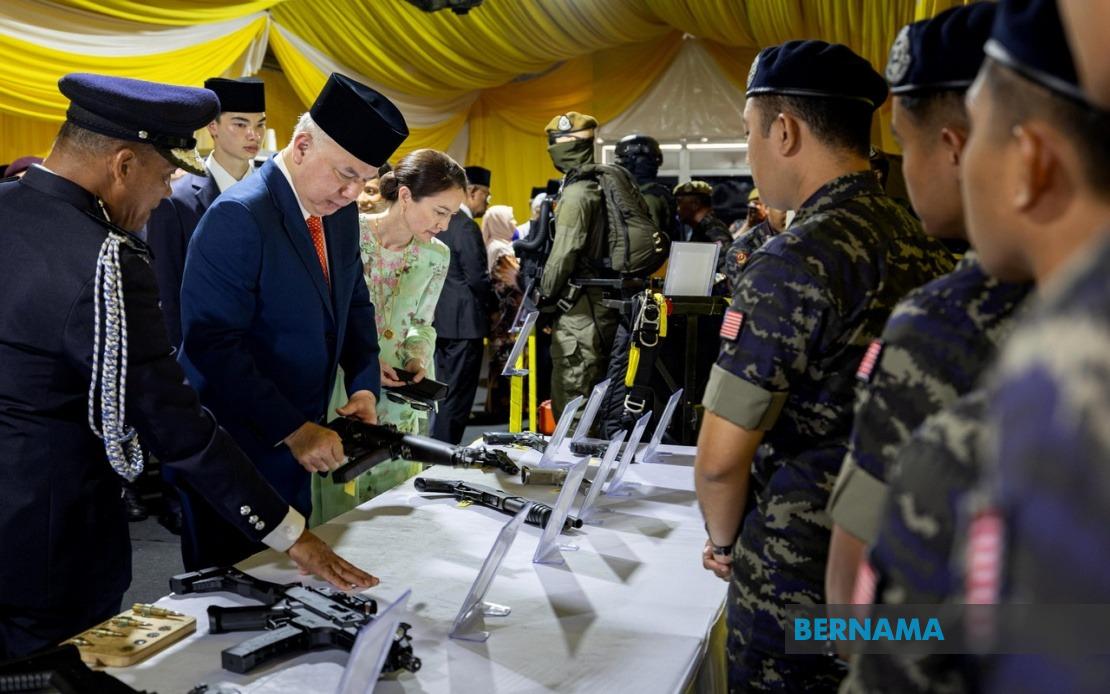
Sultan Nazrin Shah, the reigning monarch of Perak, formally inaugurated the Sultan Nazrin Shah 69 Commando Camp in Ulu Kinta on July 7, marking a significant milestone for Malaysia's security infrastructure. The ceremony brought together the state's senior royalty, federal leadership and law enforcement officials to celebrate what Home Minister Datuk Seri Saifuddin Nasution Ismail characterised as a tangible demonstration of government commitment to bolstering the nation's defence apparatus against modern security threats.
The occasion drew an impressive delegation reflecting both state and national importance. Tuanku Zara Salim, the Raja Permaisuri of Perak, joined her husband alongside Raja Jaafar Raja Muda Musa and Raja Iskandar Dzurkarnain Sultan Idris Shah, representing the royal household's full endorsement. On the government side, Menteri Besar Datuk Seri Saarani Mohamad represented state administration, while Datuk Seri Saifuddin Nasution Ismail and Inspector-General of Police Tan Sri Mohd Khalid Ismail brought federal security apparatus credentials to the event. This high-level attendance underscored the strategic weight attached to the facility's opening in Kuala Lumpur's broader security planning.
The camp itself represents an investment of more than RM206 million across a sprawling 338-hectare site, developed specifically to serve as the primary operational and training headquarters for the storied 69 Commando unit. The facility was meticulously engineered to align with contemporary operational standards before being formally transferred to the Royal Malaysia Police in 2024, functioning as an integrated complex encompassing operations, training and administrative functions. This comprehensive approach reflects recognition that modern elite units demand infrastructure matching their sophisticated operational scope.
During his address, Saifuddin Nasution framed the new camp within Malaysia's broader security achievements, noting that the country now ranks 12th among 163 nations in the Global Peace Index. This standing, he suggested, owes substantially to the calibre and dedication of security professionals such as those in the 69 Commando, whose institutional competence has translated into tangible stability for the region. For Malaysian audiences, such international benchmarking provides validation that considerable investments in security infrastructure yield measurable returns in terms of national standing and regional influence.
The 69 Commando unit, established in 1969, carries a storied operational history stretching across five decades of service. Saifuddin Nasution detailed the unit's extensive portfolio, which encompasses counter-insurgency operations during the communist threat era, the highly sensitive Al-Maunah incident in 2000, Ops Daulat in Lahad Datu, Sabah, during the 2013 incursion, and Malaysia's specialised response to the MH17 tragedy in 2014. Beyond these headline operations, the unit has consistently performed counter-terrorism work, hostage rescue missions and responses to high-risk security scenarios where split-second decision-making and specialist training prove decisive. This historical record positions the 69 Commando not merely as a unit but as an institution embodying national resilience through periods of acute security challenge.
The decision to name the new facility after Sultan Nazrin Shah carries particular significance within Perak's political and ceremonial framework. By dedicating the camp to the reigning sultan, the government elevated recognition of both the unit's importance and the state's role in hosting critical national security infrastructure. For Perak, this designation reflects how resource allocation and infrastructure investment can simultaneously serve operational imperatives and strengthen bonds between federal authority and state monarchy, a delicate balance in Malaysia's constitutional framework.
Saifuddin Nasution articulated a broader conceptual vision for the facility beyond its material dimensions. He characterised the Sultan Nazrin Shah Camp not simply as bricks, mortar and operational equipment, but as a symbolic statement of national appreciation for generations of officers and personnel who have shouldered the burden of defending Malaysia's sovereignty. This framing appeals to institutional morale and recruitment narratives, positioning service in the 69 Commando as part of a continuum of national contribution extending back decades. For Malaysian security professionals, such articulation validates their choices and reinforces organisational pride.
The minister projected forward, suggesting the camp would nurture successive cohorts of commando personnel capable of perpetuating the unit's operational legacy while adapting to emerging security paradigms. This succession planning dimension addresses a practical challenge facing elite security units: maintaining institutional knowledge whilst developing adaptability. The facility's design as a comprehensive training and operational complex positions it as an incubator for strategic thinking and tactical innovation rather than merely a barracks. For Southeast Asian observers, this reflects Malaysia's intent to maintain its commando capability at the cutting edge of regional security requirements.
Within Malaysia's broader security policy architecture, the RM206 million investment speaks to governmental prioritisation of elite capabilities over numerical expansion. Rather than dispersing resources across larger structures, the concentration of investment in the 69 Commando facility signals strategic calculation that specialised, highly trained units provide greater security dividends than generalist expansion. This investment philosophy resonates with professional military thinking globally, though it requires consistent political support to maintain effectiveness across electoral cycles and budget pressures.
The opening ceremony also implicitly addressed regional dynamics, though never explicitly stated. Positioning Malaysia's commando capability at world-class standards contributes to Southeast Asian security architecture at a moment when maritime threats, transnational crime and terrorism persist as ongoing concerns. A well-equipped, professionally trained commando unit enhances Malaysia's ability to contribute to regional security cooperation under frameworks such as ASEAN's counter-terrorism initiatives and bilateral security partnerships with regional and extra-regional powers.
For Perak specifically, hosting the facility represents both honour and responsibility. The state gains designation as a centre of national security excellence, though this also means ongoing scrutiny of operational outcomes and resource utilisation. The relationship between state administration, represented by Menteri Besar Saarani Mohamad, and federal security structures will require consistent coordination to ensure the facility functions optimally within its strategic design parameters.
Looking forward, the success of the Sultan Nazrin Shah Camp will be measured not by ceremonial grandeur but by operational outcomes: whether the 69 Commando's capabilities genuinely enhance with improved facilities, whether training outcomes demonstrably improve, and whether the unit's response capacity to future security contingencies proves superior to predecessor arrangements. These practical considerations ultimately validate the RM206 million investment far more conclusively than formal opening remarks, making the coming years critical for assessing whether infrastructure improvements translate into enhanced national security outcomes.

