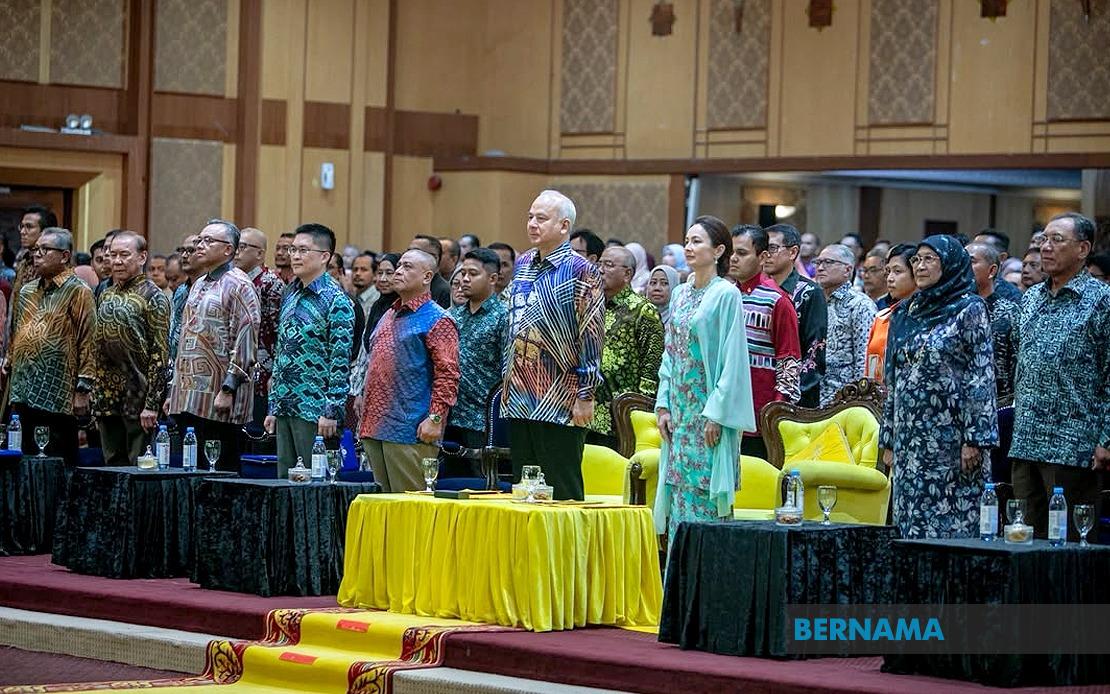
Sultan Nazrin Shah, the Sultan of Perak, presided over the state-level 2026 Merdeka Month celebration at Bangunan Perak Darul Ridzuan in Ipoh on August 15, underscoring the monarchy's continued emphasis on fostering national pride and constitutional loyalty among younger generations. The event brought together prominent figures including Raja Permaisuri Tuanku Zara Salim, Menteri Besar Datuk Seri Saarani Mohamad, and Deputy Education Minister Wong Kah Woh, reflecting the significance placed on this annual occasion by both state and federal education authorities.
The programme drew an impressive 214,095 entries representing 83.6 per cent of Perak's primary and secondary school population, demonstrating substantial grassroots engagement with national and patriotic themes. This scale of participation illustrates how educational institutions across the state have mobilized students around competitions and activities designed to reinforce Malaysia's historical narrative and constitutional values. The breadth of involvement suggests that Merdeka Month has become embedded within Perak's school calendar as a significant educational undertaking rather than a peripheral commemoration.
Comparing year-on-year metrics provides insight into the momentum behind such initiatives. The Perak Education Department reported a 15 per cent increase in participation relative to the preceding year, indicating growing enthusiasm among schools and families. This upward trajectory contradicts the sometimes-held perception that state-level patriotic programmes struggle to sustain engagement over successive iterations. Instead, the data suggests that schools have refined their promotional strategies and that students are increasingly seeing these competitions as legitimate platforms for recognition and self-development.
Zulkafli Mohamed Mokhtar, director of the Perak Education Department, articulated how the programme extends beyond ceremonial patriotism into concrete educational outcomes. He emphasized that the competitions and activities serve multiple functions: discovering latent talent, building student confidence across diverse disciplines, and cultivating demonstrated potential in academic, artistic, and oratorical fields. This multifaceted approach aligns with contemporary education policy that rejects the false dichotomy between academic achievement and character formation, recognizing instead that extracurricular excellence contributes meaningfully to holistic student development.
The state education director connected these activities explicitly to the Malaysia Education Plan 2026-2035, the federal government's comprehensive ten-year blueprint for educational transformation. By framing Merdeka Month programmes as instruments for achieving the plan's objectives, Mokhtar positioned local celebrations within a broader strategic context. The plan's emphasis on producing graduates who are not merely academically proficient but also morally principled, critically thoughtful, patriotic, historically literate, and equipped for future leadership aligns precisely with the aspirations articulated through these state-level competitions.
The recognition of achievements at the event carried both financial and ceremonial weight. The Kinta Utara District Education Office received the special award for best achievement, accompanied by RM20,000 in cash grants. This tangible support incentivizes district education offices to invest organizational resources into mobilizing schools and cultivating high-quality submissions. Financial recognition signals that such efforts merit substantive investment, encouraging bureaucratic commitment beyond pro forma participation.
Competition winners garnered individual honors and platform visibility through royal endorsement. Ifwat Arrafi Mohd Amin from Sekolah Menengah Kebangsaan Tun Abd Razak in Bagan Datuk claimed the upper secondary Malay Language Public Speaking title, while E Johnnes Abysia from SMK Sungai Pari secured victory in the English public speaking category. These bilateral linguistic competitions reflect Malaysia's commitment to maintaining proficiency across both national and international languages among its student cohort, recognizing that contemporary global engagement demands facility in English whilst constitutional and cultural citizenship requires command of Bahasa Malaysia.
Beyond the headline competitions, the programme encompassed diverse creative and expressive categories spanning primary through upper secondary levels. Choral speaking, choral recitation, choir, caricature drawing, essay writing, poetry composition, and poster drawing contests provided multiple entry points for students with varying talents and interests. This architectural diversity ensures that artistic, performative, and literary inclinations receive equal institutional validation alongside oratorical prowess, cultivating a culture where excellence manifests across the creative spectrum.
The division of prize presentation between Sultan Nazrin and Raja Permaisuri Tuanku Zara Salim reflected institutional protocol whilst symbolically underscoring the monarchy's unified commitment to educational advancement. By allocating specific competitions to each royal patron, the event structure demonstrated that both sultanate and permaisuri bear responsibility for nurturing the younger generation. This shared ceremonial authority reinforces the message that national values and educational excellence command the attention of the highest institutional offices within Perak's constitutional hierarchy.
The royal tour of exhibition spaces, particularly the drawing and caricature exhibitions, provided informal engagement with student creative output. Such walkabouts enable direct observation of artistic quality and student confidence, translating formal award ceremonies into genuine encounters with the achievements being recognized. These moments, whilst seemingly peripheral to official proceedings, create lasting impressions on participants and reinforce the tangibility of royal patronage beyond symbolic gestures.
For Malaysian education stakeholders, particularly those in states seeking to balance patriotic formation with skills-based learning, Perak's approach offers relevant lessons. The integration of linguistic, oratorical, artistic, and performative competitions within a patriotic framework demonstrates that national pride and educational excellence need not represent competing objectives. Instead, institutional commitment to discovering and nurturing student potential across multiple domains can simultaneously advance both constitutional loyalty and human development, creating a demonstration effect that reverberates across Southeast Asian approaches to civic education.

