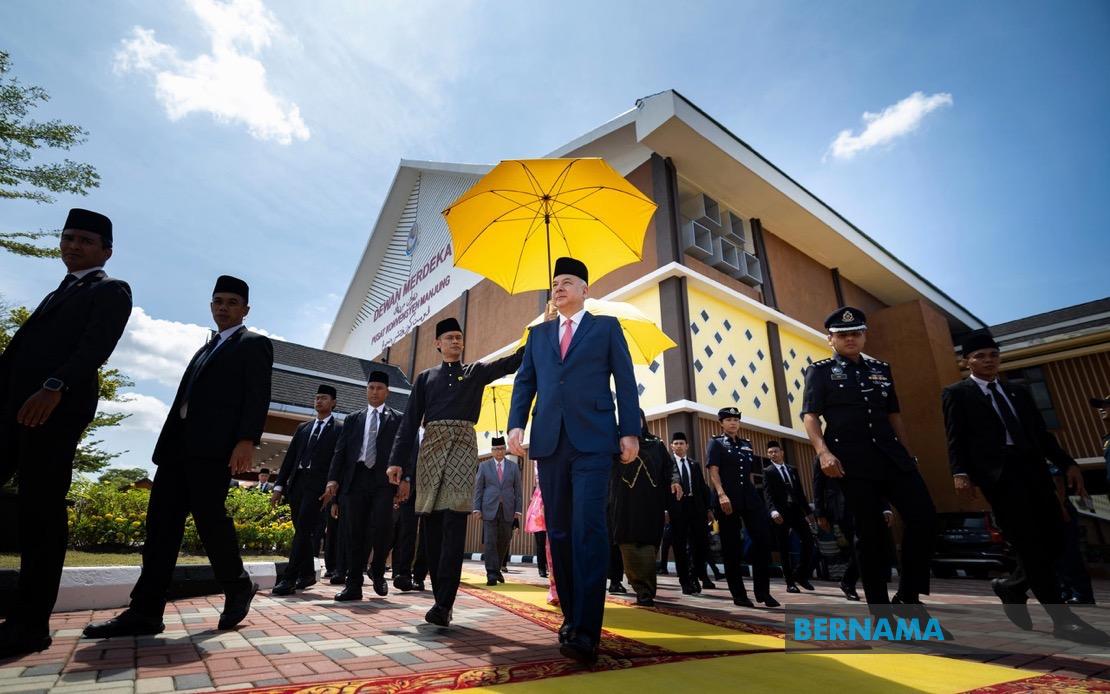
Sultan Nazrin Shah, the Sultan of Perak, formally inaugurated the Merdeka Hall of Manjung Municipal Council in Lumut on Monday, an event that brought together senior royal figures and federal and state leadership to celebrate a significant milestone for the coastal district. The ceremony was attended by Tuanku Zara Salim, Raja Permaisuri of Perak, as well as Raja Iskandar Dzurkarnain Sultan Idris Shah, Raja Di Hilir of Perak, alongside Perak Menteri Besar Datuk Seri Saarani Mohamad and Higher Education Minister Datuk Seri Dr Zambry Abd Kadir, underscoring the importance both the state and federal governments attach to the infrastructure development.
The opening of this new public facility represents the convergence of three distinct but interrelated achievements for Manjung, according to remarks delivered during the ceremony. Most immediately, it marks the completion of a vision that originated some nine years ago, when the concept was first conceived and championed by the Menteri Besar at that time. The project's eventual realisation reflects sustained commitment across two administrations, demonstrating the value of institutional continuity despite political transitions. The facility also enables the Manjung Municipal Council to mark its silver jubilee, a recognition of twenty-five years since its transformation from a district council in 1980 into a full municipal council in 2001, a status upgrade that expanded its administrative and development responsibilities significantly.
Constructed at an investment of RM12.7 million, the Merdeka Hall has been designed to accommodate up to 2,500 people, making it a major civic venue for the district. Beyond its ceremonial functions, the structure serves a multifaceted purpose within Manjung's development trajectory. Officials envision it becoming a centre for official state functions, professional conferences, and community gatherings—essential amenities for a district positioning itself as a major economic and tourism hub. The facility's completion is explicitly framed as instrumental to Manjung's broader strategic objective: achieving recognition and operational status as a Tourism and Maritime City by 2030, an ambitious target that requires not only infrastructure but also institutional capacity and coordinated governance.
Saarani's remarks during the opening ceremony emphasised the symbolic weight of the facility's name, interpreting the Merdeka Hall as a permanent reminder of the nation's independence and the ongoing responsibility Malaysians bear to protect and nurture that legacy. In his view, the hall transcends mere bricks and mortar, instead representing a commitment to sustaining the values and principles upon which Malaysia's independence rests. The Menteri Besar framed the space not simply as a venue but as a social institution where knowledge can be developed, mutual understanding strengthened, and consensus-building encouraged among diverse stakeholders within the district and state.
The trajectory of the Merdeka Hall project itself speaks to governance dynamics within Malaysia's federal system. Initiated in 2016, the proposal required navigation through both state-level planning and federal budgetary approval processes. The eventual securing of Federal Government allocation for the project demonstrates the importance of sustained advocacy and the value of bipartisan cooperation on developmental matters. That the project could be advanced across two different state administrations reflects either genuine consensus on its importance or institutional momentum that transcends partisan boundaries—a rarity in some policy domains but apparently present in infrastructure investment decisions at the state level.
Manjung's development ambitions situate the district within broader patterns of economic diversification across Perak. As a coastal municipality with established port infrastructure and growing manufacturing and tourism sectors, Manjung represents an important economic centre for northern Malaysia. The aspiration to achieve Tourism and Maritime City status by 2030 reflects both the district's geographic advantages and the state's strategy to reduce economic concentration in traditional tin-mining areas. Modern civic infrastructure like the Merdeka Hall supports this transition by enabling the professional conferences, trade exhibitions, and cultural events that characterise successful maritime and tourism hubs in the region.
From a regional perspective, Manjung's development trajectory mirrors patterns visible across Southeast Asia, where coastal districts are increasingly being leveraged for economic diversification and regional integration. The emphasis on tourism and maritime sectors reflects Malaysia's broader positioning as a maritime nation and ASEAN member seeking to develop the maritime economy pillar championed by regional forums. The new facility thus represents not merely local infrastructure but part of a larger architecture of regional economic transformation.
The timing of the facility's opening, coinciding with the council's twenty-fifth anniversary, has been deliberately positioned as symbolically significant. The council's evolution from district council status to municipal council status in 2001 represented a milestone in administrative maturation, granting expanded jurisdictional and fiscal authority necessary for larger infrastructure projects. The silver jubilee celebration thus offers an opportunity to assess progress across twenty-five years and frame future aspirations within a historical narrative of institutional strengthening and capability development.
The involvement of multiple levels of government—royal patronage, state executive leadership, and federal ministerial attendance—demonstrates the multi-layered governance structure required for significant civic projects in Malaysia. The presence of the Higher Education Minister alongside the Menteri Besar suggests connections between the Merdeka Hall's development and broader human capital and knowledge economy objectives that education ministers typically champion. Such multi-stakeholder participation in opening ceremonies serves not only ceremonial purposes but also signals aligned priorities across institutional and geographic boundaries.
Looking ahead, the Merdeka Hall's functionality will likely serve as a barometer for Manjung's broader success in achieving its Tourism and Maritime City aspirations. The facility's capacity to attract major conferences, exhibitions, and cultural events will contribute materially to the district's economic development and its attractiveness as a destination. Beyond the immediate economic impacts, the hall's success as a community space for knowledge-building and consensus-strengthening will reflect broader questions about civic participation and institutional trust in contemporary Malaysia. The symbolic naming and its connection to national independence themes suggests that officials view civic infrastructure as vehicles not merely for economic development but for reinforcing shared national narratives and social cohesion.

