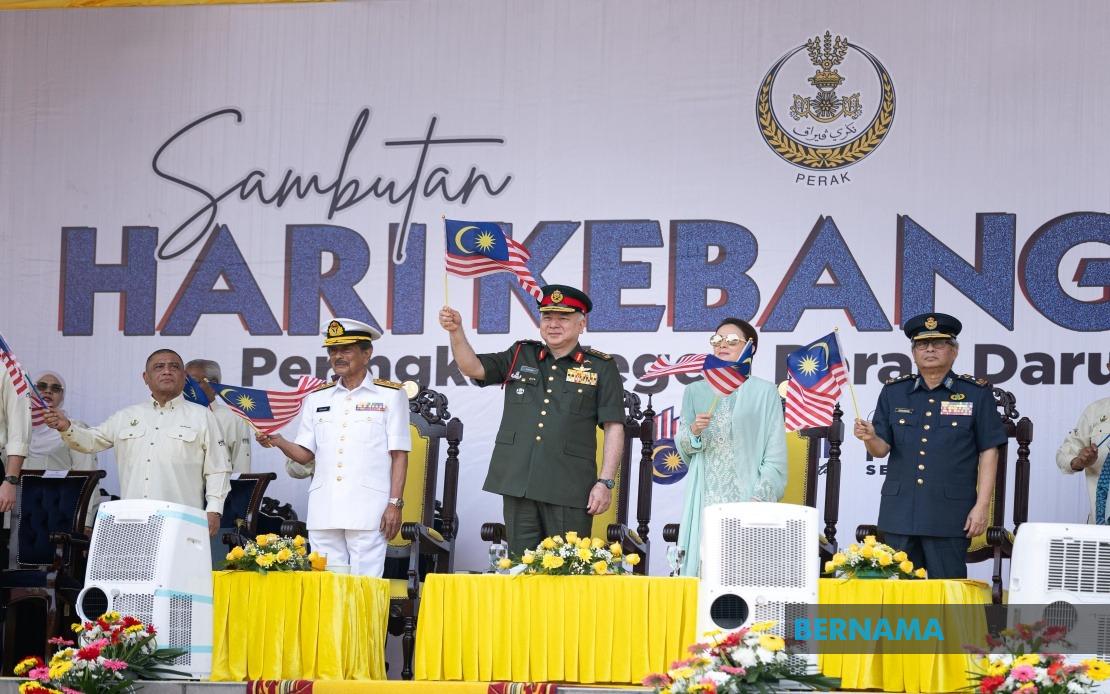
Sultan of Perak Sultan Nazrin Shah and Raja Permaisuri Tuanku Zara Salim presided over the Perak National Day 2026 Awards Presentation Ceremony at Dewan Bandaran Ipoh on August 31, highlighting the state government's commitment to recognizing those who have sacrificed for the nation's protection. The prestigious event brought together senior state leadership, including Menteri Besar Datuk Seri Saarani Mohamad and members of the State Executive Council, underscoring the significance placed on honouring service members and law enforcement personnel.
The ceremony recognized the contributions of eleven individuals whose dedication has shaped Malaysia's security landscape. Recipients included six personnel from the Malaysian Armed Forces, two from the Royal Malaysia Police, and three from the Royal Malaysian Navy. This balanced representation across security agencies reflects the multi-layered approach required to safeguard national interests across land, sea, and internal security domains. Each honouree received RM1,000 in cash alongside a certificate of appreciation, a tangible recognition of their service to the nation.
Among the most notable recipients was Warrant Officer 2 Mohamad Razali Din, whose heroism during Operation Naga in Banding came at profound personal cost. The loss of his left leg below the knee, sustained when he stepped on a landmine, exemplifies the real dangers faced by personnel deployed in counter-insurgency operations. His continued recognition decades after the incident underscores Malaysia's enduring commitment to acknowledging the permanent sacrifices made by defence force members who bore the physical and psychological burdens of protecting national interests.
Warrant Officer 2 Megat Abdullah Megat Othman received particular commendation for his operational success during Operation Batu Kawah in Sri Aman, where he successfully eliminated three communist terrorists. His receipt of a commando knife alongside the standard certificate signals the military's recognition of exceptional tactical performance. This distinction demonstrates how state-level honours ceremonies differentiate between sustained service and extraordinary achievements in active operations.
The remaining Malaysian Armed Forces recipients—Staff Sergeant Idris Ismail, Corporal Mokhtar Sulaiman, Lance Corporal Khairul Anuar Abdul Hamid, and Lance Corporal Alias Abd Wahab—represent the broader cohort of personnel whose contributions may receive less public recognition but remain integral to operational effectiveness. Their inclusion reflects an institutional practice of acknowledging service across ranks, from warrant officers to lance corporals, emphasizing that Malaysia's security rests on collective effort rather than individual heroics alone.
The Royal Malaysian Police representation through retired Sub-Inspector Omar Jayus and retired Sergeant Major Abdul Malek Nordin highlights the civilian law enforcement dimension of national security. Both recipients' retired status suggests these honours often come after decades of service, recognizing careers spanning multiple operational periods and policy changes within the force. This delayed recognition raises questions about mechanisms for earlier acknowledgment of contributions while personnel remain in active service.
Royal Malaysian Navy representation through three retired officers—First Admiral Mohamad Imran Abd Hamid, Commander Mohd Akhbar Mohd Yusof, and Warrant Officer 2 Ahmad Safwi Shaari—reflects Malaysia's maritime security priorities. With extensive coastlines and significant economic zones requiring protection, the navy's prominence in National Day honours ceremonies signifies the government's recognition of evolving security challenges in the maritime domain, particularly relevant given regional geopolitical tensions affecting Southeast Asian waters.
Menteri Besar Saarani's address transcended military commendations to articulate a vision of national cohesion that resonates throughout Malaysia and Southeast Asia. His emphasis on Malaysia's foundation as a diverse society deliberately constructed by groups choosing unity rather than imposed homogeneity offers a counterpoint to polarizing narratives increasingly prevalent in regional politics. This framing positions diversity not as a challenge to be managed but as the nation's foundational strength, directly addressing contemporary concerns about ethnic and religious polarization affecting several Southeast Asian democracies.
Saarani's cautionary notes about erosion of social cohesion when differences overshadow common humanity reveal deepening anxieties within Malaysian leadership about societal fragmentation. His metaphorical reference to neighbours and friends ceasing to be recognized as such when viewed primarily through ethnic and religious lenses captures a genuine threat to the social contract underpinning Malaysia's multi-ethnic stability. This warning gains particular significance against the backdrop of rising identity politics across the region, where Sri Lanka, Myanmar, and Thailand have experienced catastrophic breakdowns in interethnic relations.
The Menteri Besar's invocation of the Jalur Gemilang, the Federal Constitution, and Malay as the national language as unifying symbols attempts to anchor national identity in institutional and constitutional frameworks rather than demographic dominance. This approach acknowledges the Malay Rulers' constitutional role as custodians of Islam and Malay interests while positioning these institutions as protective shields for all Malaysians rather than exclusive instruments of any single community. For Malaysian readers, this represents state-level affirmation of constitutional federalism during periods when such principles face pressure from populist movements elsewhere in the region.
Saarani's assertion that togetherness cannot be assumed but must be consciously maintained reflects lessons learned from interethnic tensions in Malaysia's political history and contemporary developments in neighbouring societies. His warning that distance widens as unity becomes obscured directly addresses the incremental nature of social fracture, suggesting that National Day honours ceremonies serve functions beyond military recognition—they represent deliberate institutional efforts to reinforce national narratives before fragmentation accelerates. This layers National Day celebrations with significance as platforms for political leadership to reinforce constitutional values and social contracts.
The ceremony's parallel recognition of parade and beautification competition winners alongside military honours demonstrates how National Day observances encompass multiple expressions of national pride and civic participation. By combining military service recognition with civilian competition results, the state government presents a holistic vision of national contribution spanning security, cultural expression, and community beautification, suggesting all forms of service and effort contribute to national wellbeing.
For Southeast Asia more broadly, Malaysia's formal recognition of security force sacrifices through state-level ceremonies reflects regional patterns of military-civil relations where democratic governments maintain symbolic and material connections with defence personnel. Unlike authoritarian regional neighbours where military prominence dominates public life, Malaysia's approach to military honours within democratic frameworks offers a particular model of balance, embedding security force recognition within broader national commemoration and constitutional rhetoric. This positioning becomes increasingly significant as militarization trends accelerate across Southeast Asia and civil-military relations face pressure from internal and external security threats.

