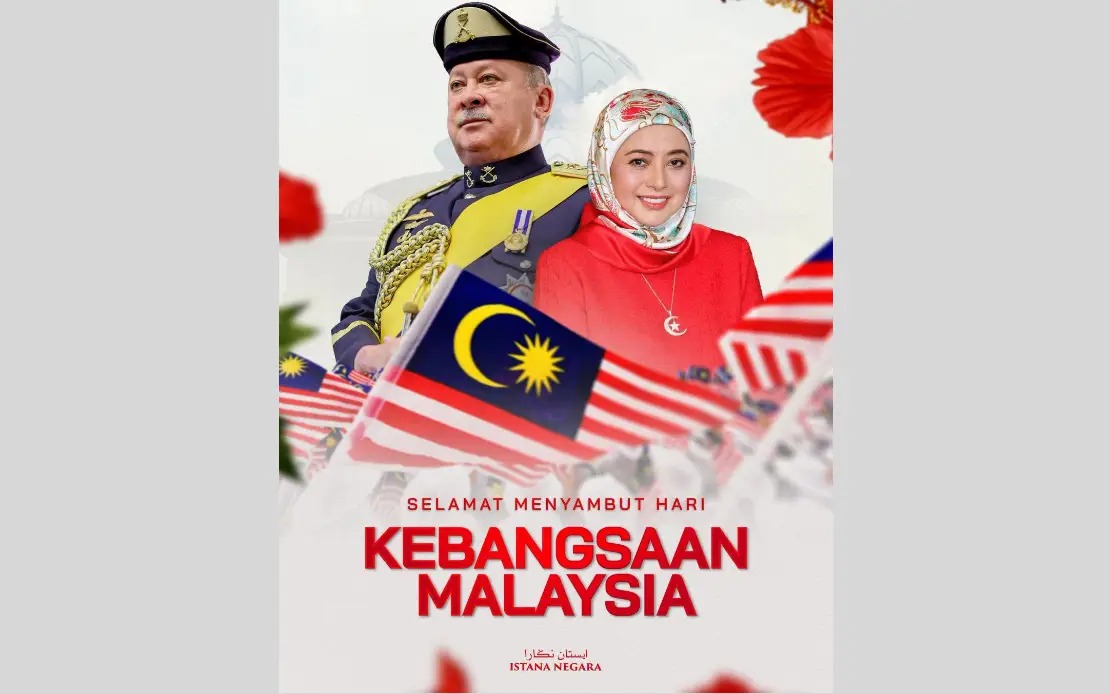
Malaysia's King and Queen, Sultan Ibrahim Sultan Iskandar and Raja Zarith Sofiah, extended their 69th National Day wishes to Malaysians through an official social media message on August 31, reaffirming the royal family's commitment to the nation's ongoing development and unity. The greeting was shared via Sultan Ibrahim's official Facebook page as the sovereign and consort presided over the main national celebration held in Putrajaya, underscoring the monarchy's central role in Malaysia's civic fabric during this significant anniversary.
Their Majesties arrived at the Putrajaya venue at 8 am to a formal reception that included Prime Minister Datuk Seri Anwar Ibrahim and his wife, Datuk Seri Dr. Wan Azizah Wan Ismail, as well as Communications Minister Datuk Seri Fahmi Fadzil. Minister Fadzil, who chairs the National Day and Malaysia Day Main Committee for 2026, coordinated the elaborate proceedings that showcased the breadth of national participation in commemorating Malaysia's independence milestone.
Centred on the theme "Malaysia MADANI: Kesejahteraan Dinikmati" (Malaysia MADANI: Wellbeing Enjoyed), the celebration articulated the government's development philosophy and commitment to equitable prosperity across all segments of society. This thematic framing reflects a deliberate emphasis on inclusive growth and social welfare as cornerstones of national identity, resonating with broader policy objectives that prioritise citizen welfare over narrow economic metrics. The messaging resonates particularly in Southeast Asia, where inclusive development remains contested among rival political and economic models.
The ceremonial programme commenced with a military display that set the formal tone before transitioning into diverse cultural performances and a spectacular parade. The parade itself represented a microcosm of Malaysia's layered identity, weaving together martial, civilian, and artistic expressions that collectively depicted the nation's multicultural character and forward-looking aspirations. Such pageantry serves important functions beyond mere spectacle, reinforcing national cohesion and providing shared civic moments increasingly rare in polarised democracies.
The scale of participation underscored the logistical complexity and symbolic weight attached to National Day. The proceedings involved 10,819 participants distributed across 76 contingents, representing diverse governmental, military, and civil society organisations. The involvement of 22 brass bands provided musical accompaniment, whilst 11 decorated vehicles and 328 land, sea, and air assets demonstrated the full apparatus of the state mobilised for national commemoration. Additionally, 112 service animals featured in the procession, and notably, 22 electric vehicles participated, subtly incorporating environmental consciousness into Malaysia's national narrative.
A particularly striking element was the human graphic display created on stadium terraces using spectators arranged in 26 distinct formations. This artistic intervention crafted a living mosaic representing Malaysia's multicultural tapestry, transforming audience members from passive observers into active participants in expressing national identity. Such inclusive staging techniques modernise traditional independence day celebrations, making them interactive rather than merely ceremonial, and democratising participation beyond military and governmental hierarchies.
The August 31 date carries profound historical resonance for Malaysia, marking the formal withdrawal of British colonial authority and the establishment of independence in 1957. Sixty-nine years later, the scale and sophistication of national celebrations demonstrate how Malaysia has consolidated independent governance and institutional capacity. The evolution from liberation struggles to state-managed ceremonial pageantry reflects the nation's transition from contested independence to settled constitutional democracy, though challenges to social cohesion persist beneath surface celebrations.
For Malaysian readers and regional observers, these ceremonies offer windows into contemporary political messaging and state priorities. The emphasis on Malaysia MADANI as a governing philosophy signals continuity with established development frameworks whilst adapting to evolving social expectations around equity and inclusion. The careful orchestration of multiethnic participation in the parade and display formations communicates governmental commitment to managing diversity through institutional inclusion rather than majoritarian assertion, a messaging critical for a nation with Malaysia's demographic composition and historical communal sensitivities.
The royal family's prominent attendance and public messaging through modern communication channels like Facebook demonstrate how traditional institutions adapt to digital public spheres. The timing of Sultan Ibrahim's greetings via social media, coordinated with physical presence at the main ceremony, reflects institutional sophistication in managing multiple audiences simultaneously. For Southeast Asian monarchies, such multimedia engagement strategies represent evolving approaches to maintaining relevance and connection with younger, digitally-native populations who consume national messages through varied platforms rather than sole reliance on broadcast media or printed proclamations.
Looking forward, the investment in elaborate National Day ceremonies and the appointment of ministerial committees planning celebrations through 2026 suggests sustained governmental commitment to national ritual and symbolic reproduction. For Malaysia specifically, where economic challenges, political realignments, and social tensions have created pressures on national unity in recent years, these highly coordinated displays of collective identity and state capacity serve important psychological and political functions. They provide counters to fragmentation narratives whilst demonstrating institutional continuity and organisational effectiveness.

