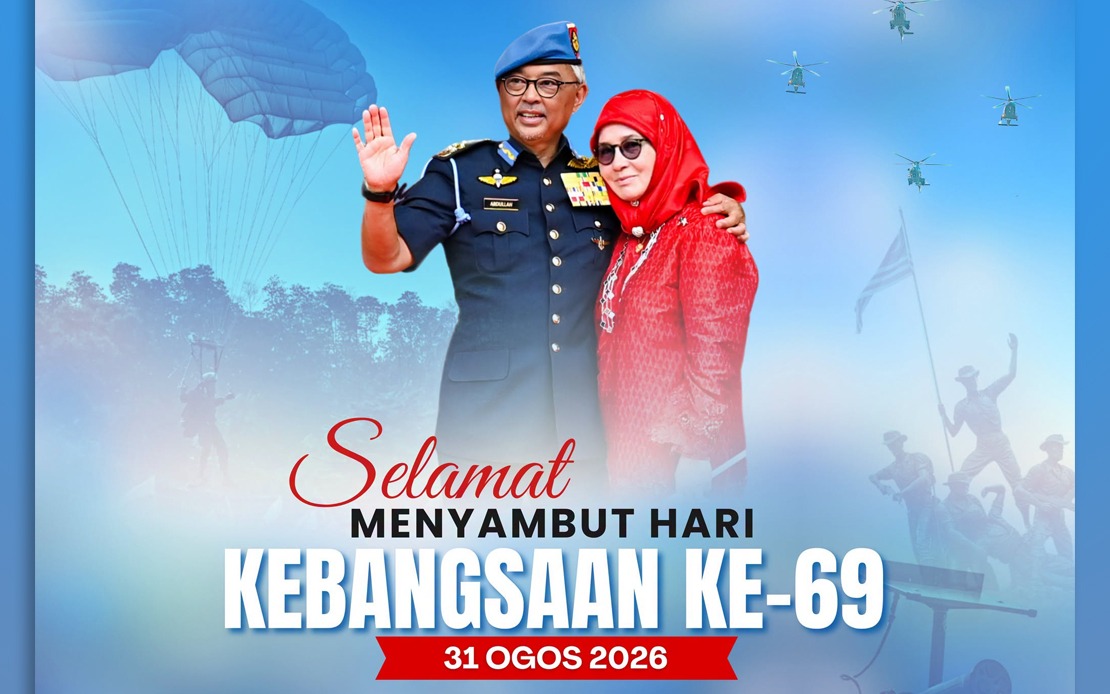
Malaysia's Sultan of Pahang Al-Sultan Abdullah Ri'ayatuddin Al-Mustafa Billah Shah and Tengku Ampuan Pahang Tunku Azizah Aminah Maimunah Iskandariah have issued their felicitations marking the nation's 69th National Day, conveying messages of gratitude and reflection on seven decades of independence from Kuantan. The royal message, shared through the Pahang Sultanate's official channels, underscores the commitment of the state's leadership to fostering national cohesion during an annual occasion that brings Malaysians together regardless of background.
At its core, the Royal Highnesses' statement reflects thanksgiving for the stable conditions that have characterised Malaysia's journey since 1957. They specifically acknowledged the blessings of peace, prosperity, and harmony that have been woven into the nation's fabric across generations. This framing places emphasis on what successive governments and institutions have managed to maintain—a relatively secure environment in a region historically marked by volatility. For Pahang, a state with significant indigenous communities, a substantial agricultural sector, and growing urban centres, such stability has been foundational to development efforts spanning decades.
The message carries particular weight given the contemporary emphasis on national unity across Malaysian leadership circles. By explicitly invoking the twin concepts of independence and sovereignty as "great trusts", the Sultan and Tengku Ampuan articulate a responsibility-based narrative that extends beyond symbolic patriotism. This framing invites Pahang residents—and by extension all Malaysians—to view national cohesion not as something passively inherited but as something requiring active stewardship. In a state where communal relationships have historically been tested by resource competition and demographic shifts, such messaging carries practical implications for how residents navigate daily coexistence.
Central to their statement is an explicit call to uphold and practise Rukun Negara principles in daily life. The five pillars of Rukun Negara—belief in God, loyalty to the monarchy, upholding the Constitution, the rule of law, and good behaviour and morality—represent Malaysia's foundational social contract. By embedding these principles into a National Day message, the royal household positions adherence to these values as integral to maintaining both national and state-level stability. For Malaysian citizens, this articulation serves as a reminder that constitutional patriotism differs meaningfully from narrower forms of nationalism.
The statement's emphasis on unity and mutual respect arrives amid a period when Malaysian society has grappled with polarisation across multiple dimensions—political, religious, and socioeconomic. By highlighting tolerance as a cornerstone of national harmony, the Sultan and Tengku Ampuan contribute to an ongoing conversation about what holds diverse communities together. In Pahang specifically, where Malay-Muslim majorities coexist with significant Chinese and Indian populations, plus indigenous Orang Asli communities with distinct cultural practices, the invocation of mutual respect carries tangible relevance to local governance and communal relations.
A notable dimension of the message addresses intergenerational responsibility, particularly regarding youth engagement with national heritage and history. The royal couple expressed hope that younger Malaysians would "appreciate the history of the country's struggle" and participate in preserving cultural and social heritage. This reflects a broader anxiety within Malaysian leadership about whether post-independence generations maintain adequate connection to independence narratives and constitutional principles. For a country where nearly 70 percent of the population was born after 1970, such intergenerational transmission of historical consciousness represents a genuine governance concern.
The invocation of younger generations also implies recognition that heritage preservation—whether cultural practices, historical sites, or institutional memory—requires active cultivation rather than passive inheritance. Pahang, as a state with significant cultural resources including royal traditions, indigenous heritage sites, and historical monuments connected to Malaysia's independence struggle, faces particular challenges in ensuring young residents develop stewardship attitudes toward these assets. The royal message thereby connects patriotic sentiment to concrete responsibilities around cultural custodianship.
The closing invocation requesting divine protection and continued blessings for Pahang reflects both the religious dimensions of Malaysian governance and the specific role of the Sultan as upholder of Islam within the state. This spiritual framing complements the constitutional and civic dimensions emphasized earlier in the statement. For many Pahang residents, particularly the Muslim majority, such religious language reinforces perceptions of the monarchy as spiritually rooted rather than merely ceremonial, thereby enhancing the symbolic power of the message.
The timing of such messages during National Day celebrations carries significance beyond the immediate occasion. Malaysia's independence anniversary provides an annual opportunity for state and federal leadership to reset narratives about national purpose and shared identity. For Pahang specifically, which has occasionally occupied a more peripheral position in national political discourse compared to larger states like Selangor or Johor, the Sultan's prominent issuance of such messages reinforces the state's integral role in Malaysia's national story. This year's emphasis on unity and Rukun Negara principles responds to contemporary political currents while maintaining continuity with long-standing royal messaging.
The statement's focus on preserving independence and sovereignty as ongoing responsibilities resonates within a regional context where some Southeast Asian nations have experienced democratic erosion or authoritarian consolidation. By framing constitutional governance and the rule of law as active commitments rather than settled achievements, Malaysia's Pahang leadership contributes to democratic reinforcement at both state and national levels. This messaging implicitly acknowledges that democratic systems require continuous recommitment rather than permanent security.
For Malaysian citizens and policymakers, the Sultan and Tengku Ampuan's National Day message encapsulates a particular vision of patriotism emphasizing institutional continuity, communal harmony, and constitutional fidelity over more nationalist or exclusionary formulations. The emphasis on practical daily application of Rukun Negara principles transforms abstract constitutional ideals into behavioural expectations, making the message relevant to Malaysians navigating plural societies. Whether such messaging translates into meaningful shifts in public behaviour or institutional practice remains an ongoing question, but the articulation of these principles by state-level royal authority provides normative reinforcement for those committed to pluralistic governance.
The Pahang leadership's National Day statement ultimately reflects Malaysia's particular historical experience—a multi-ethnic, multi-religious federation held together through constitutional compromise, institutional balance, and acceptance of monarchy as unifying symbol. By emphasizing gratitude, shared trust, and intergenerational responsibility alongside traditional themes of patriotism, the Sultan and Tengku Ampuan present a vision of national belonging grounded in mutual obligation rather than blood or faith alone. As Malaysia navigates evolving social and political challenges, such messaging from traditional authority figures provides continuity while the substantive meaning of unity, respect, and harmony remains subject to interpretation and contestation within diverse communities.

