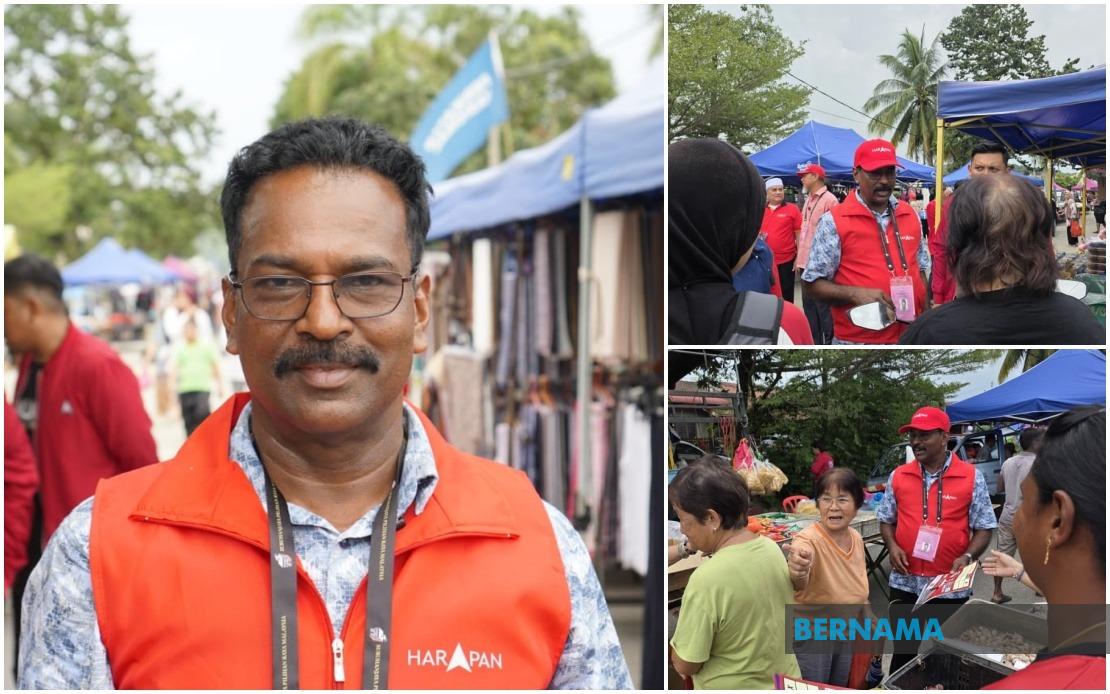
C. Subramani, the Pakatan Harapan contender for Bukit Kepong in Saturday's Johor state election, believes grassroots momentum favours a surprise upset in the three-way contest. The Pagoh native has built his campaign around documented community grievances and the visible desire among residents for administrative renewal, positioning himself as the agent of meaningful change that local voters increasingly demand.
Subramani's confidence stems from extensive ground engagement throughout the campaign period, during which he has systematically mapped infrastructure shortfalls and socioeconomic challenges across the constituency. His visits to Orang Asli settlements have proven particularly illuminating, revealing gaps in service delivery and resource allocation that he argues the incumbent administration has failed to address adequately. By converting these field observations into concrete policy commitments, Subramani has crafted a platform rooted in demonstrable local need rather than abstract political messaging.
The candidate's strategy hinges on a critical institutional reform: establishing stronger alignment between state and federal governments to expedite resolution of local issues that fall under federal jurisdiction. This approach acknowledges a systemic problem familiar to Malaysian constituencies—the friction that often arises when state and federal authorities operate at cross-purposes. Subramani contends that when administrations of the same political coalition govern simultaneously, they can channel issues more efficiently through direct ministerial channels, accelerating solutions to education challenges, irrigation problems, and drainage system failures that currently languish in bureaucratic limbo.
Among Subramani's substantive development pledges is reimagining Bukit Kepong Gallery as a regional historical tourism destination, a initiative that could inject economic vitality into a community historically overshadowed by larger urban centres in Johor. Tourism-driven development represents an underexploited avenue for rural constituencies, offering sustainable income generation without requiring large-scale industrial investment. Combined with targeted interventions addressing chronic infrastructural deficits—inadequate street lighting, structurally compromised bridges, and acute housing shortages for lower-income households—this platform speaks directly to tangible quality-of-life improvements.
The race itself reflects the intensifying fragmentation of Malaysia's electoral landscape. Bukit Kepong presents a genuine three-cornered contest between Pakatan Harapan, Barisan Nasional, and Perikatan Nasional, mirroring the broader diffusion of voter preferences evident across Malaysian politics since 2018. This fragmentation paradoxically creates openings for candidates like Subramani, as vote-splitting allows disciplined campaigns focused on specific constituencies to achieve disproportionate impact. The 2022 result in this seat—a narrow 710-vote majority for Datuk Dr Sahruddin Jamal representing Perikatan Nasional-Bersatu—suggests vulnerability that Subramani is determined to exploit.
Subramani's electoral pedigree, while not triumphant, demonstrates serious engagement with the democratic process. His 2022 candidacy in Buloh Kasap established him as a committed political operator willing to contest competitive seats, building party visibility and personal name recognition in the process. Rather than retreating to safer ground, his elevation to contest Bukit Kepong signals PKR's confidence in his organizational capabilities and his demonstrated capacity to connect with voters across diverse demographics and community types.
The broader context of Johor's 16th state election—with 172 candidates competing for 56 assembly seats and approximately 2.7 million registered voters—underscores the scale of this contest's political significance. As Malaysia's second-largest state, Johor's electoral outcome ripples through national coalition mathematics and presidential-level political calculations. A Pakatan Harapan resurgence in the state would signify meaningful recovery after previous electoral disappointments, while any Perikatan Nasional breakthrough would further consolidate the opposition's position in a state traditionally regarded as Barisan Nasional's heartland.
Subramani's confidence appears grounded in tangible feedback rather than wishful thinking. His repeated references to positive resident sentiment and voter receptiveness suggest campaigns have moved beyond symbolic gestures toward substantive dialogues about constituency needs. In Malaysian electoral politics, where incumbency advantages typically run deep and rural constituencies often demonstrate loyalty to established power structures, evidence of genuine voter appetite for change carries considerable weight and warrants the optimism Subramani articulates.
The candidate's emphasis on infrastructure and service delivery also reflects evolving Malaysian voter priorities. Post-pandemic, electorate attention has concentrated increasingly on concrete governance outcomes—functioning public utilities, accessible education, affordable housing—rather than abstract ideological positioning. Subramani's granular focus on street lighting, bridge maintenance, and Orang Asli community needs demonstrates sophistication about what mobilizes contemporary voters, particularly in constituencies where basic service provision remains inconsistent.
For PKR and Pakatan Harapan more broadly, Subramani's candidacy represents a calculated gambit in a state where the coalition has struggled to establish commanding presence. A victory would provide momentum extending beyond Johor's boundaries, signalling to other constituencies that the coalition retains competitive capacity and can generate genuine surprise outcomes even in traditionally challenging terrain. Conversely, defeat would invite fresh questions about the coalition's rural constituency appeal and its capacity to bridge administrative coordination challenges it claims as competitive advantages.

