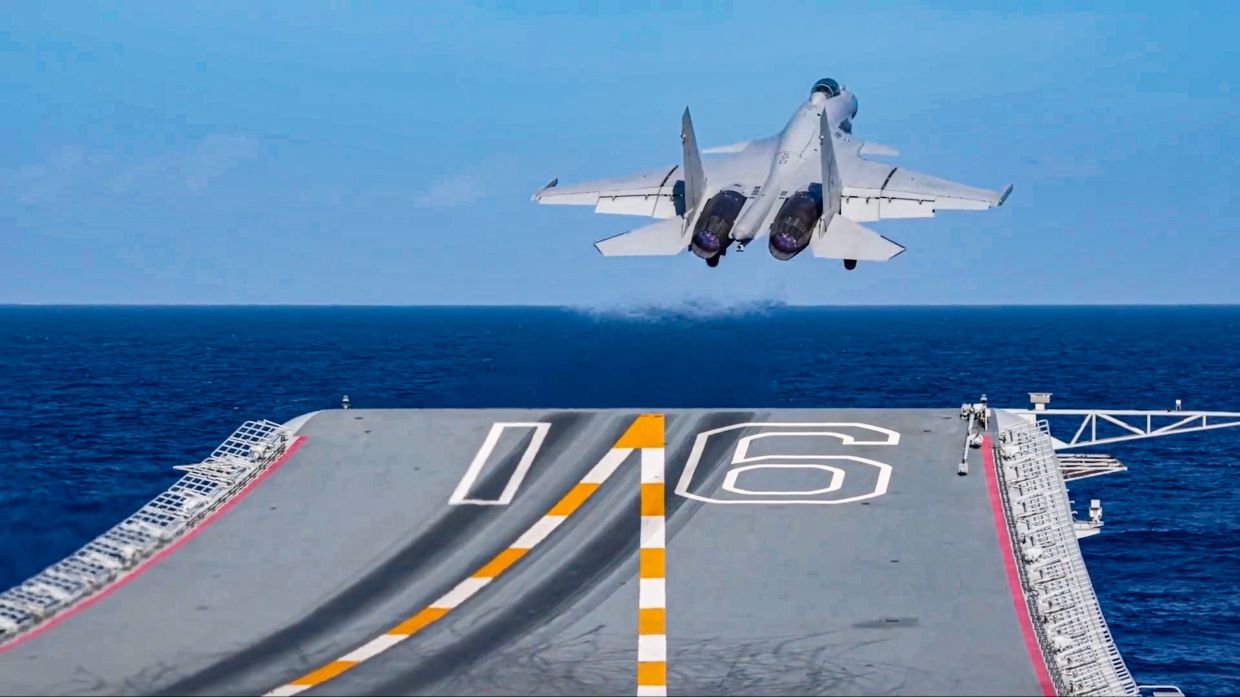
China's ambitious expansion of its carrier fleet is attracting scrutiny from strategic defence analysts who argue that despite technological advances, a fundamental weakness persists in underwater operations. Recent assessments from major think tanks, including the Washington-based Centre for Strategic and International Studies, have identified submarine threats as potentially the most damaging element in any confrontation involving Chinese naval assets. This vulnerability extends beyond simple operational concerns to shape the broader calculus of regional security, with implications that ripple across Southeast Asia and the Indo-Pacific.
The strategic analysis focuses on what experts term a "cost-imposition" approach, which would leverage multiple attack vectors against carrier groups. These encompass land-based strike networks, satellite-guided long-range air operations, electromagnetic and cyber capabilities, and coordinated drone swarm tactics. Yet among these varied threats, analysts consistently point to submarine operations—particularly those conducted by US attack submarines operating in the western Pacific—as the most consequential danger facing Chinese naval formations. The distinction matters not merely as an academic exercise but because it reveals where Chinese military planners must focus their modernization efforts if they intend to project power effectively beyond their immediate coastal waters.
The geographic layout of the western Pacific reinforces this undersea vulnerability in concrete ways. Critical maritime passages through which carrier groups must transit funnel naval traffic through a limited number of strategic chokepoints. Adversarial forces could position submarines and other assets to threaten carriers as they navigate these confined waterways, transforming geography itself into a strategic disadvantage for Beijing. This reality constrains operational flexibility and forces difficult choices about deployment patterns and risk acceptance.
Central to the vulnerability debate is China's acknowledged gap in submarine detection and oceanographic knowledge. Christopher Sharman, director of the China Maritime Studies Institute at the US Naval War College, emphasizes that while the People's Liberation Army Navy has invested substantially in improving undersea awareness in recent years, "important gaps" remain. Chinese military-affiliated researchers themselves have conceded that their nation's meteorological and oceanographic capabilities lag behind those of the US Navy. This comparative disadvantage proves particularly constraining in operations extending beyond the first island chain, where advanced knowledge of undersea conditions directly translates into operational effectiveness for both submarine and anti-submarine warfare.
Recognizing these deficiencies, Beijing has initiated several programs designed to close the undersea awareness gap. The Transparent Ocean initiative, originally proposed more than a decade ago, represents an ambitious attempt to establish comprehensive oceanographic monitoring across the western Pacific, South China Sea, and Indian Ocean. This system would integrate satellites, research vessels, buoys, underwater gliders, and seabed sensors to collect real-time environmental data. The Ocean University of China has already established hundreds of deep-sea observation systems and expanded monitoring networks, while Chinese sources have explicitly linked these civilian-appearing programs to national security objectives.
Simultaneously, the People's Liberation Army Navy has modernized its anti-submarine capabilities through multiple channels. Military analysts have documented the expansion of fixed-wing maritime patrol aircraft, the deployment of Type 927 ocean-surveillance ships equipped with advanced towed-array sonar systems, and systematic upgrades to detection sensors installed on helicopters and aircraft dedicated to submarine hunting. These investments reflect official acknowledgment that underwater warfare competence has become central to contemporary naval strategy, not merely a peripheral concern.
The strategic significance of submarine operations extends far beyond carrier protection alone. Undersea warfare represents a core component of China's broader naval strategy, particularly within the first island chain where it underpins objectives for wartime sea control. Beyond the first island chain and into the Indian Ocean, PLA strategists view effective undersea capabilities as essential to countering American naval superiority and complicating potential third-party intervention in any conflict over Taiwan. Chinese military-affiliated authors have candidly described the depths near their coast as a "wide-open door" precisely because current monitoring and control systems cannot sufficiently exclude foreign submarines.
The Taiwan factor adds another layer of complexity to these calculations. While Beijing regards Taiwan as part of China and has never formally renounced force for reunification, American security commitments and weapons supplies to the island create a tripwire for potential conflict. If Japan were drawn into such a confrontation, as some analysts suggest remains plausible, Japanese naval and submarine forces operating close to their own coast could multiply the threats facing Chinese carriers. This scenario introduces asymmetric challenges that underscore why some defence analysts question whether deploying expensive carrier groups so far from protected waters represents sound strategic judgment.
Timothy Heath, head of defence research firm Perceptum, highlights that US submarines rank among the world's quietest vessels, making detection extraordinarily difficult. This technological advantage compounds China's geographic and oceanographic disadvantages. He also notes that carriers may prove too valuable and costly to deploy in the vulnerable positions required for projecting influence across the second island chain. Instead, Heath suggests that China's land-based intermediate-range ballistic missiles remain superior instruments for threatening distant American naval formations, making carrier deployments into forward areas potentially wasteful of irreplaceable assets.
For regional powers including Malaysia and other Southeast Asian nations, these technical debates carry significant implications. A China that struggles to project reliable carrier power beyond the first island chain might demonstrate greater restraint in maritime disputes within the South China Sea. Conversely, successful resolution of submarine detection and anti-submarine challenges could enable Beijing to maintain sustained naval presence throughout waters claimed by multiple nations. The balance of undersea capability thus indirectly shapes the distribution of influence throughout Southeast Asia, affecting security calculations and alliance considerations for smaller maritime states.
The strategic community has begun urging responses that would reinforce submarine-based threats against Chinese carriers. Defence analysts call for increased allied investment in submarine production, advanced torpedoes, undersea drones, and coordinated operational concepts involving Japan, Australia, and the United States. Such recommendations reflect confidence that submarine vulnerability represents a persistent weakness unlikely to be quickly overcome despite China's evident modernization efforts. This assessment carries implications not just for military balance but for the broader question of whether Chinese power projection will face meaningful constraints in coming years.

