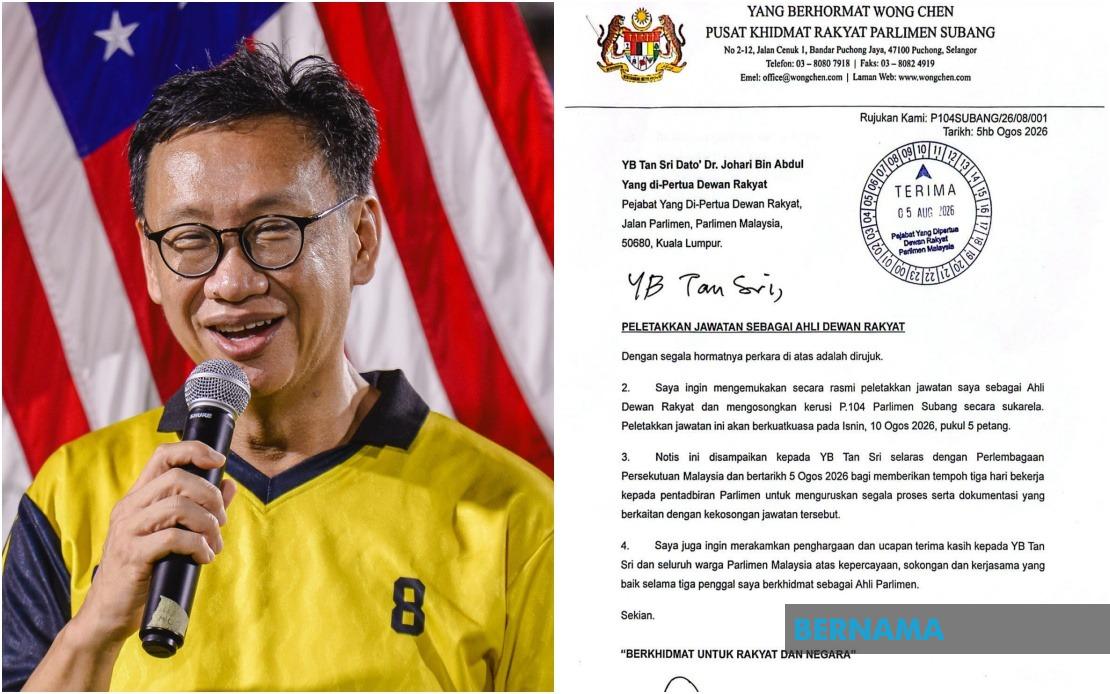
Wong Chen, the Member of Parliament representing Subang, has formally ended his parliamentary career by submitting his resignation to the Dewan Rakyat. The resignation, which takes legal effect at 5:00 pm today, marks the conclusion of a twelve-year tenure spanning three full parliamentary terms. The veteran legislator submitted his official resignation letter to Speaker Tan Sri Johari Abdul on August 5, deliberately providing advance notice to enable the Parliament administration adequate time to process the vacancy and organise a by-election for the Subang constituency.
In announcing his decision through a Facebook post, Wong Chen expressed his appreciation for the institutional support he received throughout his time in the legislature. His letter of resignation, formally dated August 5, 2026, emphasised that his decision to vacate the Subang parliamentary seat was made voluntarily and in full compliance with the provisions set out in the Federal Constitution. The deliberate advance notice—more than a week before his departure became effective—demonstrated Wong's institutional courtesy and concern for the Parliament's administrative requirements during the transition.
Wong Chen's departure from Parliament represents a significant shift in Subang's political representation and opens questions about the direction of the constituency's interests in the coming months. The Subang seat has historically been a competitive parliamentary constituency with varied political fortunes, and Wong's exit will trigger a by-election process that is likely to draw considerable attention from multiple political parties seeking to capture this urban, educated electorate. The constituency, which encompasses areas in the Klang Valley, carries considerable symbolic weight in Malaysian politics as a bellwether of urban voter sentiment.
The timing of Wong's resignation, effective immediately after his announcement, suggests a carefully planned departure rather than a sudden decision driven by controversy or internal party conflict. His arrangement to provide nearly two weeks' notice to Parliament indicates a desire to maintain positive institutional relationships and ensure a smooth handover process. This approach contrasts sharply with other high-profile parliamentary resignations that have occurred amid political turbulence, suggesting Wong's departure may be driven by personal considerations or other non-contentious factors.
As part of his formal departure from office, Wong Chen has instructed that the honorific title "Yang Berhormat" (a Malaysian honorific meaning "Most Honourable"), which is customarily used by Members of Parliament, be removed from all billboards, signboards, and official office correspondence beginning next month. This procedural step reflects standard parliamentary protocol whereby outgoing members must cease using official titles and designations once their tenure concludes. The removal of these designations represents the final administrative steps in formally ceasing his parliamentary functions.
Wong Chen has scheduled a comprehensive press conference for tomorrow at 11:00 am to provide further details regarding his resignation and clarify the circumstances surrounding his departure. This planned media engagement suggests he intends to address public curiosity about his decision and possibly provide context about his future endeavours or reasons for stepping down. Such press conferences by departing parliamentarians often offer insights into their assessments of parliament, their personal ambitions, or their views on contemporary political developments.
The departure of Wong Chen from Parliament eliminates one of the more vocal and independent voices within the Dewan Rakyat. Over his three terms, Wong has been associated with various parliamentary initiatives and has maintained a relatively high public profile for a backbench Member of Parliament. His resignation will alter the dynamics of parliamentary debate and representation, particularly on matters affecting his urban, middle-class constituency.
The vacancy in Subang will now trigger an electoral process governed by Malaysian electoral law, with the Election Commission responsible for determining the timing of the by-election. The Subang by-election will serve as a significant political barometer, offering an early indication of voter sentiment and the relative strength of competing political coalitions. Given Subang's urban demographics and historical electoral competitiveness, the seat is likely to witness intense campaign activity from major political parties and coalitions.
For the Parliament administration, Wong Chen's early notification provides crucial time to prepare for the seat's vacancy, update constituency records, and facilitate the electoral process without unnecessary delays. The Speaker's office and relevant parliamentary departments can use the intervening period to ensure all procedural requirements are met and that no legislative gaps emerge from the Subang constituency's temporary representation deficit. This administrative continuity reflects the professional functioning of Malaysian parliamentary institutions despite regular political changes.
Wong Chen's three-term parliamentary career spans a significant period of Malaysian political development, encompassing various coalition governments and shifts in the country's political landscape. His exit marks the end of an era for his constituency's representation and opens a new chapter as political parties mobilise to contest the Subang seat. The by-election process ahead will provide valuable insights into evolving voter preferences and the effectiveness of competing political narratives among this urban, educated electorate.

