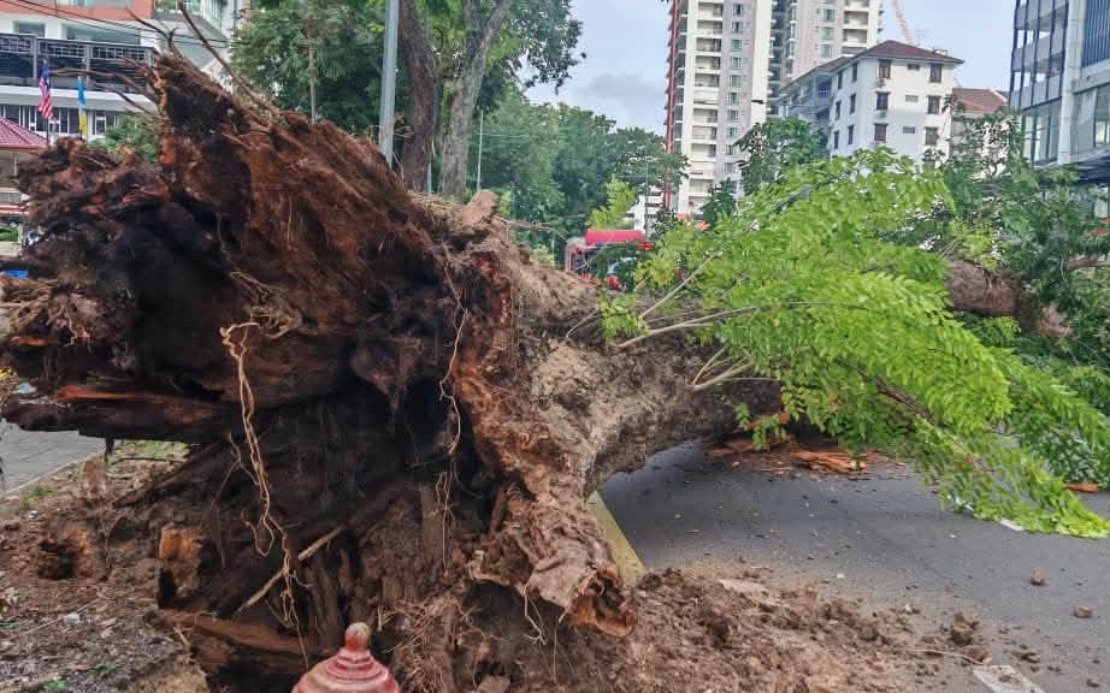
A 28-metre Angsana tree that toppled along Jalan Macalister in George Town on August 9 had been severely compromised by root decay and structural cavities, officials say, with the incident leaving three occupants of a Perodua Ativa injured when the vehicle was struck. The tree, a Pterocarpus indicus specimen estimated to be 90 years old, exhibited approximately 30 per cent root rot alongside cavity decay affecting roughly 40 per cent of its base trunk—damage that, when combined with other environmental stressors, proved sufficient to overcome the tree's structural integrity and trigger catastrophic failure around 9 am.
According to MBPP Mayor Datuk A. Rajendran, the confluence of multiple degradative factors transformed what might ordinarily have been a manageable horticultural situation into an acute safety hazard. Beyond the biological deterioration evident in the root system and trunk base, the tree faced chronic soil compaction beneath its canopy, severely constrained rooting space that prevented adequate nutrient and water absorption, and the considerable mechanical stress imposed by its considerable height. Infrastructure upgrading activities being conducted in the vicinity added further destabilising pressure on an already weakened specimen, collectively elevating the structural failure risk to dangerous levels.
Remarkably, weather conditions did not appear to have precipitated the collapse, with MBPP noting the absence of heavy rainfall or sustained strong winds either during or immediately preceding the incident. This observation underscores the reality that the tree's failure resulted from accumulated internal degradation rather than acute external trauma, a distinction that raises questions about earlier warning signs and the effectiveness of routine monitoring protocols. The swift response following the incident saw MBPP crews mobilising at 9.41 am to begin removal operations, with the roadway fully reopened and cleared by 2.20 pm.
The George Town municipality had conducted systematic assessments of mature and aged trees along Jalan Macalister during 2024, identifying 13 specimens deemed unfit for retention. All 13 trees designated for removal have now been felled. Most recently, maintenance operations on trees along the street were performed on January 29, 2024. Yet a remote sensing study conducted in the previous year had indicated that trees throughout the area remained in generally satisfactory condition, with no particular warning indicators evident. This apparent contradiction between the remote sensing findings and the actual condition of the collapsed tree highlights potential limitations in current monitoring methodologies, particularly regarding the detection of internal decay processes that may not manifest visibly until structural failure occurs.
The incident occurs within the context of MBPP's broader tree management regime, which approved 179 high-risk specimens for removal during 2024. Of these, 148 have already been felled, whilst an additional 247 trees were removed during the first three quarters of the year across various municipal operations. The reasons for these removals span a diverse spectrum: drainage obstruction, dead wood, dangerous lean, assessed collapse risk, development projects, road and river expansion initiatives, and encroachment upon Penang Water Supply Corporation pipeline corridors. This multifaceted approach reflects the complex balancing act that urban authorities must perform between environmental preservation and public safety.
A comprehensive inventory conducted last year identified 2,535 trees requiring categorical assessment across MBPP's jurisdiction. Within this inventory, 45 cases involved drainage interference, 138 trees showed clear signs of death or senescence, 2,242 were classified under various risk or miscellaneous categories, and 110 were linked to development or infrastructure requirements. These figures demonstrate the scale of ongoing tree management challenges confronting the municipality and indicate that the Jalan Macalister collapse, whilst dramatic and injurious, represents a single incident within a much broader pattern of urban arboricultural strain.
MBPP's stated policy prioritises the removal or remediation of trees presenting genuine safety threats, with particular attention directed toward specimens affected by infrastructure works or confined by limited rooting environments. The municipality has instructed its appointed contractor to intensify efforts specifically along Jalan Macalister, focusing on reducing tree heights and removing additional specimens assessed by certified arborists as presenting collapse risks. This responsive escalation acknowledges the urgency of the situation whilst attempting to prevent further incidents before they develop.
For Malaysian and Southeast Asian readers, this incident illuminates broader challenges confronting regional cities as they grapple with aging urban forest infrastructure and the tension between heritage preservation and modernisation pressures. George Town's tree management crisis reflects similar pressures facing Kuala Lumpur, Jakarta, Bangkok, and Singapore, where rapid infrastructure development, soil degradation from compaction, and inadequate rooting space increasingly compromise specimen viability. The collapse highlights the necessity for more sophisticated early-detection systems, potentially incorporating ground-penetrating radar or advanced imaging technologies capable of identifying internal decay before catastrophic failure occurs.
The injury to the three individuals—an elderly couple and grandchild—underscores the human consequences of deferred tree maintenance and inadequate risk assessment. As Asian cities continue densifying and infrastructural projects proliferate, the question of how to systematically identify dangerous specimens without resorting to mass felling campaigns becomes increasingly pressing. Solutions may require international collaboration, enhanced funding for arboricultural expertise, and community engagement in tree stewardship programmes that recognise urban forests as vital infrastructure requiring professional management rather than reactive crisis response.
Looking forward, the Jalan Macalister incident will likely prompt MBPP and peer municipalities across Malaysia and the broader region to reconsider their assessment protocols and maintenance scheduling. The gap between the 2023 remote sensing study indicating good condition and the 2024 discovery of extensive internal decay suggests that tree health monitoring technology requires upgrading and that assessment intervals may need shortening for aged specimens. Additionally, the interaction between infrastructure works and tree stability deserves more careful pre-project evaluation, potentially preventing situations where upgrading activities directly contribute to specimen failure.

