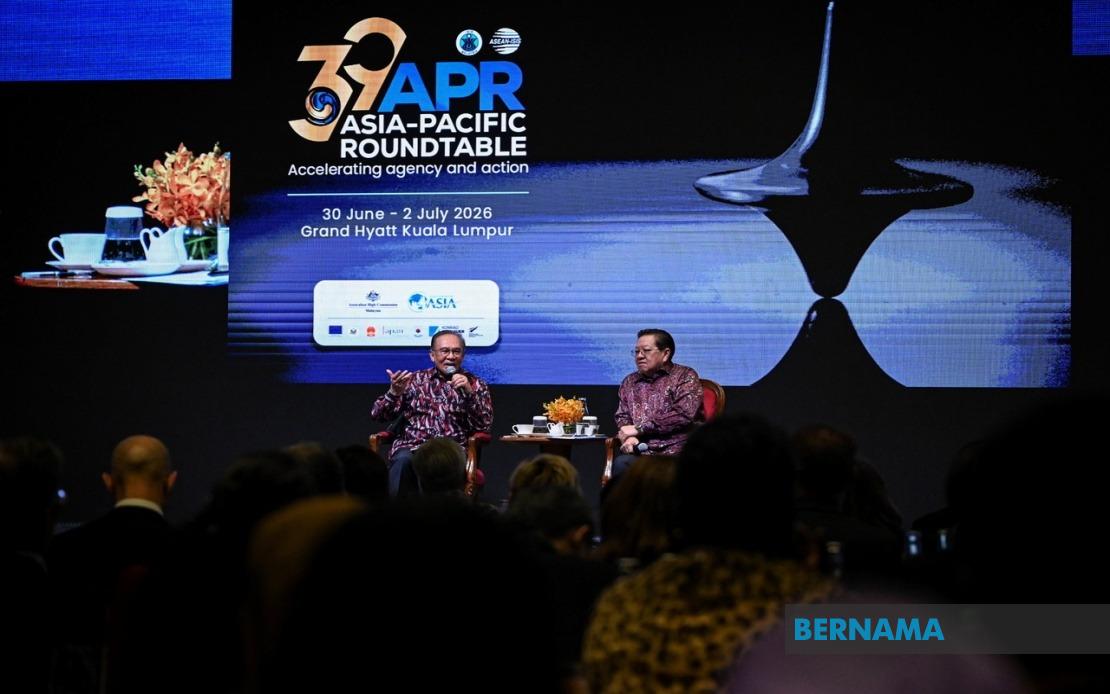
Prime Minister Datuk Seri Anwar Ibrahim has placed domestic governance reform at the centre of Malaysia's national agenda, insisting that any credible engagement in international matters must be anchored in robust institutional performance and ethical leadership at home. Speaking during a question-and-answer session at the 39th Asia-Pacific Roundtable in Kuala Lumpur, Anwar outlined a vision in which the country addresses internal challenges before attempting to shape global narratives or advance regional positions on contentious international questions.
The Prime Minister outlined four interconnected pillars that will define his administration's focus in the years ahead: strengthening governance structures, eradicating corruption, narrowing inequality, and guaranteeing that every Malaysian has genuine access to quality education and healthcare. This multifaceted approach reflects recognition that institutional credibility and public trust are prerequisites for effective policymaking. By framing governance enhancement as a moral and practical imperative, Anwar has signalled that administrative competence and ethical conduct will be measured not merely in official proclamations but in tangible improvements to citizens' daily lives.
Crucially, Anwar acknowledged Malaysia's continued role in international affairs while subordinating that engagement to domestic priorities. He stressed that Malaysia would maintain principled positions on global issues, yet made clear that the government's energies must primarily be directed towards national renewal. This balancing act reflects a pragmatic understanding that a nation struggling with internal institutional weaknesses cannot credibly or effectively champion causes abroad. For Southeast Asian observers, this declaration carries implications for how Malaysia will calibrate its diplomatic involvement in regional tensions, trade disputes, and multilateral forums in coming months.
An important dimension of Anwar's remarks concerned Malaysia's identity as a Muslim-majority democracy. He emphasised that the country must demonstrate to the world that Islamic-majority nations can simultaneously uphold democratic institutions, practise religious moderation, and foster genuine inclusivity across communal lines. This framing addresses persistent international scepticism about whether Muslim-majority countries can sustain liberal democratic norms, positioning Malaysia as a counterexample to polarised narratives that dominate global discourse on Islam and governance.
The Prime Minister explicitly cautioned against interpreting contemporary geopolitical tensions through the lens of civilisational conflict, citing the analytical framework of late Palestinian-American scholar Edward Said. Rather than accepting the notion of a "clash of civilisations," Anwar reframed recurring international disagreements as rooted in misunderstanding, prejudice, and what he termed a "clash of ignorance." This conceptual reorientation suggests that many disputes arise not from irreconcilable ideological or cultural differences but from insufficient knowledge and mutual comprehension among parties involved.
Central to Anwar's vision is the government's MADANI framework, which purports to integrate technological progress with human values and social cohesion. The framework represents an attempt to reject the false choice between modernisation and traditional cultural or spiritual concerns, instead positioning both as complementary elements of national development. For Malaysia's diverse population, this approach theoretically allows citizens of different backgrounds to participate in development without perceiving technological advancement as culturally or religiously threatening.
Anwar drew on Islamic theological concepts to reinforce his message of intercommunal understanding, invoking the Quranic principle of "li ta'arafu"—often translated as "that you may know one another." By referencing this classical Islamic teaching, the Prime Minister grounded his call for deeper mutual appreciation in religious tradition rather than secular liberal doctrine alone. This rhetorical strategy acknowledges Malaysia's Islamic heritage while arguing that Islam itself enjoins believers to seek understanding across differences. The approach carries particular weight in a country where some political actors have weaponised religion to deepen rather than bridge communal divides.
The emphasis on moving beyond mere tolerance towards genuine understanding addresses a longstanding tension in Malaysian multiculturalism. Decades of official policy have promoted tolerance as the primary virtue governing interethnic and interreligious relations. However, tolerance itself can be passive and grudging—a mere acceptance of others' existence without enthusiasm or meaningful engagement. By contrast, Anwar's invocation of ta'arafu suggests active curiosity, deliberate learning, and appreciation for others' perspectives and heritage. This represents a potentially more demanding and dynamic vision of social coexistence than tolerance alone.
For a multiracial and multireligious polity like Malaysia, where historical grievances and contemporary resource competition generate periodic communal tension, this intellectual reorientation could carry substantial practical implications. If policymakers, media figures, and community leaders internalise the distinction between mere tolerance and substantive understanding, the quality of public discourse and policy design might shift measurably. Educational curricula, intercommunal dialogue initiatives, and media regulations could be redesigned to promote ta'arafu as an active principle rather than passive coexistence.
Anwar's remarks also implicitly challenge both internationally and domestically oriented critics of his administration. To international observers sceptical of Malaysia's commitment to democracy and human rights, he offers a counterargument: the government is methodically rebuilding institutions and addressing corruption as the necessary foundation for credible global engagement. To domestic constituencies impatient for faster results on narrower communal or sectarian concerns, he signals that the administration's priorities are structured around universal principles—competent governance, education, healthcare, and equality—rather than particularistic advantage for any single group.
The strategic timing of these remarks at a high-profile regional forum underscores the importance of the messaging. The Asia-Pacific Roundtable brings together policymakers, academics, and business leaders from throughout the region and beyond, creating an audience of influential voices who shape international perceptions of Malaysia. By articulating a coherent governance agenda before this audience, Anwar appears to be establishing benchmarks against which Malaysia's performance will be measured and demonstrating that his government possesses a substantive vision extending beyond rhetorical flourishes.
As Malaysia navigates complex regional dynamics involving great power competition, economic pressures, and internal social fragmentation, Anwar's insistence on prioritising domestic governance offers a potential pathway for coherent policymaking. Whether the administration can translate these principles into sustained institutional improvement, corruption reduction, and expanded educational and healthcare access remains the critical question. The coming years will reveal whether governance reform emerges as Malaysia's genuine foremost responsibility or remains aspirational rhetoric.

