Deputy Prime Minister Datuk Seri Dr Ahmad Zahid Hamidi has moved to reassure the public that Malaysia's federal administration will remain stable despite intensifying political competition at the state level, particularly following recent elections in Johor and Negeri Sembilan. Speaking at the Rural and Regional Development Ministry's monthly gathering in Putrajaya on August 6, Ahmad Zahid sought to downplay concerns that state-level political developments could threaten the cohesion of the national Unity Government, which took office in the wake of the 2022 general election.
The Barisan Nasional chairman framed his message around a core principle: the federal government's stability depends fundamentally on the foundational agreement that brought the Unity Government into existence, not on the shifting political landscape within individual states. He emphasised that this understanding would remain operative as long as Parliament has not been dissolved, a notably specific condition that underscores both the formal requirements of Malaysian politics and the implicit recognition that coalition governments operate within defined constitutional timelines. This distinction is particularly relevant for Malaysian observers familiar with the country's history of coalition fragility and the role Parliament plays in determining governmental longevity.
Ahmad Zahid's comments carry significance beyond mere reassurance. They represent an attempt to articulate a governing philosophy that allows component parties within the coalition to maintain distinct political identities and pursue separate strategies at the state level without jeopardising the federal partnership. This approach acknowledges a fundamental reality of Malaysian politics: state governments operate with considerable autonomy, and political parties naturally prioritise winning seats and influence in their respective territorial bases. The challenge lies in preventing such state-level ambitions from catalysing broader coalition ruptures at the federal centre.
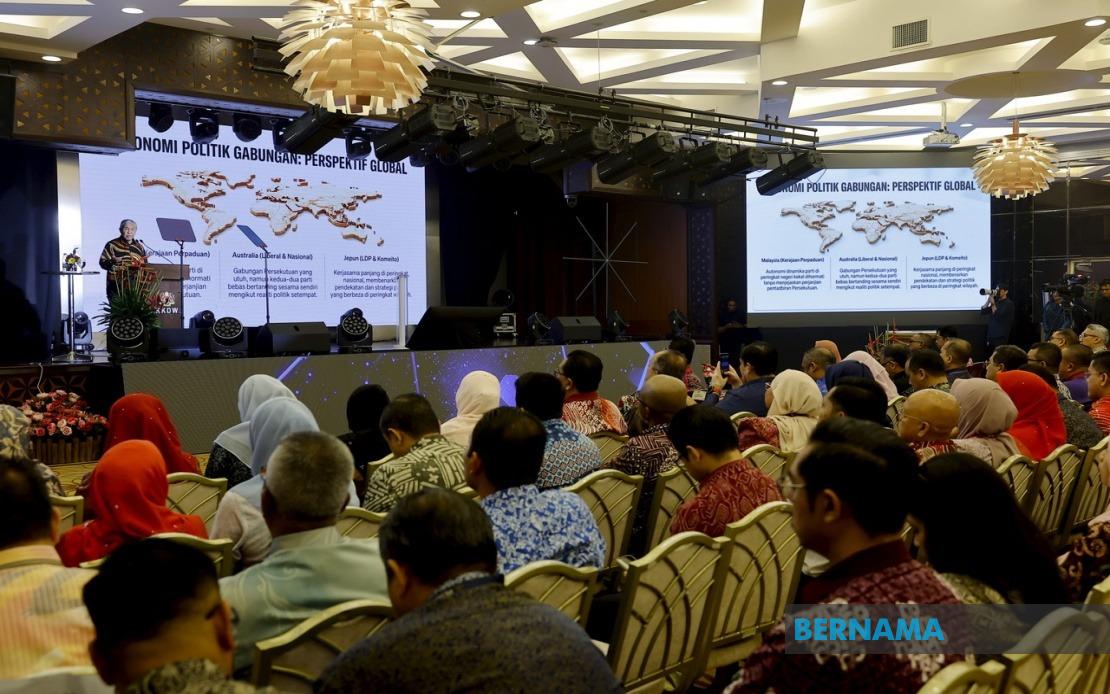
The Deputy Prime Minister introduced the concept of "political autonomy within a coalition government" to describe this arrangement. This formulation suggests that member parties retain the freedom to articulate their own political positions and contest state elections vigorously, provided they honour the foundational compact that keeps the federal administration functioning. The notion reflects a pragmatic acceptance that political parties cannot reasonably be expected to suppress their competitive instincts or abandon their partisan identities simply by entering a coalition government. Rather than viewing such intra-coalition competition as inherently destabilising, Ahmad Zahid presented it as a manageable feature of coalition governance that can coexist with federal stability.
The specific reference to recent state elections in Johor and Negeri Sembilan indicates that Ahmad Zahid's reassurances respond to concrete concerns about coalition cohesion in the post-election environment. These contests have likely intensified competition among coalition members or between government and opposition parties, potentially raising questions about the durability of the national partnership. By directly addressing these developments, Ahmad Zahid sought to anchor public and investor confidence in the federal government's continuity and ability to execute policy regardless of state-level outcomes.
Crucially, Ahmad Zahid stressed that the MADANI Government's policy agenda—the administration's stated development framework—would proceed uninterrupted by state political developments. This commitment extends to all planned government policies, programmes, and projects. For Malaysian readers concerned about infrastructure investments, social programmes, or economic initiatives dependent on federal action, this assurance carries practical importance. It suggests that coalitional politics need not translate into governmental paralysis or policy reversals at the federal tier, even if individual states experience changing political configurations.
The assertion that cooperation within the coalition does not require parties to forfeit their respective identities or political principles represents an important clarification of how the Unity Government operates in practice. Malaysia's prior experience with coalition governments has sometimes involved tension between these demands—whether parties could maintain genuine political distinctiveness while functioning as part of a governing arrangement. Ahmad Zahid's framing suggests that such sacrifice is neither necessary nor expected, provided the broader commitment to federal stability is honoured. This approach may prove more sustainable than models requiring complete sublimation of party interests to coalition imperatives.
The Deputy Prime Minister's remarks also implicitly acknowledge Malaysia's constitutional framework, wherein executive stability depends on maintaining parliamentary confidence. As long as the government retains the necessary votes in Parliament, electoral setbacks in individual states need not translate into loss of federal office. This mathematical reality provides reassurance that state-level contests, however competitive or acrimonious, operate within constraints that protect the sitting federal administration. However, this protection is contingent rather than absolute—the agreement underpinning the coalition remains the ultimate guarantor of stability.
For Malaysia's business community and foreign investors, such reassurances about policy continuity and governmental stability hold particular significance. Coalition governments operating across Southeast Asia have sometimes struggled to maintain consistent policy directions through periods of political competition. Ahmad Zahid's explicit commitment to uninterrupted policy implementation may help sustain investor confidence and facilitate long-term planning for projects dependent on government cooperation. The clarity that parliamentary dissolution represents the true dividing line between current arrangements and potential reconfiguration also provides a temporal framework within which stakeholders can operate with reasonable confidence.
The broader context of Ahmad Zahid's comments reflects Malaysia's ongoing navigation of coalition governance in an environment of genuine multiparty competition. Unlike some Southeast Asian neighbours with dominant-party systems, Malaysia's competitive landscape requires constant balancing among coalition partners while maintaining sufficient unity to function as a government. Ahmad Zahid's articulation of political autonomy within coalition frameworks represents an attempt to theorise this balance—to acknowledge competitive realities while insisting that they need not destabilise the federal partnership. Whether this balanced approach ultimately proves durable will depend on how vigorously member parties pursue state-level advantage and whether such competition can genuinely be compartmentalised from federal relationships.

