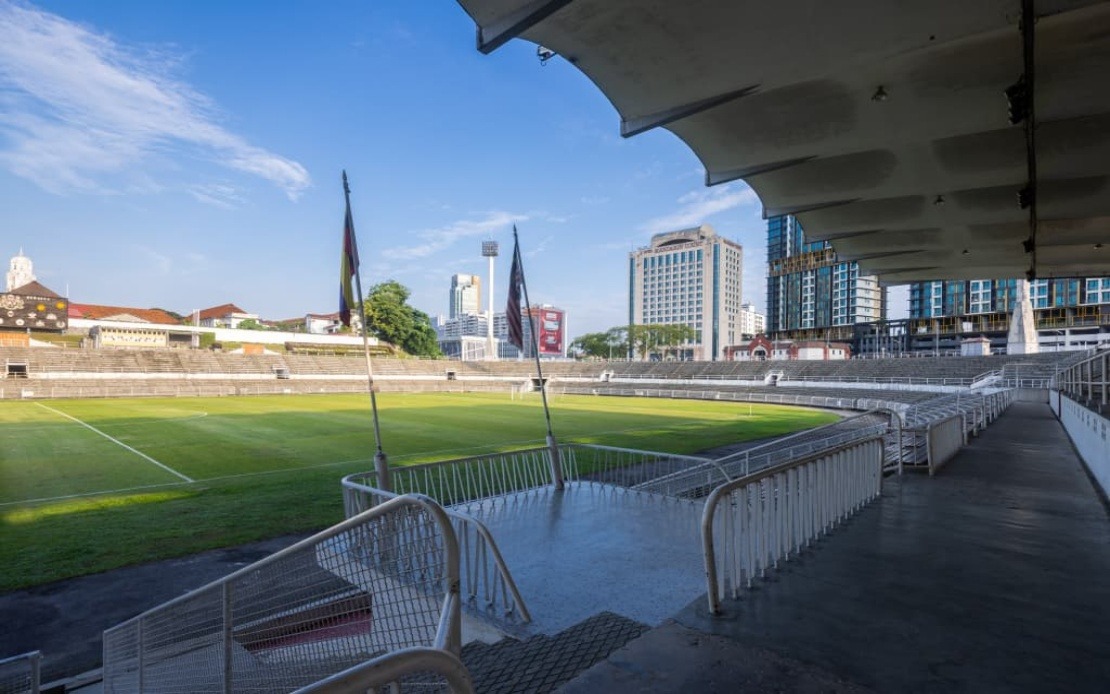
Nearly seven decades after witnessing the proclamation of independence, Stadium Merdeka remains a living symbol of Malaysia's freedom, a place that still remembers the day a nation was born. Standing amidst the modern skyline beside the towering Merdeka 118, the stadium continues to serve as a vital connection to the nation's history, its original architecture now meticulously restored against a backdrop of contemporary urban development.
The stadium's significance is rooted in its role as the venue where Tunku Abdul Rahman Putra Al-Haj, Malaysia's first Prime Minister, proclaimed Malaya's independence on August 31, 1957. Constructed within a single year at a cost of approximately RM2.3 million, the facility was purpose-built to accommodate this pivotal moment in the nation's story. Tunku Abdul Rahman's seven resounding cries of "Merdeka!" echoed through the venue, accompanied by the first playing of the national anthem, marking the end of British colonial rule and the birth of a sovereign nation. This event represented far more than a ceremonial occasion; it symbolised the realisation of decades of nationalist struggle and aspiration.
According to Prof Dr Sarjit Singh Gill, a social anthropology expert at Universiti Putra Malaysia and chairman of the National Council of Professors' National Unity Cluster, the stadium transcends its physical function as a sports venue. He characterises it as a historical monument that embodies the nation's identity, dignity and rich heritage. The site's significance extends beyond 1957, as the stadium also hosted another defining moment in 1963 when it witnessed the proclamation of the Malaysian Federation, effectively establishing the union of Malaya, Sabah, Sarawak and Singapore—though the latter would later separate from the federation.
The preservation of Stadium Merdeka reflects broader national priorities regarding heritage conservation. During the late 1990s, the site faced potential redevelopment threats that could have erased this irreplaceable landmark. However, substantial public opposition combined with government intervention ensured its survival. In 2000, Permodalan Nasional Berhad (PNB) assumed stewardship of the heritage site, committing resources and expertise to its long-term preservation. This transition marked a turning point, transforming the stadium from a vulnerable historical relic into an actively managed national treasure.
The restoration effort undertaken by PNB demonstrated meticulous attention to historical authenticity. Guided by original Public Works Department construction drawings, conservators systematically addressed the stadium's structural and aesthetic elements. Upper seating tiers added in later decades were removed to restore the original 20,000-seat capacity, while significant features including the scoreboard, washroom facilities, mosaic tiles and distinctive cantilevered roof underwent careful rehabilitation. This commitment to preservation rather than modernisation reflects a deliberate philosophy prioritising historical integrity over contemporary convenience.
Datak Dr Izwan Ibrahim, Chief Executive Officer of PNB Merdeka Ventures Sdn Bhd, articulates the organisation's core mission with particular emphasis on accessibility and storytelling. He emphasises that Stadium Merdeka transcends its function as a historical reminder, instead representing the aspirations and determination that shaped the modern nation. This perspective positions the stadium not as a static museum piece but as a dynamic space where Malaysia's founding principles remain tangible and relevant. The stadium's recognition by international authorities has reinforced this status: it received a UNESCO Asia-Pacific Heritage Award in 2008 and was gazetted as a National Heritage site in 2009, validating its significance within global heritage frameworks.
The evolution of Stadium Merdeka from exclusive National Day venue to accessible public landmark demonstrates shifting attitudes toward heritage engagement. Today, the stadium functions as more than a ceremonial space, hosting the Bazram Merdeka bazaar, a Ramadan marketplace that attracted over 250,000 visitors earlier this year. The refurbished track accommodates community use, enabling residents to exercise within a historically significant environment. This multifunctional approach transforms the stadium into a living space where contemporary Malaysian life intersects with historical consciousness, creating opportunities for organic connection rather than formal education.
Yet perhaps the most compelling aspect of Stadium Merdeka's contemporary relevance concerns intergenerational transmission of historical awareness. Izwan Ibrahim specifically highlights efforts to engage younger Malaysians who may have encountered 1957 only through school curricula or family accounts. The organisation recognises that abstract knowledge of independence differs fundamentally from visceral experience of the site where history unfolded. Neighbouring schools increasingly visit the stadium for experiential learning, while young people engage through cultural activities and recreational use. This deliberate strategy acknowledges that sustained national identity depends not merely on preserving physical monuments but on enabling successive generations to forge personal connections with historical significance.
For long-serving staff member Alias Daud, who devoted 35 years to PNB before spending his final decade caring for the venue, Stadium Merdeka represents profound personal meaning beyond employment. He describes experiencing pride, gratitude and nostalgia upon entering the stadium, having witnessed diverse Malaysians traverse its gates with their individual stories and memories. Alias observes that the atmosphere becomes especially charged during the national month, when government agencies, schools and universities visit to absorb the stadium's history and document Merdeka-related content. Younger visitors particularly impress him with their genuine interest in learning where independence was proclaimed, their engagement transcending mere tourism to reflect authentic historical curiosity.
The contrast between Stadium Merdeka and its surrounding urban landscape presents an compelling visual metaphor for Malaysia's relationship with its past. As modern skyscrapers rise around the stadium, including the imposing Merdeka 118, the older structure maintains its presence as a powerful counterpoint to contemporary development. This juxtaposition raises important questions about urban heritage management in rapidly developing Southeast Asian cities, where pressure for redevelopment often threatens sites associated with national founding moments. Stadium Merdeka's survival and flourishing within this competitive landscape demonstrates that heritage preservation and urban progress need not constitute zero-sum propositions.
The stadium's ongoing significance also reflects Malaysia's democratic maturity in honouring diverse historical narratives. Rather than confining remembrance to official state ceremonies, the site encourages open public access and community participation. This democratisation of heritage stands in contrast to historical periods when access to such iconic venues remained restricted or ceremonial. The integration of recreational facilities alongside historical functions suggests a vision wherein future Malaysians will continue exercising, celebrating and gathering within spaces where the nation's founding promises were articulated.
Looking forward, Stadium Merdeka's role as a bridge between past and future appears increasingly vital. With 2057 marking the bicentennial of Malaysian independence, heritage sites like this stadium will become essential focal points for national reflection and intergenerational dialogue. The investments made by PNB and supportive government policies create infrastructure enabling such commemoration. As Malaysia navigates complex contemporary challenges spanning economic transformation, social cohesion and geopolitical positioning, returning to founding principles articulated at Stadium Merdeka offers grounding in national purpose and collective identity.
The stadium ultimately endures as testimony that physical spaces matter profoundly for national consciousness. Walls that witnessed Tunku Abdul Rahman's declarations of freedom, ground trodden by celebrants of independence, and architecture embodying the aspirations of 1957 continue speaking to succeeding generations of Malaysians. Through careful preservation, public accessibility and community engagement, Stadium Merdeka transcends monument status to become a living institution, perpetually renewing the spirit of Merdeka for those who enter its gates.

