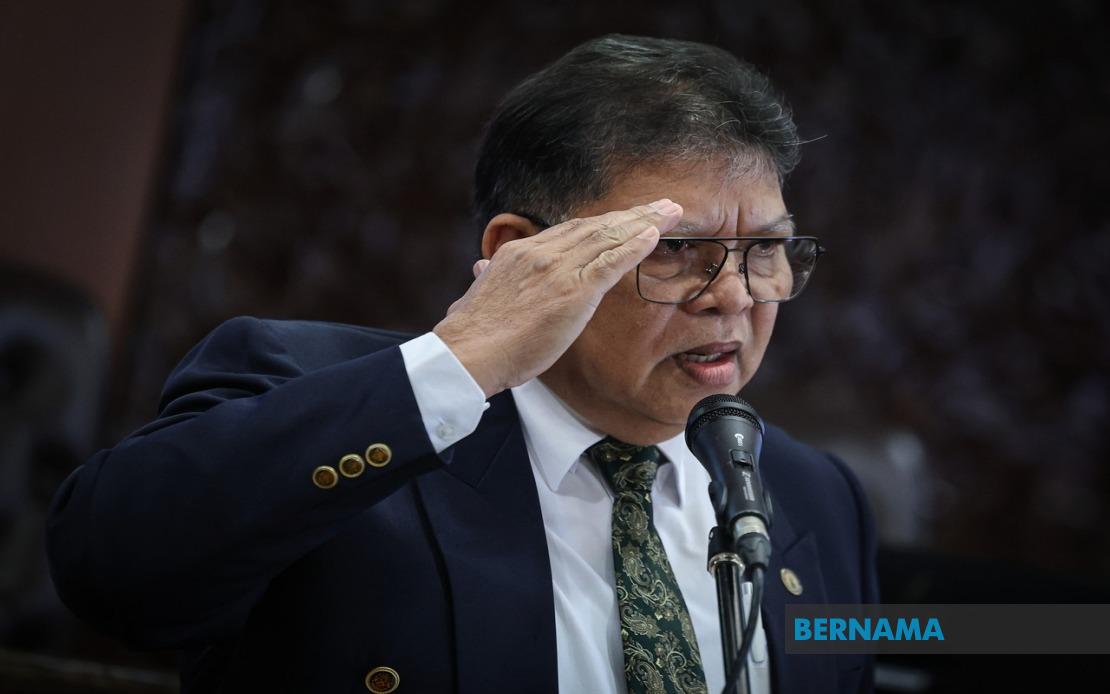
Dewan Rakyat Speaker Tan Sri Johari Abdul has proposed introducing a proportional representation electoral system as a mechanism to ensure Malaysia's ethnic and religious minorities retain meaningful parliamentary representation in the coming decades. Speaking at the Harmony Symposium held at the Parliament building in Kuala Lumpur on June 26, Johari articulated a forward-looking vision for the nation's democratic institutions, one that acknowledges the profound demographic transformations forecast for the next three decades.
The Speaker's intervention into the electoral reform debate carries particular weight given his institutional position overseeing parliamentary proceedings. He grounded his argument in concrete demographic data, citing projections that Bumiputera Malays will constitute 77 per cent of Malaysia's population by 2050. This mathematical reality, Johari suggested, renders the current first-past-the-post electoral system increasingly problematic for minority communities. Under the existing arrangement, where parliamentary representation depends on geographic constituency majorities, constituencies where ethnic minorities form electoral pluralities will become progressively rarer as overall demographic ratios shift. The consequence, he warned, is a systematic erosion of minority voices from the legislative chamber.
Johari's concern transcends mere mathematical representation. He articulated a deeper anxiety about social cohesion and interethnic relations if minority communities find themselves structurally excluded from parliamentary deliberation. His framing suggests that denying minorities meaningful legislative input could create groundswell grievances and undermine the social compact upon which Malaysian multiculturalism depends. This perspective reflects a particular understanding of democratic legitimacy—that all significant communities must perceive themselves as having genuine channels to shape national policy, regardless of their numerical proportion of the population.
The Speaker emphasised that Malaysia's complexity extends beyond its primary ethnic categories. The nation is home to 77 distinct ethnic groups, a fact that amplifies rather than diminishes the importance of electoral mechanisms capable of translating demographic diversity into parliamentary inclusion. This broader ethnic universe complicates simplistic binary frameworks and suggests that proportional systems might better capture the full spectrum of Malaysian identity and community interests.
Johari's temporal framework proved equally significant. He explicitly cautioned against focusing exclusively on immediate contemporary issues, instead urging Malaysia to project its political imagination across the next five to 100 years. This extended timeline acknowledges that constitutional and electoral reforms implemented today will shape the nation's democratic functioning across multiple generations. By divorcing the discussion from yesterday's grievances and today's political convenience, Johari positioned electoral reform as a foundational matter of long-term national architecture rather than short-term partisan advantage.
Proportional representation systems vary substantially in their design and implementation globally, from pure proportional models to mixed systems combining geographic representation with proportional allocation. Johari did not specify which variant he envisioned for Malaysia, leaving room for subsequent technical debate. However, his core contention remains straightforward: the current system cannot sustainably accommodate Malaysia's evolving demographic profile while maintaining minority representation and, by extension, the inclusive governance structures that have underpinned the nation's historical stability.
The symposium itself reflected broader efforts to institutionalise harmony discussions within Malaysia's formal democratic structures. Syahredzan Johan, chairman of the Malaysia Cross-Party Parliamentary Group on Racial and Religious Harmony (KRPPM-KKA) and Member of Parliament for Bangi, underscored that bringing racial and religious harmony discussions into Parliament itself represents a strategic elevation of these concerns within national governance architecture. By locating these conversations in the nation's legislative chamber rather than confining them to civil society forums, participants signalled the fundamental importance of these questions to constitutional and policy frameworks.
Syahredzan articulated KRPPM-KKA's broader mission as advancing policy and legal reforms capable of constructing a more inclusive Malaysian national model. The organisation envisions itself as a bridge-builder between Parliament, government ministries, civil society organisations, and educational institutions. This multi-institutional approach recognises that electoral and parliamentary reforms represent only partial solutions. Sustainable inclusion requires complementary shifts in policy frameworks, legal architecture, and educational content across multiple state and non-state sectors.
The proportional representation proposal arrives amid ongoing Malaysian discussions about electoral reform and constitutional modernisation. While Malaysia has historically maintained the first-past-the-post system inherited from its Westminster colonial legacy, periodic voices have advocated for alternative arrangements. Johari's explicit endorsement from the Speaker's office lends administrative and institutional weight to these perennial reform arguments. His position as the nation's chief parliamentary officer means his pronouncements on electoral structure carry implications for how these reforms might eventually be operationalised.
Implementing proportional representation would require substantial constitutional amendment under Malaysia's existing legal framework, creating both technical and political complexities. Malaysia's federal structure adds another layer of institutional complexity, as state-level assemblies operate under separate electoral arrangements. Any national shift toward proportional representation at the federal level would require careful coordination with state-level systems to avoid creating misaligned incentive structures.
The practical implications of proportional representation extend beyond parliamentary composition. Such systems typically generate multi-party coalitions requiring negotiation and compromise across ideological and communal lines. For Malaysia, this could intensify bargaining dynamics among ethnic and religious communities, potentially creating both opportunities for deeper cross-communal engagement and risks of more explicit communal horse-trading in legislative coalition-building.
Johari's proposal reflects a particular interpretation of Malaysian multiculturalism—one that views minority representation not merely as a matter of justice or symbolic inclusion, but as fundamental to regime stability and social peace. This framing positions electoral reform from the Speaker's office not as accommodating minority demands but as protecting majority-minority coexistence mechanisms essential for continued national cohesion. By grounding the argument in demographic necessity rather than minority rights claims, Johari adopted rhetorical framing potentially more persuasive to traditionally dominant communities.

