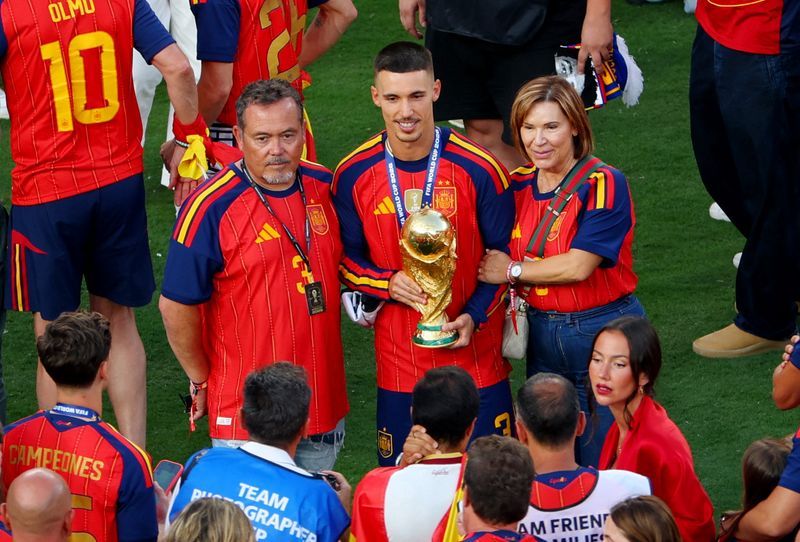
Spain claimed the World Cup trophy on Sunday with a 1-0 victory over Argentina that embodied everything the Spanish footballing philosophy represents: patience, collective purpose, and an almost reverential treatment of the ball. Playing at East Rutherford, New Jersey, Luis de la Fuente's squad did not deviate from their fundamental identity to win the tournament's most important match. Instead, they reaffirmed it, executing their possession-based approach with such discipline that Argentina found itself reduced to a single off-target shot deep into extra time while Spain orchestrated play like a nation protecting its most precious asset.
The decisive moment itself carried symbolic weight. Nico Williams and Ferran Torres, both substitutes, combined to produce the winning goal—the third instance in the knockout stages where Spain's bench had delivered a knockout blow. This recurring pattern reveals something essential about De la Fuente's construction. Rather than assembling a team built around individual brilliance, he has crafted an institution where players are largely interchangeable components within a larger system. The bench players understood the tactical requirements and rhythms so thoroughly that they could step in and perform with the same fluency as their starting counterparts, suggesting a depth of preparation and philosophical alignment uncommon in modern football.
The statistical dominance tells only part of the story. Spain controlled the ball for more than 65 percent of the match, created 12 shots on target, and completed more than twice as many passes as Argentina. Yet these numbers, while impressive, undersell the true nature of Spanish superiority. Argentina's desperate search for openings never materialized into genuine chances until the closing stages. The Spanish approach was neither pretty nor relentless in the manner of traditional attacking football; it was methodical, suffocating, and ultimately triumphant through sheer organizational coherence.
One weakness persisted despite the victory. Spain's chronic shortage of a traditional, prolific centre forward meant that for all their dominance, they created more opportunities than they converted. The absence of a ruthless finisher remains their vulnerable point in an otherwise comprehensive defensive and midfield structure. Yet this single flaw proved inconsequential, masked entirely by the team's collective efficiency elsewhere. Where other nations might have crumbled under the pressure of near-miss after near-miss, Spain maintained composure and continued executing their system, secure in the knowledge that opportunities would eventually translate into goals.
The tournament accolades further emphasized Spain's commitment to collective success over individual stardom. Pau Cubarsi won Best Young Player, Unai Simon took Best Goalkeeper, and Rodri earned Most Valuable Player—a clean sweep that highlighted the breadth of quality across the squad. France's Kylian Mbappe captured the Golden Boot, a consolation that actually strengthened the narrative of Spanish football. Spain's eight-goal contribution came from eight different players, mirroring their European Championship triumph in 2024 when 10 different scorers contributed 16 goals across the tournament. This distributing of goals across the roster stands in stark contrast to football's modern tendency toward reliance on single dominant scorers.
Spain's achievement extends beyond this single tournament. The victory stretched their unbeaten run to 38 matches, surpassing Italy's previous record and underscoring three consecutive years of sustained excellence in international football. This consistency suggests that their success is not dependent on individual tournaments or lucky draws, but rather reflects a sustained period of dominance built on methodical development and unwavering tactical philosophy. De la Fuente's steady hand throughout this period has proven crucial, particularly given that he inherited a programme questioning its direction after previous tournament disappointments.
The manager himself represents a vindication of patience in the modern era. Spanish media once questioned his pedigree when he took charge, reducing his name to mockery as Luis de la "Who?" after years spent primarily in the Spanish Football Federation's youth development programmes. Yet that very background—developing young talent systematically over years rather than decades—proved invaluable. He understood player development at the deepest level, could identify potential early, and possessed the patience to nurture young talent toward tournament readiness. By turning that apprenticeship into world football's greatest prize, De la Fuente has demonstrated that domestic experience and youth-system knowledge can rival the glamour traditionally associated with club football stardom.
Beyond the tactical and personnel considerations, Spain's World Cup triumph carries profound meaning for the nation itself. The squad represents a geographical and cultural mosaic reflecting Spain's fundamental composition. Players from the Basque Country—Mikel Oyarzabal, Unai Simon, and Mikel Merino—share the pitch with Borja Iglesias from Galicia, Ferran Torres from Valencia, Rodri from Madrid, Fabian Ruiz and Gavi from Andalucia, and Pedri from the Canary Islands. Nine players originated from Catalonia, including Cubarsi and Marc Cucurella, while Lamine Yamal and Nico Williams represent the new Spain shaped by immigration and multicultural integration. This diversity of origin mirrors the historical reality of Spain as a confederation of distinct regions, each possessing its own language, culture, and identity.
Spain's historical strength has always derived from this internal diversity, yet this same quality has frequently become a source of political tension and fragmentation. Regional identities—Basque, Catalan, Galician, Andalusian—sometimes feel at odds with a unified national concept. These differences have shaped Spanish politics for centuries, occasionally erupting into serious dispute over autonomy, representation, and cultural recognition. Football, however, achieved on Sunday what political dialogue often struggles to accomplish. For one evening, the differences did not dissolve but rather ceased functioning as obstacles. Instead, regional pride channelled itself into collective national purpose, with each player's distinct cultural background adding colour and texture to a unified whole rather than creating division.
This moment of national cohesion, achieved through sport rather than politics, carries lessons worth examining. Spain demonstrated that diversity need not be divisive if organized around shared purpose and clear principles. The team's success emerged not despite its regional composition but through harnessing that composition within a coherent framework. Each player brought the particular qualities, technical sophistication, and mentality shaped by their regional footballing culture, yet all subordinated these individual characteristics to a larger team philosophy. The result was a side more complete and more resilient than any homogeneous group could have been.
For Malaysia and broader Southeast Asia, Spain's example offers relevant perspective. Regional and cultural diversity characterizes the entire region, with nations comprising multiple ethnic groups, religions, and traditions. Spain's success in channelling this diversity into collective achievement without suppressing individual identity suggests pathways for thinking about national unity that moves beyond mere tolerance toward genuine integration of distinctive strengths. The Spanish model, while dependent on specific historical and footballing contexts, demonstrates that diversity managed well becomes an asset rather than a liability.
Spain's World Cup triumph ultimately transcends sport. It showcases how an organization built on clear principles, patient development, and genuine respect for collective over individual can achieve excellence while simultaneously embodying and reflecting the society it represents. In a football landscape increasingly dominated by financial power and individual superstardom, Spain's methodical, ball-worshipping approach to winning the world's greatest tournament stands as a powerful counterargument to prevailing trends. They proved that the beautiful game can simultaneously be beautiful football and beautiful unity.

