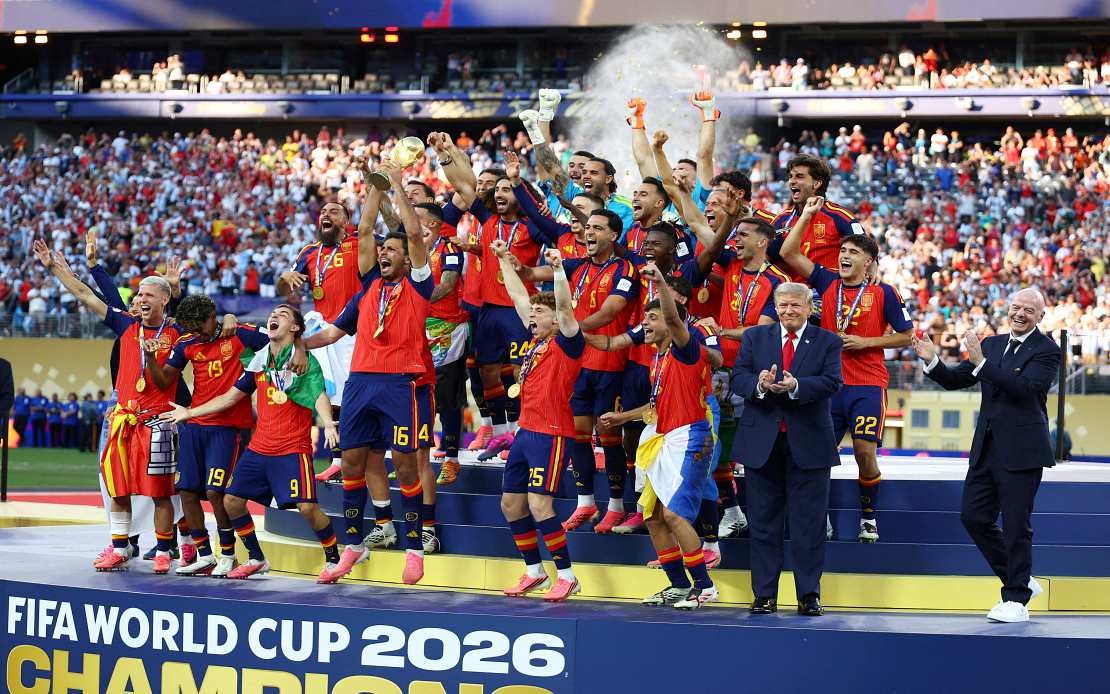
Spain's triumphant national football team touched down in Madrid on Monday afternoon to begin an extended celebration of their second men's World Cup title, with organisers preparing for what officials anticipated would be one of the capital's largest public gatherings in recent memory. The squad, captained by Rodri, was scheduled to land at Madrid airport at 12:50 pm local time, marking the beginning of a carefully orchestrated day of events designed to honour the players and allow the Spanish public to express their joy at the historic achievement.
The sporting victory itself came on Sunday in the United States, where Ferran Torres secured the championship with a decisive extra-time goal against Argentina. The triumph represented Spain's second World Cup title, cementing the nation's status as one of international football's premier powers. The final itself drew significant attention from Spain's political leadership, with Prime Minister Pedro Sánchez and King Felipe VI both attending the match in New Jersey to witness the victory firsthand. The Prime Minister subsequently posted on social media platform X, declaring "We Are World Champions. Our national team is tremendous. Thanks, Team," capturing the collective sentiment sweeping across Spain.
Monday's itinerary reflected the magnitude of the achievement, with the Spanish government and football authorities coordinating multiple events throughout the afternoon and evening. Following their airport arrival, the team was scheduled to proceed to the Royal Palace, where King Felipe VI would host an official reception. This formal acknowledgment of the victory carried particular significance given the Spanish monarchy's traditional role as custodian of national pride and continuity. The palace reception would provide an appropriate setting for the head of state to honour the players and coaching staff personally, a gesture that underscored the World Cup triumph's importance to the entire nation.
The centrepiece of Monday's celebrations was an open-top bus parade through Madrid's streets, a tradition that allows supporters to line the city's thoroughfares and greet their heroes. Organisers expected the crowds lining the parade route to number in the hundreds of thousands, transforming Madrid's urban landscape into a sea of red and gold Spanish flags and enthusiastic supporters. Such celebrations have become defining moments in Spanish sporting culture, occasions when the normal rhythm of city life pauses to acknowledge extraordinary achievement. The parade represented a collective catharsis for millions of Spaniards who had invested emotional energy in their national team's campaign.
The day's events were designed to culminate at Cibales Square, where officials scheduled a major public show to commence at 6 pm, with the team expected to arrive approximately three hours later. This timing allowed for the construction of an elaborate stage and technical setup befitting the occasion, while also extending the celebration period to enable different groups of supporters to participate across the extended timeframe. The square has historically served as a gathering point for significant national celebrations in Madrid, making it an appropriate venue for honouring World Cup success.
Defender Marc Cucurella articulated the players' perspective on returning home, expressing genuine enthusiasm about celebrating with Spanish supporters who had been unable to travel to the United States for the final. His comments reflected an understanding among the squad that their achievement belonged not merely to the players themselves but to the broader Spanish population that had supported the team throughout the tournament. Cucurella's assertion that the team "deserved a good celebration" acknowledged the considerable effort, dedication, and pressure that accompanied competing at the highest level of international football, where margins between success and failure are often measured in millimetres and split seconds.
For Malaysian and Southeast Asian observers, Spain's World Cup victory and the accompanying national celebration offer insights into how established football powerhouses consolidate their dominance and engage with their public following major triumphs. The coordination between government institutions, the monarchy, and sporting authorities demonstrates the integration of football success into broader national narrative and identity construction. The scale of Madrid's planned celebrations also illustrates the cultural significance football holds in European societies, where international tournament success transcends mere sporting achievement to become a vehicle for expressing national pride and unity.
The presence of both the Spanish Prime Minister and the King at the World Cup final underscored football's unique position within Spanish political and social life. Unlike many other sporting competitions, the World Cup commands the attention of the highest levels of government and state institutions, reflecting both the tournament's global significance and its capacity to mobilise popular sentiment across all social strata. Spain's success in winning the tournament represented vindication of the tactical and philosophical approaches embedded within Spanish football over the preceding decade, periods during which the national team had occasionally disappointed supporters in major competitions.
The narrative of Spain's World Cup victory also carried implications for football development and methodology throughout the broader European context. The team's ability to secure victory demonstrated the continued competitiveness of traditionally dominant football nations and the effectiveness of their player development systems and coaching philosophies. For emerging football nations across Southeast Asia working to improve their international standing, Spain's example provides both inspiration and a sobering reminder of the resources and institutional commitment required to compete consistently at the world's highest level.
Monday's celebrations represented more than merely festive occasions; they constituted a moment when Spanish national identity found expression through sporting triumph. The coordination of events—from the royal palace reception through the open-top bus parade to the Cibales Square festivities—created a structured opportunity for millions of Spaniards to participate in collective acknowledgment of achievement. Such moments, though ostensibly temporary, frequently leave lasting impressions on national consciousness and become reference points in cultural memory for generations of supporters who experience them.

