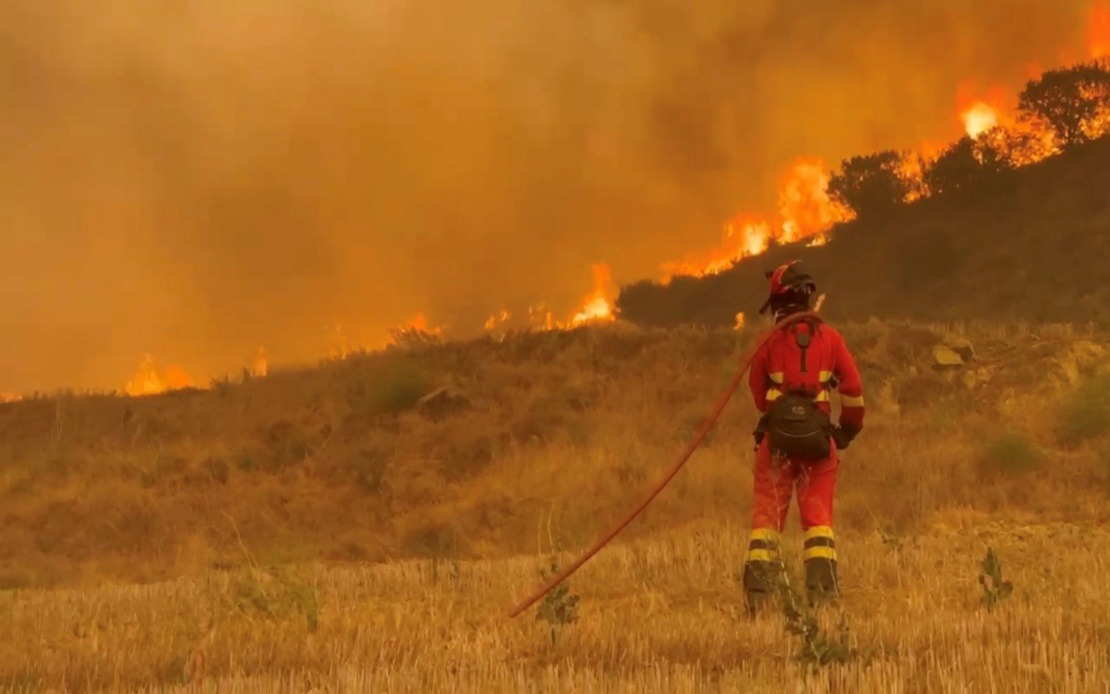
Spain is grappling with its most destructive wildfire this year, an emergency unfolding across the northeastern province of Zaragoza where flames have consumed approximately 12,000 hectares of terrain. The disaster has prompted authorities to evacuate more than 1,100 people from affected communities, with firefighting efforts intensifying as the blaze remains highly active and continues to spread. The incident underscores the mounting vulnerability of southern European nations to wildfires, a challenge that carries lessons for Mediterranean regions and climate-exposed areas globally, including parts of Southeast Asia monitoring similar environmental trends.
The fire ignited on Wednesday within the Cinco Villas region of Zaragoza and has since expanded dramatically, covering a perimeter spanning approximately 60 kilometres. Rather than slowing, the flames demonstrated significant progression overnight into Friday, prompting authorities to characterize the situation as remaining "quite active" and unpredictable. The scale of evacuation affected six municipalities in total—five located within Zaragoza itself and one across the border in neighbouring Navarre—reflecting how rapidly the fire spread beyond initial jurisdictional boundaries and challenged regional coordination efforts.
The emergency response mobilized substantial resources by Thursday, with some 400 ground-based firefighters and 19 aircraft engaged in suppression operations. Emergency personnel concentrated overnight defensive efforts on the municipality of Uncastillo, where structural protection became the priority as complete containment proved elusive. Infrastructure damage compounds the displacement challenge, with multiple road networks remaining closed throughout the affected zone, disrupting commerce and complicating both evacuation routes and supply access. However, authorities managed to restore electrical service to all impacted towns relatively swiftly, mitigating secondary humanitarian complications that extended power outages might otherwise create.
The Zaragoza fire represents only one of multiple simultaneous crises confronting Spanish firefighting capacity. A second wildfire ravaged the La Mierla area in Guadalajara province, burning approximately 900 hectares and triggering evacuations and lockdown measures in neighbouring communities. The regional administration sought reinforcement by requesting deployment of Spain's Military Emergency Unit, which dispatched around 100 additional personnel to bolster firefighting operations. This dual-front scenario strained national resources and illustrated how seasonal conditions can generate cascading emergencies across geographically dispersed areas.
A third active fire near Lozoyuela, situated north of Madrid, added to the emergency burden, though emergency services indicated this blaze was progressing more favourably. Nevertheless, it remained neither fully controlled nor completely contained at the reporting stage, maintaining uncertainty about its ultimate trajectory. The need to manage three major fires simultaneously exposed the limitations of rapid resource allocation, even within a well-organized European nation accustomed to seasonal wildfire management.
Environmental factors converged to create conditions favouring rapid fire spread across northeastern Spain. Elevated temperatures, powerful winds, and exceptionally low humidity levels combined with abundant vegetation that flourished following an unusually wet spring. The paradox of excessive winter and spring precipitation leading to dense vegetation growth, which subsequently becomes highly flammable under summer heat stress, presents a recurring challenge for fire management strategies throughout Mediterranean climates. Climate scientists increasingly recognize this pattern as a destabilizing consequence of shifting weather extremes.
Expert analysis extends beyond immediate meteorological conditions to identify systemic vulnerabilities amplifying wildfire risk. Climate change itself emerges as a fundamental driver, fundamentally altering temperature patterns, precipitation distribution, and atmospheric moisture dynamics across southern Europe. Simultaneously, the abandonment of rural agricultural and forestry practices has allowed vegetation to accumulate unchecked in many regions, creating denser fuel loads that burn with greater intensity when ignition occurs. This intersection of global environmental change and local demographic patterns represents a critical vulnerability that communities throughout the Mediterranean and beyond must address strategically.
Investigative elements further complicated the emergency landscape when authorities apprehended a man suspected of deliberately initiating the Madrid-region fire, revealing that some wildfires stem not merely from natural hazard dynamics but from deliberate human action. The regional government committed to participating as a civil party in subsequent legal proceedings, signalling institutional determination to pursue accountability. The criminalization of arson underscores how wildfire causation involves multiple pathways—from environmental conditions enabling rapid spread, to human behaviour deliberately or negligently igniting blazes—requiring multifaceted policy responses.
The Spanish wildfire episodes carry resonance for Southeast Asian policymakers and communities confronting escalating fire risks. While Malaysia and neighbouring nations typically experience fire pressures driven by agricultural clearing and land development rather than summer heat waves, the underlying principles of vegetation management, rural depopulation, and climate sensitivity remain applicable. The mass evacuation protocols deployed in Zaragoza, the international mutual aid mechanisms embedded within Spanish and European emergency systems, and the forensic investigation linking human culpability to environmental catastrophe offer instructive models for regional capacity building.
These concurrent fires demonstrate how environmental stress, demographic change, and climate volatility interact to create compound disasters that stretch institutional response capacities. Spanish authorities deployed coordinated military and civil emergency systems, yet even well-resourced nations struggle when multiple major incidents overlap temporally. The challenge intensifies in regions with less developed emergency infrastructure or constrained budgetary allocation to wildfire preparedness, suggesting that preventing rather than merely responding to major blazes should command elevated strategic priority across vulnerable territories.

