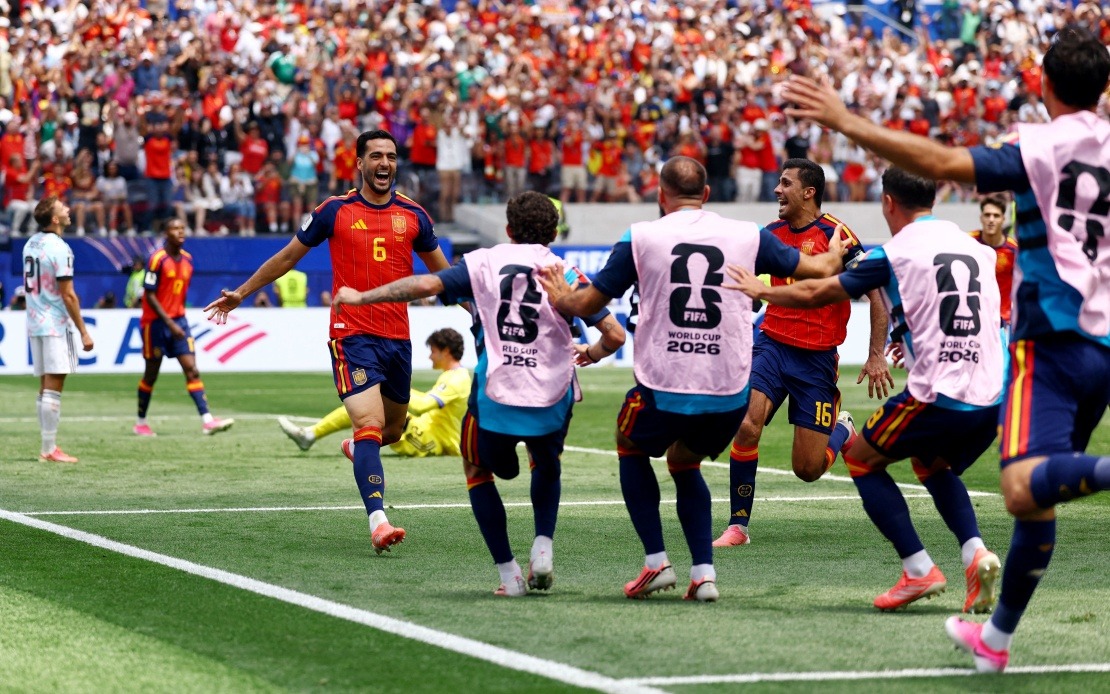
Mikel Merino's clinical finishing from the bench has become a defining feature of Spain's World Cup campaign, and the Arsenal midfielder struck again on Friday evening to deliver the defending European champions a passage into the semi-finals. Spain's 2-1 triumph over Belgium at SoFi Stadium in Inglewood, California sets up a tantalising showdown against France—a meeting that will echo their Euro 2024 semi-final encounter which La Roja won decisively. For Spain, the prospect of reaching their first World Cup final since their triumphant 2010 campaign in South Africa now lies within grasp, though they must navigate past one of football's traditional powerhouses.
Fabián Ruiz provided Spain with an early advantage when he broke the deadlock in the 30th minute, establishing a platform from which the Europeans could control proceedings against a Belgian outfit severely undermined by injury. That opening goal proved significant not merely for its contribution to the scoreline, but for what it represented in the context of Spain's defensive resilience. Goalkeeper Unai Simón had maintained an extraordinary record in World Cup competition, finally surrendering his first goal after an astonishing 649 minutes spread across two tournament campaigns. Charles De Ketelaere's equaliser for Belgium represented a moment of vulnerability for the Spanish rearguard, though it would prove temporary rather than reflective of deeper defensive shortcomings.
Belgium's preparation for the quarter-final clash was severely compromised by a cascade of injuries that depleted their midfield resources. Captain Youri Tielemans was forced to withdraw during the warm-up period with what appeared to be a hamstring complaint, compounding the absence of Amadou Onana, whose knee ligament tear had already ruled him out of the competition. These absences robbed Belgium of crucial creative and defensive machinery, leaving them vulnerable to Spain's measured attacking approach. The injury toll worsened when Thibaut Courtois, Belgium's experienced goalkeeper, suffered an injury in the 71st minute that forced him to leave the field, his distress evident to all observers.
With Courtois unable to continue, Manchester United's Senne Lammens was thrust into the demanding role of goalkeeper at short notice. The substitute custodian would prove unable to rise to the occasion when it mattered most. Spain, reinvigorated by fresh attacking options introduced through substitutions including Nico Williams and Merino, began to suffocate their opponents in the closing stages. The decisive moment arrived in the 88th minute when Pau Cubarsi launched a long-range effort that Lammens poorly handled, spilling the ball into a dangerous area where Merino capitalised with a finish into the roof of the net.
Merino's critical contribution echoes his performance in the previous knockout round against Portugal, where he similarly emerged from the bench to deliver a match-winning moment. This pattern suggests a player thriving under pressure circumstances, with the confidence and composure to execute when opportunities materialise. For Spain's head coach, the tactical flexibility to deploy such impactful substitutes represents a significant strategic advantage as the tournament progresses, providing attacking options when the opposition's defensive structures show signs of fatigue.
The upcoming semi-final encounter with France carries considerable historical weight and sporting significance. France remains among the tournament's most experienced and talented squads, having claimed World Cup victories in 1998 and 2018, with a runners-up finish to Argentina in the previous World Cup cycle. However, the French acknowledge that Spain represents a qualitatively different challenge compared to their path through the tournament thus far. The Spanish team's dominance throughout their quarter-final against depleted opposition, combined with their Euro 2024 pedigree and their victory over France in that continental semi-final, establishes them as formidable opponents despite France's status as tournament favourites.
Geographically, the semi-final will be contested near Dallas, Texas, maintaining the tournament's American base for this penultimate stage. The venue decision carries practical implications for both teams' preparation and travel logistics in the final crucial week before the ultimate decider. For Malaysian and Southeast Asian observers, Spain's progression represents the advancement of a side built on technical excellence, possession-based football, and intelligent movement—principles that have long defined the Spanish approach to the game.
Spain's World Cup history provides important context for their current aspirations. Since their sole world championship in 2010, they have remained among the game's elite despite varying tournament performances. Their evolution as a squad, moving beyond the tiki-taka blueprint that defined their dominant era, demonstrates the capacity for tactical adaptation while maintaining fundamental principles. The current generation of Spanish players represents a blend of youth and experience, with emerging talents complementing established figures in constructing a competitive unit capable of competing across multiple competitions simultaneously.
France's path to the semi-final reflects their status as tournament favourites, though expectations in knockout football create their own psychological pressures. The French have demonstrated capability to overcome challenges, yet the psychological edge Spain possesses from their Euro 2024 success cannot be dismissed. As these two European heavyweights prepare for their encounter, the wider football world recognises the quality of either potential finalist, with each representing elite-level modern football and contrasting but complementary approaches to the game's fundamental tactical questions.

