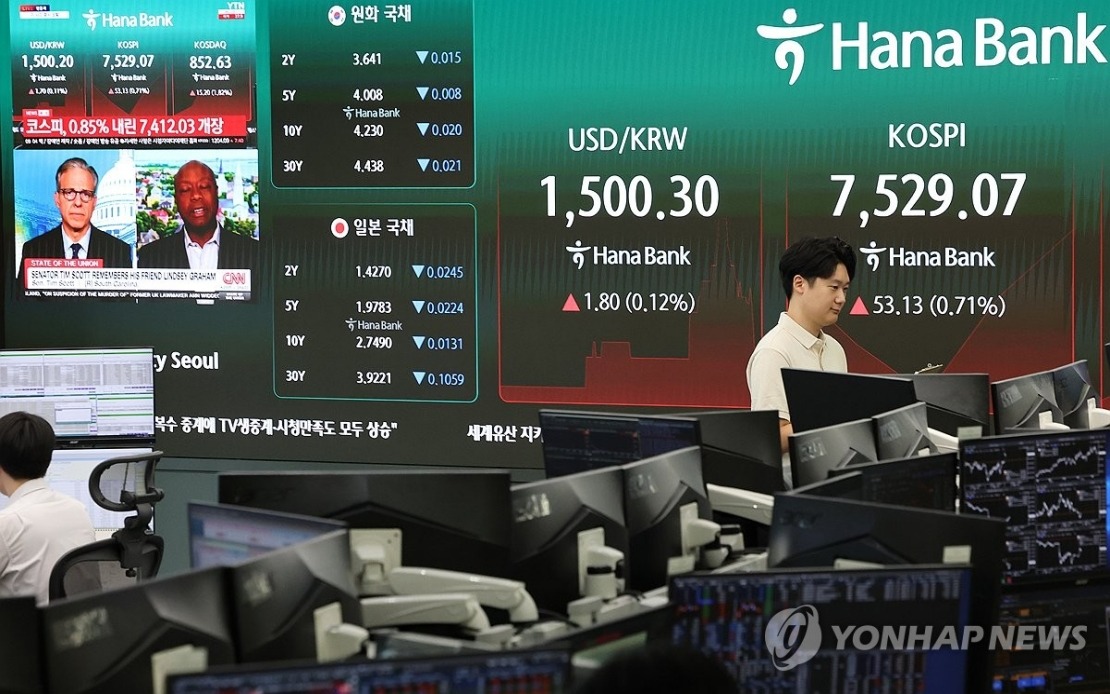
South Korea's bourse operator moved to stabilise market conditions on Monday by implementing a circuit breaker mechanism for the country's flagship stock index following a significant sell-off driven by renewed geopolitical tensions in the Middle East. The Korea Exchange halted trading in KOSPI-listed shares for twenty minutes after triggering the automatic circuit breaker at approximately 1:28 p.m. local time, when the Korea Composite Stock Price Index shed more than eight percent from the previous session's closing level.
The sharp decline in Seoul's benchmark equity gauge reflected investor unease stemming from fresh military confrontations between the United States and Iran, particularly concerning their competing claims over control and passage rights through the Strait of Hormuz. This strategically vital waterway channels approximately one-third of global seaborne traded oil, making any disruption to shipping lanes a matter of significant concern for energy-dependent economies across Asia, including regional players like South Korea, Japan, and Singapore. The heightened tensions raised fresh concerns among market participants about potential supply chain disruptions and energy price volatility that could ripple through Asian economies.
The activation of the circuit breaker mechanism represents a standard protective measure employed by modern financial exchanges to prevent panic selling and excessive volatility during periods of acute market stress. When equity indices decline beyond predetermined thresholds within compressed timeframes, these automated halts provide investors and market participants with breathing space to reassess fundamentals and rebalance portfolios in a more orderly fashion. The twenty-minute trading suspension allows institutional investors, fund managers, and retail traders to step back from immediate reaction-driven decisions and permits news dissemination to be fully absorbed by market participants globally.
This marked the seventh instance during 2024 that the Korea Exchange has deployed its circuit breaker system, suggesting that volatility remains elevated throughout the year due to recurring geopolitical flashpoints and macroeconomic uncertainties affecting global equity markets. For Malaysian investors and financial institutions with exposure to Korean equities or regional stock markets, such episodes underscore the interconnected nature of modern financial systems and the speed with which negative sentiment in one region can rapidly transmit to others. The frequency of these circuit breaker activations serves as a barometer of broader market anxiety and heightened sensitivities to geopolitical developments.
South Korea's economy remains particularly vulnerable to Middle Eastern supply disruptions given its substantial reliance on oil imports to fuel its industrial base and power generation infrastructure. Approximately ninety percent of South Korea's petroleum consumption depends on imports, with significant volumes sourced from Middle Eastern producers. Any sustained escalation in US-Iran hostilities carries the potential to disrupt global energy markets and inflate crude oil prices, which would cascade through Korean manufacturing sectors including petrochemicals, automotive, and heavy industries that form the backbone of the country's export-dependent economy.
The KOSPI's sharp decline also reflects broader concerns about the trajectory of global economic growth and corporate earnings prospects if geopolitical instability constrains energy supply or elevates input costs for manufacturers. South Korean conglomerates with substantial international operations would face margin compression if energy and transportation costs spike, potentially impacting dividend yields and capital allocation decisions. Regional equity investors with diversified Southeast Asian and Northeast Asian portfolios must contend with these cross-border transmission mechanisms as geopolitical risks in distant regions can swiftly erode valuations.
The circuit breaker mechanism implemented by the Korea Exchange forms part of a coordinated global approach to equity market regulation adopted by major bourses following the 2008 financial crisis and subsequent episodes of extreme volatility. Stock exchanges from New York to Hong Kong to Singapore maintain similar circuit breaker protocols calibrated to their respective market characteristics and trading volumes. These safeguards remain essential infrastructure for maintaining orderly price discovery and preventing cascading forced selling that could transform temporary dislocations into systemic crises.
For Southeast Asian markets including Malaysia's Bursa Malaysia, developments on the Korean exchange carry indirect but meaningful implications. Many Malaysian institutional investors, pension funds, and insurance companies maintain exposure to Asian equity markets as part of their diversification strategies. Sharp sell-offs in major regional bourses can trigger contagion effects as fund managers rebalance portfolios, raising demand for liquidity and potentially pressuring smaller equity markets with more limited trading depth. Understanding interconnections between major East Asian exchanges and regional capital flows remains critical for Malaysian investors navigating increasingly complex cross-border investment landscapes.
The immediate trigger for Monday's volatility—renewed US-Iran military confrontation—points to an underlying geopolitical fault line that appears unlikely to be fully resolved in the near term. Periodic escalations and de-escalations between Washington and Tehran have become a recurring feature of Middle Eastern politics, creating an environment of persistent uncertainty for energy markets and equity investors globally. This structural instability means that financial market participants must maintain heightened vigilance toward developments in the region, recognising that seemingly localised conflicts can generate material impacts on equity valuations and risk appetite.
Government policymakers and financial regulators across Southeast Asia will likely observe South Korea's experience with circuit breaker implementations, given that Malaysia and other regional exchanges face similar challenges in managing volatility during periods of geopolitical stress. The effectiveness of automatic trading halts in preventing panic-driven market deterioration remains subject to ongoing evaluation by financial authorities worldwide. As markets become increasingly technologically sophisticated and trading occurs at microsecond intervals, exchange operators must continually refine their circuit breaker mechanisms to balance the competing objectives of preventing systemic risk whilst preserving market liquidity and price discovery.
Looking forward, the frequency of circuit breaker activations in Seoul and other major Asian exchanges will likely persist as long as geopolitical uncertainties remain elevated and macroeconomic headwinds continue to weigh on global growth outlooks. Investors across the region should recognise that such volatility, whilst unsettling in the short term, reflects the normal functioning of markets attempting to incorporate new information about risks and opportunities. For Malaysian investors with regional exposure, maintaining appropriately diversified portfolios and understanding the mechanics of circuit breaker systems provides essential grounding for navigating periods of elevated market turbulence.

