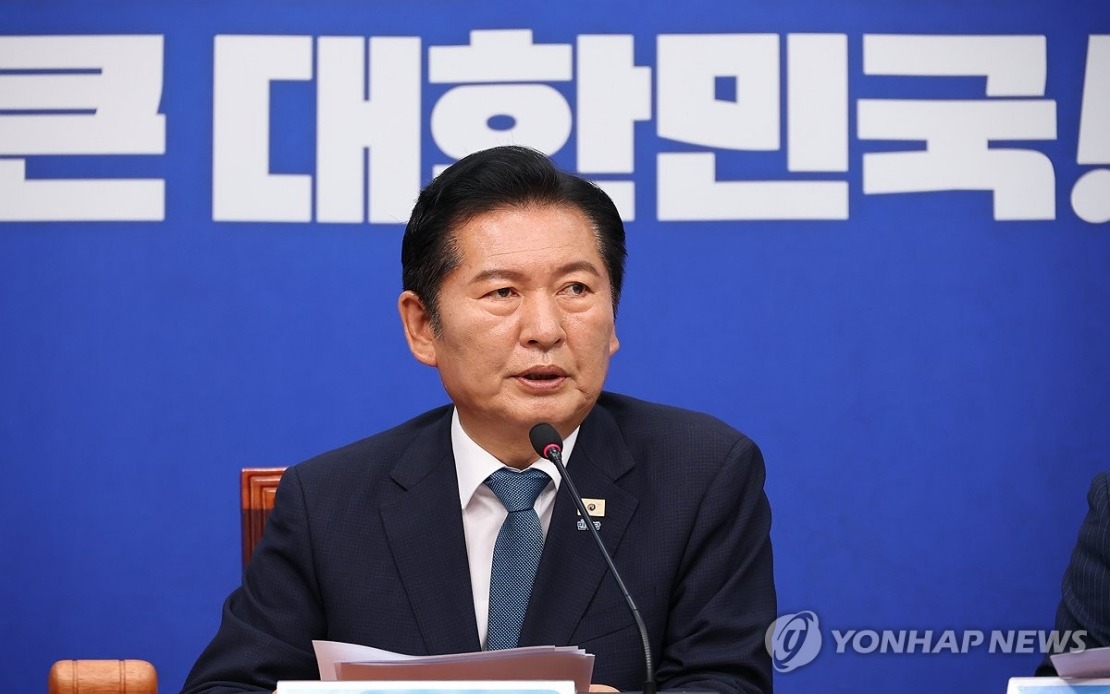
South Korean ruling party chief Jung Chung-rae has stepped down from his position as chairman of the Democratic Party, a maneuver widely interpreted as a tactical move to clear the way for him to contest the party's upcoming national convention scheduled for August 17. The lawmaker made his announcement during a meeting of the party's supreme council at the National Assembly on Wednesday, marking a significant shift in the internal political dynamics of President Lee Jae-myung's administration.
In his resignation speech, Jung reflected candidly on the personal toll of his leadership tenure, acknowledging the psychological strain of navigating the party's fractious politics. He described spending sleepless nights engaged in self-examination about his political career and the direction he had taken the party, suggesting that his decision came after substantial internal deliberation about both personal sustainability and party interests. His willingness to publicly articulate this emotional dimension of political leadership was notable in the typically formal South Korean political context.
Throughout his term as party chairman, Jung emphasized his unwavering commitment to supporting the Lee Jae-myung administration and facilitating harmonious collaboration between the ruling party, government apparatus, and presidential office. He positioned himself as having worked selflessly to maintain unity despite operating in a deeply contested political environment, framing his tenure as one of service despite considerable obstacles. The rhetoric underscored the persistent friction that has characterized Democratic Party operations, particularly between different ideological and factional camps vying for influence over policy direction.
The circumstances surrounding Jung's departure reveal deeper fault lines within the ruling party. Certain pro-Lee faction members have leveled criticism that Jung has prioritized the preferences of his own hard-line supporters over maintaining coherent alignment with the president's broader agenda. This tension between factional loyalty and administrative cohesion has created an untenable position for the party chairman, caught between competing power centers. The criticism suggests that Jung's leadership style, while pleasing to certain party constituencies, has been perceived as working at cross-purposes with presidential priorities on key policy matters.
With Jung's resignation, Democratic Party floor leader Han Byung-do will assume the role of acting party leader, serving in a caretaker capacity until the convention concludes in mid-August. This arrangement allows the party to maintain operational continuity while the broader leadership race unfolds in the background, though Han's limited mandate ensures that major policy initiatives will likely remain on hold pending the outcome of the convention.
The August convention is shaping up as a notably competitive three-way contest that will test the party's internal balance of power. Beyond Jung, the race includes Prime Minister Kim Min-seok, who represents the most institutional connection to President Lee and embodies the administration's formal authority structure. Kim's candidacy would effectively represent continuity with existing presidential preferences and government policy direction. The third major contender is Song Young-gil, a former party leader whose political standing remains substantial despite his earlier tenure in party leadership.
Song's positioning in the race carries particular strategic significance. According to Democratic Party lawmaker Park Jie-won, who disclosed details to radio broadcaster CBS, Song has indicated to President Lee his intention to enter the race. More intriguingly, Song has suggested the possibility of consolidating his candidacy with Kim, a move that would represent a significant strategic alliance. Such a merger would effectively create a unified pro-administration bloc competing against Jung's factional support base, fundamentally altering the calculus of the convention race.
For Malaysian and Southeast Asian observers, this intra-party struggle within South Korea's ruling Democratic Party illustrates the persistent tension between centralized executive authority and factional party politics that characterizes many East Asian democracies. The machinations surrounding Jung's resignation and the emerging convention contest demonstrate how deeply rooted factional divisions can complicate even ruling parties' ability to function coherently. Unlike Malaysia's more structured coalition politics, South Korean ruling parties often grapple with these internal competitions while simultaneously governing, creating potential governance instability.
The timing of these leadership changes also carries implications for South Korea's political trajectory over the coming months. The convention outcome in August will influence whether the Democratic Party can achieve greater internal unity or whether factional tensions will persist and potentially undermine the administration's legislative agenda. Given the narrow margins by which many Asian governments operate in parliament, internal party discord can have outsized consequences for policy implementation and executive effectiveness.
The resignation itself, while framed as Jung's personal decision, should be understood within the context of these broader power struggles. By stepping down voluntarily rather than being forced out, Jung preserves his political standing and avoids the appearance of factional defeat, while simultaneously repositioning himself for the convention contest. This calculated approach reflects sophisticated understanding of South Korean political dynamics, where the appearance of dignity and voluntary action often carries substantial symbolic weight.
The Democratic Party's internal instability contrasts sharply with the external pressures facing the Lee administration, including economic concerns and North Korean military activities. The ruling party's ability to maintain sufficient cohesion to pass legislation and support government initiatives will depend significantly on how effectively the convention resolves these underlying factional tensions. Should the convention result in a narrow victory for any candidate, the defeated factions may continue to obstruct party unity, potentially complicating governance.