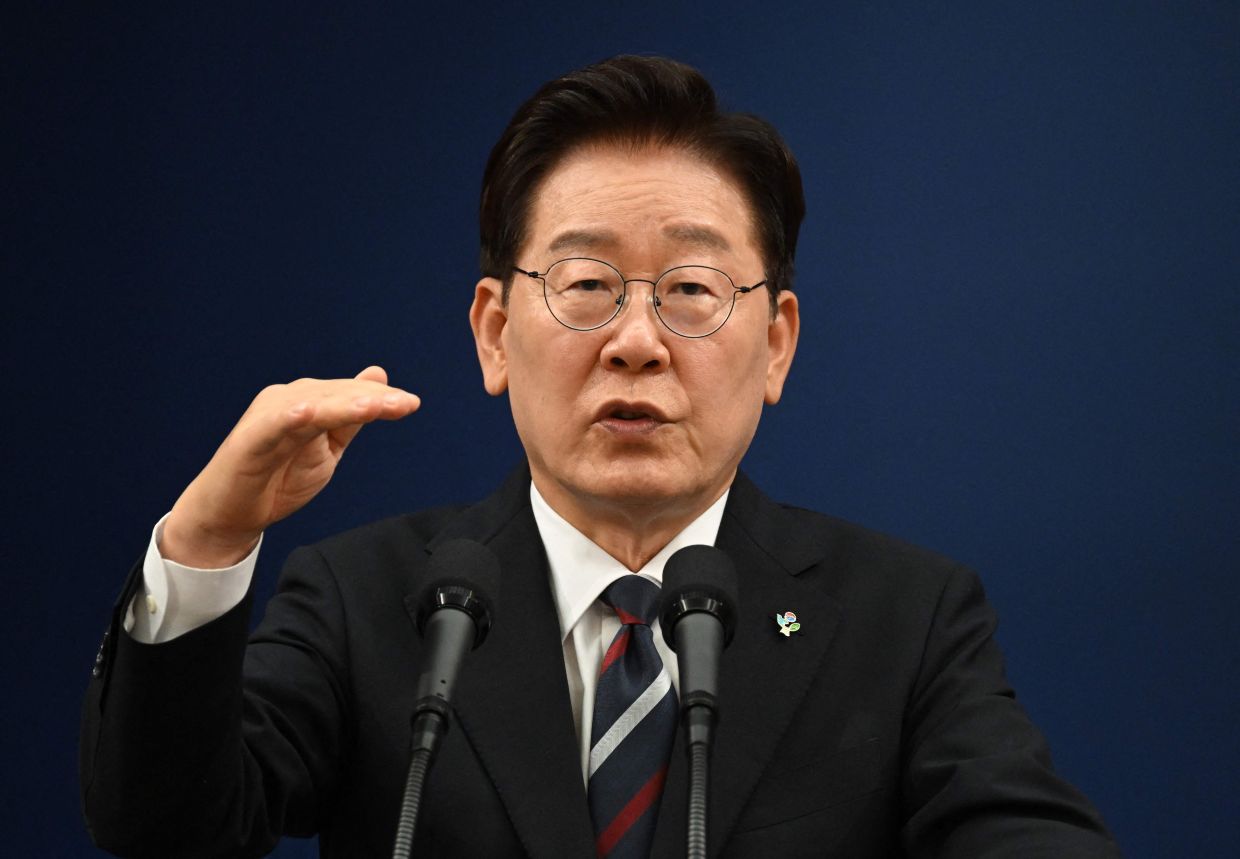
South Korean President Lee Jae Myung has crossed a critical political threshold, with his approval rating slipping into negative territory for the first time since his inauguration in early June 2025. According to polling data released on June 22 by local research firm Realmeter, just 46.7 per cent of respondents viewed his performance favourably, while 49.7 per cent held unfavourable opinions—a reversal that underscores mounting public dissatisfaction with his fledgling administration and raises questions about its political durability in the critical months ahead.
The erosion of presidential support has been remarkably swift. Lee's approval rating stood at a robust 60.5 per cent in mid-May, but has experienced a steady decline over five consecutive weeks. The trajectory from 59.3 per cent to 59.1 per cent to 55.2 per cent and finally to 46.7 per cent reveals a pattern of consistent deterioration that extends well beyond normal polling fluctuations. This marks the first occasion his rating has fallen below the psychologically significant 50 per cent benchmark, a milestone that typically signals serious trouble for any sitting president.
Comparative historical context demonstrates that Lee's struggles, while acute, are not unprecedented in South Korean politics. His predecessor Yoon Suk Yeol experienced a similar crossover into negative approval territory far more rapidly, achieving this dubious milestone within merely six weeks of taking office in June 2022. Former President Park Geun-hye required approximately 16 months before her disapproval rating overtook her approval rating, while Moon Jae-in's equivalent threshold came roughly 19 months into his presidency. By this standard, Lee's five-week trajectory to negative approval ratings represents a genuinely precipitous decline, suggesting that the specific combination of factors driving public discontent may be particularly potent.
The primary culprits behind this political deterioration are twofold and interconnected. The immediate trigger involves the ballot shortage crisis that marred South Korea's June 3 local elections, an administrative failure that sparked widespread public anger and calls for accountability. Simultaneously, the ruling Democratic Party of Korea has descended into acrimonious internal disputes over its leadership succession, with the party's convention scheduled for August 17 creating factionalism that undermines governmental coherence and projects weakness to voters. Realmeter analysts specifically cited "growing demands for accountability following the election management fiasco and escalating infighting within the ruling party" as the primary drivers of approval erosion.
Geographic analysis reveals that Lee's political vulnerabilities are particularly acute in regions where his party should theoretically enjoy strong support. In the traditionally conservative strongholds of Daegu and North Gyeongsang Province, his approval rating experienced the most dramatic collapse, plummeting 9.9 percentage points to merely 34.6 per cent. This erosion of support among the president's natural constituency is particularly telling. Meanwhile, the Greater Seoul metropolitan area—which encompasses Incheon, Gyeonggi Province, and Seoul proper—has proven less than welcoming, with approval ratings dropping to 44.8 per cent and 39.8 per cent respectively. These figures suggest that Lee is haemorrhaging support simultaneously among both conservative base voters and moderate urbanites, an extraordinarily difficult political position to remedy.
Demographic fractures further compound the presidential predicament. Among voters identifying as moderates, approval declined 4.9 percentage points to 47.5 per cent, indicating that the crucial centre of the political spectrum is shifting away from the administration. Liberal voters remain relatively supportive at 80.4 per cent, though even this cohort has experienced a measurable 3.2 percentage point decline. Most tellingly, conservative voters—theoretically Lee's bedrock constituency—register a mere 19.8 per cent approval rating, having declined by only 0.7 percentage points. This low floor suggests conservative support has already collapsed to its hard core, with minimal further deterioration possible.
Polling data also identifies asset market inequality as an emerging concern eroding presidential support. Realmeter suggested that "concerns over widening disparities in the asset market appeared to erode support among moderate voters," pointing toward economic grievances extending beyond immediate election administration failures. This finding carries particular relevance for Southeast Asian observers, as similar patterns of concentrated wealth and asset inequality have fuelled political discontent across the region. While Lee's European trip received positive reviews and the Kospi stock index's breakthrough above the 9,000-point mark provided modest positive reinforcement, these achievements have proven insufficient to counterbalance deteriorating public sentiment regarding economic fairness.
The presidential office responded to the approval rating collapse with carefully calibrated humility, with Cheong Wa Dae issuing a statement accepting the numbers and pledging greater attention to public concerns. This measured response reflects political sophistication—excessive defensiveness or dismissal might accelerate further deterioration—though whether rhetorical contrition can arrest the underlying trend remains uncertain. The office framed the decline as reflecting public assessments of both economic conditions and overall governance, suggesting a multi-faceted rather than single-issue problem requiring comprehensive rather than targeted solutions.
Beyond presidential approval, the broader party landscape also reveals Democratic Party recovery even as the ruling coalition weakens structurally. Support for the Democratic Party rose 2.1 percentage points to 40.1 per cent, while the main opposition People Power Party declined 2 percentage points to 42.3 per cent. Realmeter attributed this Democratic Party rebound to what it termed a "crisis-management phase" following a bipartisan agreement to investigate election administration failures. Paradoxically, even as the party experienced internal convulsions over leadership selection, emphasis on unity around governmental success strengthened support among its core base. The opposition People Power Party, meanwhile, faced compounding pressures from ballot shortage controversies intertwined with internal disputes over leadership accountability, resulting in particularly pronounced erosion among younger voters—a 10.5 percentage point collapse among those in their twenties and 5.1 percentage point decline among those in their thirties.
The implications extend beyond immediate Korean politics, resonating throughout East Asia's democratic systems. Lee's predicament illustrates how electoral administration failures and intra-party factionalism can rapidly transform initial goodwill into profound disillusionment. For Malaysia and regional policymakers, the Korean case demonstrates that establishing institutional credibility during foundational governance moments proves critical for long-term political sustainability. The speed at which Lee's honeymoon evaporated—particularly given his substantial May approval ratings—suggests that voters punish administrative incompetence and internal party division severely, potentially more severely than traditional policy disagreements.
Looking forward, the trajectory of Lee's approval rating over the coming weeks will prove crucial for determining whether current trends represent cyclical volatility or structural political realignment. The August 17 Democratic Party convention offers a critical inflection point; successful leadership transition and demonstrated party unity might arrest further deterioration, while continued factionalism could accelerate the decline. For observers across Southeast Asia monitoring presidential approval dynamics and party coherence, South Korea's current political turbulence offers instructive lessons regarding the fragility of newly acquired electoral mandates and the potent combination of administrative failures and internal party conflict in eroding public confidence.