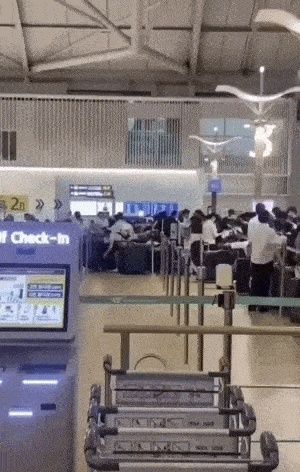
Incheon Airport in Seoul is preparing to strengthen security infrastructure at its check-in counters following a spate of disruptive incidents where suspected Chinese traders, known colloquially as daigou, forcibly bypassed passenger queues, resulting in injuries to airport personnel. The South Korean transport hub announced the planned installation of additional physical barriers after local media highlighted the problem on Sunday, drawing public attention to a growing operational challenge that has tested staff patience and passenger safety protocols throughout July.
The most visible evidence of the problem emerged when a video recording from July 2 went viral on social media, capturing a chaotic scene in Terminal 1's third-floor departure hall. The footage showed dozens of passengers abandoning orderly queue procedures and instead pushing baggage carts directly toward check-in counters designated for flights returning to mainland China. Rather than respecting the existing zigzag layout of retractable belt barriers designed to organize passenger flow, the group surged forward in what appeared to be a coordinated effort to secure advantageous positions at the counters. Airport observers noted the deliberate, almost practiced nature of the breach, suggesting familiarity with security layouts among those involved.
These incidents are not isolated occurrences. According to reporting from Yonhap News Agency, airport authorities documented five comparable disruptions throughout July alone, each involving passengers abandoning designated queuing areas. While not all individuals involved were formally identified, airport management and transport analysts believe the majority were daigou—a category of informal traders who have become increasingly prominent at major Asian transportation hubs in recent years. The daigou business model depends on purchasing discounted duty-free merchandise in bulk across South Korea, particularly luxury goods and cosmetics, then transporting these items to resale markets in China and neighbouring Southeast Asian nations where they command premium prices due to import restrictions and tariffs.
The human cost of these disruptions extended beyond mere inconvenience. Multiple airline employees sustained injuries while attempting to redirect aggressive passengers back into proper queue lines. Accounts from airport staff suggest that some daigou traders resisted verbal instructions from uniformed personnel, creating confrontational situations that occasionally escalated to physical altercations. For airport workers accustomed to managing routine passenger flow, these encounters represented an unexpected escalation in workplace hazards that raised broader concerns about occupational safety in public transportation environments.
In response to the security breaches, Incheon Airport management has devised a multifaceted approach combining infrastructure modifications with enhanced staffing protocols. The primary structural intervention involves installing additional plastic partition walls between existing queue barriers, effectively creating more segmented pathways that would render it physically impossible for passengers to cut across designated lines. These partitions would complement the existing retractable belt system, creating a more robust maze-like structure that channels all passengers through predetermined routes. Simultaneously, airport authorities have authorized increased personnel presence within departure halls during peak hours, with staff conducting more frequent inspections and actively monitoring passenger behaviour to ensure compliance with check-in procedures.
The underlying demand for daigou services has been partly driven by operational changes at Incheon Airport itself. Airlines operating major routes between South Korea and China have progressively deployed larger aircraft on these corridors, expanding passenger capacity by approximately 100 seats on certain flights. This expansion reflects the commercial importance of the China trade route and the lucrative nature of bulk duty-free purchases, which incentivizes carriers to accommodate higher volumes. The combination of increased aircraft capacity and the attractiveness of Korean duty-free products to Chinese consumers has created a perfect environment for daigou activity to flourish, inadvertently encouraging the very behaviour that airport authorities now seek to curtail.
Interestingly, airport officials report that the frequency of such incidents has moderated somewhat in recent weeks, attributing this improvement partly to enforcement actions undertaken by Chinese authorities. Stricter regulations implemented on the Chinese side have reportedly reduced the number of active daigou traders departing South Korea for return journeys, thereby naturally decreasing passenger volumes engaged in bulk purchasing. However, airport management remains cautious about assuming the problem has permanently resolved. Officials have indicated their intention to maintain heightened vigilance across check-in areas, recognizing that enforcement policies in China could shift at any time, potentially reactivating large-scale daigou operations and recreating the conditions that precipitated the July incidents.
The daigou phenomenon reflects broader economic dynamics within East Asia. The price differential between Korean and Chinese retail markets for Western luxury brands and cosmetics creates substantial profit margins that justify the logistical effort of purchasing, transporting, and reselling goods across borders. Daigou traders occupy a grey area in international commerce—they are not smugglers engaged in illegal activity, but rather informal merchants exploiting regulatory and tariff structures that make Korean products significantly cheaper than equivalent items sold in China. This semi-legitimate status complicates enforcement responses, as authorities cannot simply prohibit the activity outright, but rather must manage its operational impacts on airport environments.
For Malaysian and Southeast Asian readers, the Incheon Airport situation offers instructive lessons about how major transportation hubs must adapt to evolving passenger demographics and commercial activities. Malaysian airports, particularly Kuala Lumpur International Airport and its counterparts throughout the region, may face comparable pressures as regional duty-free markets attract traders seeking arbitrage opportunities. The daigou model is not uniquely Korean; similar informal trading networks operate throughout Asia, taking advantage of price differences between jurisdictions. The case of Incheon Airport demonstrates both the security challenges posed by high-volume informal commerce and the necessity of balancing commercial interests—airports benefit from passenger volume and retail activity—with fundamental safety and order maintenance.
Looking forward, Incheon Airport's response strategy represents a practical, infrastructure-based approach to a behaviour-modification challenge. Rather than attempting to restrict daigou activities directly through regulatory prohibition, the airport is making queue-jumping physically impractical through environmental design. This approach acknowledges that traders will continue operating as long as economic incentives exist, but ensures that their operations do not compromise airport safety or disrupt normal passenger services. The implementation of these measures will likely conclude by early autumn, following which airport authorities will reassess whether additional interventions prove necessary based on observed passenger behaviour patterns and injury incident rates among staff members.

