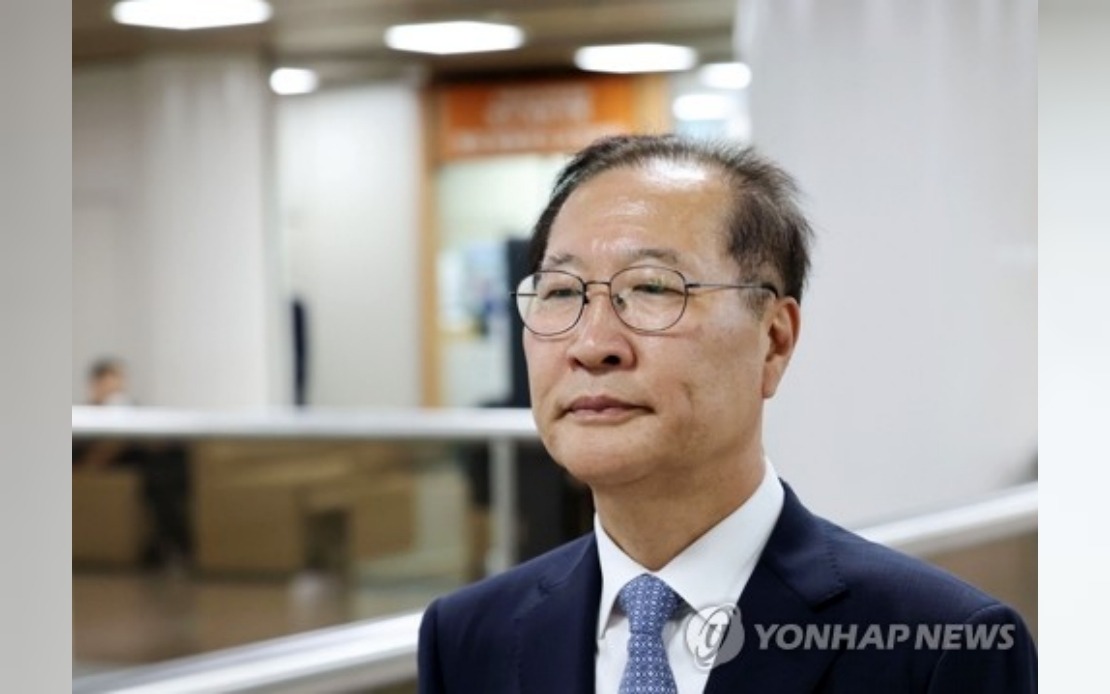
South Korea's legal system delivered another significant blow to the constitutional crisis triggered by former President Yoon Suk Yeol's ill-fated martial law declaration when the Seoul Central District Court handed down a 25-year prison sentence to ex-Justice Minister Park Sung-jae on Monday. The punishment, which exceeds the 20-year term recommended by special counsel prosecutors, marks the latest development in a sweeping crackdown on high-ranking officials accused of orchestrating one of the nation's most serious challenges to democratic rule in recent decades.
Park's conviction on charges of playing a pivotal role in an insurrection and abusing his ministerial authority signals the judiciary's determination to hold top government figures accountable for their actions during the tumultuous events of December 3, 2024. The court immediately placed him in custody following the verdict, indicating concerns that he might attempt to tamper with or destroy evidence. This custodial measure underscores the severity with which South Korean authorities are treating the broader insurrection investigation, which has ensnared multiple layers of the government apparatus.
The judicial findings reveal that Park's involvement extended beyond passive acquiescence to the martial law declaration. Prosecutors successfully demonstrated that he convened a meeting of senior ministry officials specifically to review operational matters that would support the insurrection's implementation. These included assessing the dispatch of prosecutors to entities that would operate under martial law authority, evaluating whether correctional facilities possessed sufficient capacity to accommodate politicians and other prominent figures expected to face arrest, and ordering officials responsible for imposing travel restrictions to report for duty.
In its ruling, the court articulated a stark assessment of Park's conduct, stating that he fundamentally abandoned his constitutional duty to defend the rule of law. Rather than resisting what the judiciary has characterised as an illegal seizure of authority, Park chose to actively participate in the insurrection, apparently believing that Yoon's power grab would succeed. This framing establishes an important precedent: cabinet ministers are not merely passive observers but bear affirmative obligations to refuse participation in unconstitutional acts, regardless of their superior's directives.
Park's sentencing adds to a growing roster of high-ranking officials brought to justice in connection with the martial law episode. Former Prime Minister Han Duck-soo and former Defence Minister Kim Yong-hyun have already received convictions on identical insurrection charges, indicating that the investigation has methodically worked through the government's command structure. More dramatically, Yoon himself received a life sentence in February for leading the insurrection through his declaration of martial law, though he has lodged an appeal against that judgment.
The case against Park encompassed additional allegations of corruption and abuse of power extending beyond the martial law crisis. Prosecutors alleged that he had improperly ordered his subordinates to investigate details of a corruption enquiry into Yoon's wife, Kim Keon Hee, acting on her direct request in May 2024. However, the court dismissed these charges, determining that they fell outside the special counsel's investigative authority. This technical ruling, while favourable to Park on that specific count, failed to shield him from the primary insurrection conviction.
For Malaysian and Southeast Asian observers, the unfolding South Korean crisis illuminates fundamental tensions within democratic systems when elected leaders attempt constitutional overreach. The swift judicial response to Yoon's martial law declaration, coupled with the systematic prosecution of his subordinates, demonstrates institutional resilience—courts and prosecutors refusing to legitimise an unconstitutional power grab. Yet it also exposes vulnerabilities, as the fact that Yoon could declare martial law in the first place suggests insufficient preventive mechanisms.
Park's case particularly illustrates how insurrection charges can extend beyond those who conceived the plot to those who facilitated its execution through administrative machinery. By actively deploying his ministry's resources to support the martial law apparatus, Park crossed from the grey zone of passive compliance into active collaboration. This distinction carries implications for regional governance: it establishes that professional administrators cannot shelter behind claims of hierarchical obedience when asked to participate in unconstitutional schemes.
The defence team's immediate announcement of plans to appeal, arguing that the sentence lacks factual or legal foundation, suggests the case will likely proceed through appellate courts. Conversely, the special counsel team indicated reluctance to appeal, viewing the ruling as adequately articulating the constitutional duties of justice ministers and the gravity of transgression. This prosecutorial position suggests confidence in the verdict's legal reasoning and possibly a calculation that further litigation would yield diminishing returns.
The broader institutional context remains significant for regional stability. South Korea's handling of the martial law crisis—with independent prosecutors, impartial courts, and appellate processes functioning despite extraordinary political pressures—contrasts sharply with some neighbouring jurisdictions where constitutional breaches might receive less robust legal response. This judicial activism, while controversial among Yoon's supporters, reinforces rule-of-law norms that stabilise democratic governance across Asia.
For the South Korean public, Park's conviction provides a measure of accountability and reinforces the principle that high office offers no immunity from the law when constitutional boundaries are transgressed. Yet the case also exposes the vulnerability of constitutional orders when sitting executives command the full apparatus of state power and are willing to risk extra-legal action. The ongoing appeals and trials will continue to shape South Korea's constitutional jurisprudence and broader regional conversations about democratic resilience.