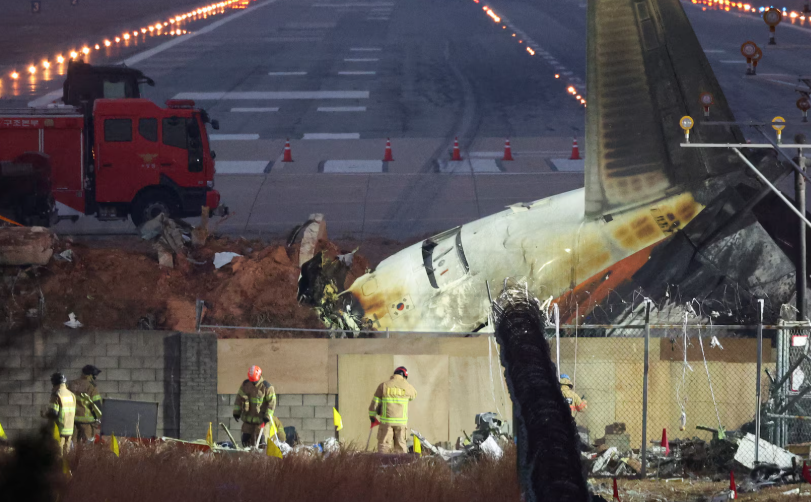
South Korean authorities intensified their investigation into the Jeju Air disaster on Tuesday by conducting coordinated raids on multiple government agencies and airport operators. Officers from the special investigation team descended on Korea Airports Corp, the transport ministry and the Busan Regional Office of Aviation to gather additional evidence as the probe into the December 2024 crash at Muan International Airport continues its methodical course.
The disaster, which occurred on 29 December 2024, claimed 179 lives when the aircraft failed to land safely, becoming one of South Korea's deadliest aviation incidents in recent memory. The scale of the tragedy has prompted investigators to cast a wide net across multiple institutions and officials believed to have played roles in either the circumstances leading to the crash or the emergency response that followed.
Korea Airports Corp operates the majority of the nation's major domestic terminals, excluding only Incheon International Airport, giving it substantial responsibility for safety protocols and operational procedures at the affected airport. The agency's involvement in the investigation reflects authorities' determination to examine every aspect of airport operations that may have contributed to the incident. The searches represent an escalation in the probe's intensity and scope as investigators move beyond initial interviews and documentary reviews to secure physical evidence and records directly from the institutions.
A team official confirmed that the raids target the gathering of materials connected to allegations of professional negligence causing death or injury, one of 74 charges currently pending against various suspects involved in the case. This particular charge carries significant legal weight in South Korean law and typically requires demonstrating that an individual or organisation failed to exercise the duty of care expected of their position, resulting directly in fatal or serious consequences. The broad number of suspects suggests a complex web of potential responsibility spanning multiple levels of authority and operational decision-making.
Tuesday's raids marked the third occasion that investigators have accessed the transport ministry's facilities, indicating that officials expect to uncover additional documentation or evidence with each successive search. This repeated scrutiny suggests that investigators may be following up on leads uncovered during earlier visits or pursuing newly discovered information regarding the ministry's oversight responsibilities and communication with airport operators.
Beyond the current negligence charges, prosecutors are considering whether to add accusations of causing a serious public disaster, a more severe criminal classification that could substantially increase potential penalties for those ultimately held responsible. Such charges typically apply when authorities determine that organisational or systemic failures endangered public safety on a mass scale rather than resulting from isolated individual errors. The consideration of such charges underscores the gravity with which South Korean justice officials view the incident and the institutional failures they suspect contributed to it.
The investigation's focus remains firmly on establishing the precise cause of the crash at Muan International Airport while simultaneously evaluating whether relevant agencies executed their responsibilities adequately. This dual-track approach reflects standard crash investigation methodology, which distinguishes between technical factors contributing to the accident itself and the human and organisational elements that may have exacerbated consequences or failed to prevent the disaster. Investigators are examining everything from pre-flight maintenance records and weather monitoring systems to emergency protocols and ground crew responses.
For Malaysian aviation observers, the Jeju Air investigation carries particular relevance given the region's reliance on commercial air transport and shared safety standards across Asian aviation authorities. The Jeju Air incident serves as a cautionary example of how systemic failures in airport operations, maintenance procedures or emergency response protocols can transform potentially survivable incidents into mass tragedies. Malaysia's own aviation safety record has benefited from rigorous oversight and international cooperation, yet the complexity revealed in the Korean investigation demonstrates that vigilance remains essential across all operational levels.
The involvement of multiple government agencies in the South Korean probe highlights how aviation safety depends on coordinated performance across numerous institutions with different mandates and operational responsibilities. Transport ministries set policy and standards, airport operators manage daily operations and safety protocols, and individual facilities maintain specific equipment and procedures. When these systems fail to align effectively, as the Jeju Air investigation increasingly suggests, the consequences can be catastrophic.
As the investigation progresses, South Korean authorities appear determined to pursue accountability across all potentially responsible parties, whether individual operators, facility managers or policy officials. The continuation of raids and the accumulation of charges indicate that prosecutors are building a comprehensive case that examines not merely how the crash occurred but why adequate safeguards failed to prevent it or limit its consequences. This thorough approach, while time-consuming, aims to ensure that systemic failures are fully exposed and addressed through both criminal accountability and institutional reform.

