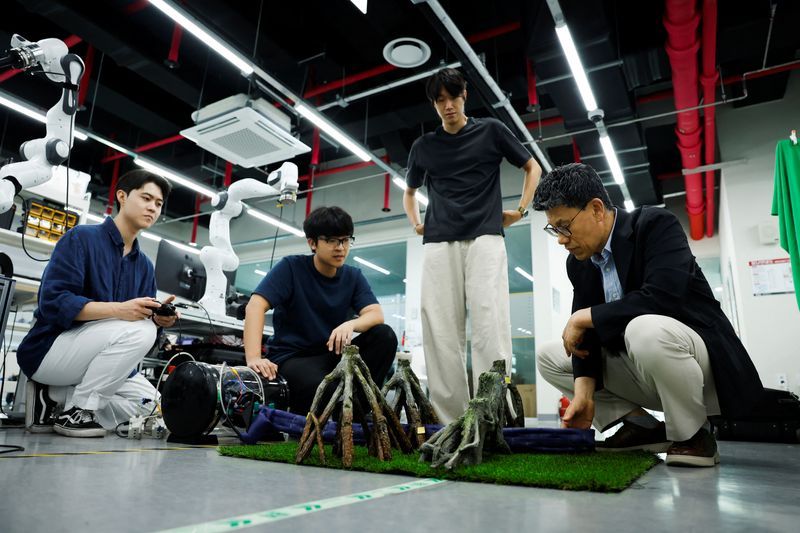
Scientists from South Korea's Korea Advanced Institute of Science and Technology (KAIST) and Stanford University have jointly developed a groundbreaking robotic system that enables people to don protective clothing independently, marking a significant advancement in wearable robotics technology with far-reaching applications across multiple sectors.
The technology operates through an ingenious mechanism inspired by climbing ivy plants. Soft, flexible pneumatic channels—referred to as "vines" by the research team—are embedded throughout the fabric and function by channelling pressurised air. As the air flows through these channels, the fabric glides smoothly against the wearer's body in a manner similar to how ivy winds around a tree, gradually enveloping the person in protective layers. Remarkably, this process occurs even when the wearer remains in motion, eliminating the need for the person to stand stationary during the donning process.
Kim Nam Gyun, the postdoctoral researcher at KAIST who led the project, drew inspiration for the innovation from an everyday experience. While cycling during a rainstorm, Kim contemplated how advantageous it would be if a raincoat could automatically position itself while riding. This mundane observation catalysed the development of technology that transforms the concept into practical reality. The system requires merely ten seconds to fully equip a person with a complete protective suit, fundamentally changing how such clothing functions in real-world scenarios.
The operational mechanics of the vine robot represent a clever departure from conventional robotic systems. Rather than propelling its entire body forward like traditional robots, the vine extends itself by growing from its tip while turning the clothing inside out as it advances. This growth mechanism enables the system to maintain stable contact with the wearer's body regardless of the wearer's physical movement or body shape variations. According to Professor Ryu Jee-Hwan of KAIST's civil and environmental engineering department, the vine robot can navigate narrow passages, adapt to environmental contours, and function effectively across different surface conditions whether slippery, adhesive, or inclined.
A critical advantage distinguishing this technology from existing alternatives lies in its operational simplicity and independence from intricate computational systems. The research team emphasises that the system does not demand complex control algorithms or external guidance systems, making it significantly more practical for deployment across diverse environments and user populations. This elegant simplicity suggests the technology could eventually be implemented in resource-constrained settings where sophisticated computing infrastructure remains unavailable.
The immediate beneficiaries of this innovation extend to vulnerable populations requiring assistance with daily tasks. Elderly individuals and people with disabilities who struggle with conventional clothing fastening mechanisms could gain independence through this automated approach. However, the potential applications extend substantially beyond these obvious use cases into industrial and emergency response contexts where speed and hands-free operation prove essential.
Semiconductor manufacturing cleanrooms represent one compelling application area. Workers in these sterile environments must don contamination-protective suits without introducing pathogens or debris, a process currently requiring significant time and assistance from colleagues. The robotic system could dramatically reduce donning time while maintaining contamination protocols. Similarly, emergency response personnel—firefighters, rescue workers, and hazardous materials teams—require rapid deployment of protective equipment during time-critical operations. Traditional suit-up procedures consume precious seconds that this technology could reclaim for actual response activities.
Professor Ryu highlighted an important philosophical dimension of the work, noting that contemporary technological discourse fixates predominantly on artificial intelligence and software-driven solutions. This research exemplifies how mechanical engineering principles, when combined thoughtfully with pneumatic systems, can deliver tangible functional improvements without requiring algorithmic sophistication. The vine robot demonstrates that innovative engineering encompasses diverse disciplines extending well beyond computer science and machine learning paradigms dominating current conversation.
The researchers presented their findings in IEEE Robotics and Automation Letters, a peer-reviewed publication that ensures the work has undergone rigorous scientific scrutiny. This publication in a respected venue signals the project's credibility within the global robotics research community and opens pathways for subsequent development and potential commercialisation.
For the Southeast Asian region specifically, this technology carries particular relevance given the demographic trends affecting countries across the area. Rapidly ageing populations in nations like South Korea, Japan, and increasingly Singapore and Malaysia present mounting challenges for elder care infrastructure. Innovations reducing caregiving burden and promoting elderly independence could help address labour shortages in healthcare sectors already struggling with insufficient workforce capacity. Furthermore, the semiconductor industry remains crucial to Southeast Asian economies, with countries like Malaysia, Singapore, and Vietnam hosting significant manufacturing operations that could benefit from productivity enhancements.
The collaborative nature of this research between South Korean and American institutions reflects broader trends in advanced technology development where multinational partnerships pool expertise and resources. Such cooperation accelerates innovation cycles and facilitates technology transfer across regions. As KAIST and Stanford continue refining this technology, opportunities may emerge for Southeast Asian institutions and companies to participate in subsequent development phases, potentially positioning the region at the forefront of practical robotic applications.

