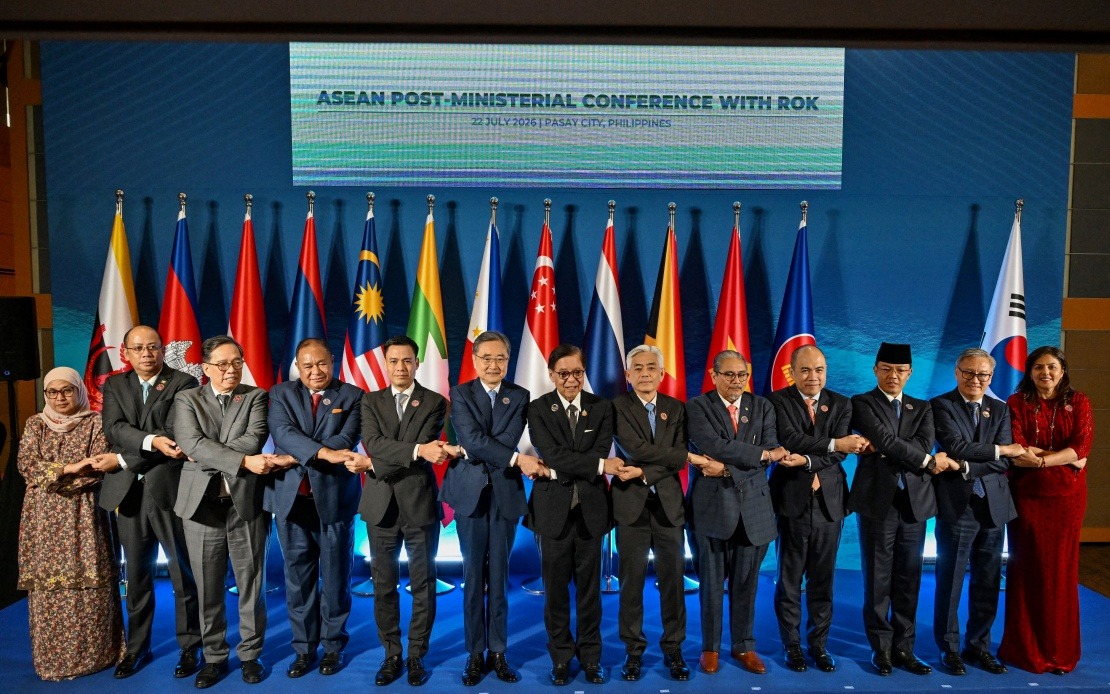
South Korea and ASEAN have recommitted themselves to strengthening bilateral ties through concrete new partnerships, particularly in emerging technological and cultural domains. The commitment came during a meeting of foreign ministers held in Manila on July 22, where Seoul's top diplomat Cho Hyun co-chaired discussions with his Thai counterpart. The reaffirmation signals that despite shifting geopolitical currents and economic pressures across the region, both sides view each other as indispensable partners capable of driving meaningful progress on shared challenges.
The partnership framework underpinning these latest initiatives traces back to last year's summit, when South Korean President Lee Jae Myung introduced a comprehensive strategic vision centred on three foundational pillars: people-to-people cooperation, economic growth paired with innovation, and regional peace and stability. This three-pronged approach reflects an attempt to move beyond transactional trade relationships toward deeper institutional and social connections that can weather economic cycles and political transitions.
Among the most significant announcements was Seoul's introduction of the Korea-ASEAN AI Partnership Initiative, positioning artificial intelligence as a cornerstone of future cooperation. The programme leverages South Korea's advanced technological capabilities across the full spectrum of AI development, from foundational research through to practical applications. The scheme encompasses three key pillars: establishing robust AI ecosystems across participating nations, fostering dedicated research initiatives and nurturing talent pipelines to meet anticipated demand for AI specialists, and establishing governance frameworks ensuring AI deployment prioritises safety and responsible innovation. For Southeast Asian nations still developing their own AI infrastructure and regulatory frameworks, South Korea's expertise represents a valuable resource as the region races to avoid technological dependency on larger powers.
Beyond technology, Seoul has advanced a parallel agenda in cultural and creative industries, recognising that soft power and economic opportunities increasingly intersect in the digital age. South Korean entertainment, design, and digital content have achieved remarkable penetration in Southeast Asian markets, and these new initiatives aim to formalise and expand that influence while creating reciprocal opportunities for ASEAN creators. This reflects a sophisticated understanding that cultural exchange can strengthen diplomatic relationships whilst generating economic returns through tourism, intellectual property, and digital commerce.
The partnership extends into practical security domains as well. Seoul has proposed establishing a joint maritime safety academy alongside initiatives targeting online scam crimes, increasingly prevalent across Southeast Asia. The maritime initiative carries particular resonance for island nations and those dependent on sea lanes; the academy would provide shared training and operational protocols to enhance regional maritime security and incident response. Similarly, the focus on cross-border fraud reflects mounting concern across ASEAN about criminal networks exploiting digital systems and infrastructure gaps, with Malaysians amongst the victims of sophisticated online schemes originating from various jurisdictions.
On the economic front, both parties have committed to deepening their existing trade framework. South Korea ranks as ASEAN's third-largest trading partner, with bilateral exports totalling approximately US$122.5 billion during 2025. However, officials have acknowledged that this substantial volume masks untapped potential. Last month, the two sides formally initiated talks to upgrade their free trade agreement, which has operated in its current form since a goods agreement in 2006, followed by subsequent protocols covering services and investment. The modernised FTA aims to capture opportunities in emerging sectors including digital economy expansion, supply chain resilience specifically regarding critical minerals essential for battery production and semiconductor manufacturing, and other advanced industries.
ASEAN member states have responded positively to Seoul's overtures, welcoming the strategic vision and pledging active participation across proposed initiatives. This receptiveness reflects broader regional recognition that South Korea offers complementary strengths: advanced manufacturing capabilities, technological expertise, cultural soft power, and a foreign policy uncommitted to the zero-sum competition characterising great power rivalries in the Indo-Pacific. For smaller economies balancing relationships with larger powers, a reliable mid-sized partner with aligned democratic values and technological prowess holds considerable appeal.
During the ministerial session, South Korea also sought ASEAN's continued backing for its Korean Peninsula policy, requesting support for Seoul's pursuit of peaceful coexistence and mutual growth with North Korea. ASEAN member states reciprocated by reaffirming their commitment to supporting South Korean objectives on the peninsula, whilst emphasising that peninsular stability serves broader regional security interests. This linkage underscores how Korean and Southeast Asian security concerns remain deeply interconnected; instability on the peninsula would inevitably reverberate across shipping lanes, supply chains, and regional alignments that matter enormously to ASEAN economies.
Chairman Cho's bilateral engagements with counterparts from the Philippines, Thailand, and other ASEAN nations during the broader ministerial meetings suggest that Seoul is pursuing a multi-track approach: advancing collective initiatives through ASEAN's institutional structures whilst simultaneously nurturing individual bilateral relationships with key member states. This dual strategy maximises flexibility and allows Seoul to tailor cooperation to specific national circumstances and capacities, whilst maintaining the momentum of broader partnership development.
The timing of these announcements carries significance for Malaysian and broader Southeast Asian observers. The initiatives address genuine regional needs—artificial intelligence expertise gaps, cultural industry development, maritime safety, supply chain resilience—that transcend individual nations. By packaging these as partnership initiatives rather than unilateral aid or investment, Seoul signals respect for ASEAN agency and expertise. Moreover, by focusing on enablement and capacity-building rather than technology transfer dependency, South Korea positions itself as a collaborative partner rather than a technology hegemon.
Looking forward, successful implementation of these initiatives will depend on sustained political commitment, adequate resource allocation, and meaningful participation from ASEAN member states beyond passive acceptance. The modernised FTA negotiations will prove particularly consequential; whether Seoul and ASEAN can negotiate frameworks accommodating emerging technologies, digital trade, and critical minerals will substantially influence regional economic resilience and technological sovereignty. The AI partnership initiative similarly requires clarity on intellectual property frameworks, data governance, and talent mobility to realise its potential.
For Malaysia specifically, these developments offer particular relevance. As one of ASEAN's most technologically advanced economies with significant digital infrastructure, Malaysia stands well-positioned to benefit from AI ecosystem initiatives whilst potentially contributing expertise to regional projects. Malaysian companies operating across creative industries could capitalise on expanded cultural cooperation frameworks. Simultaneously, Malaysia's critical role in semiconductor supply chains and critical minerals gives the country leverage in FTA modernisation discussions. The maritime safety academy could enhance coast guard and naval capabilities across a region facing increasing challenges from piracy, trafficking, and environmental threats in congested waterways.
The Korea-ASEAN partnership, as articulated through these latest initiatives, represents an attempt to deepen engagement beyond traditional trade relationships toward comprehensive cooperation spanning technology, culture, security, and economic resilience. Whether this ambitious vision translates into tangible results depends on both sides following through with implementation, resource commitment, and willingness to adapt frameworks as regional circumstances evolve. For Southeast Asia, having a stable, technologically advanced, and diplomatically engaged South Korea as a committed partner offers valuable strategic optionality in an increasingly complex regional landscape.

