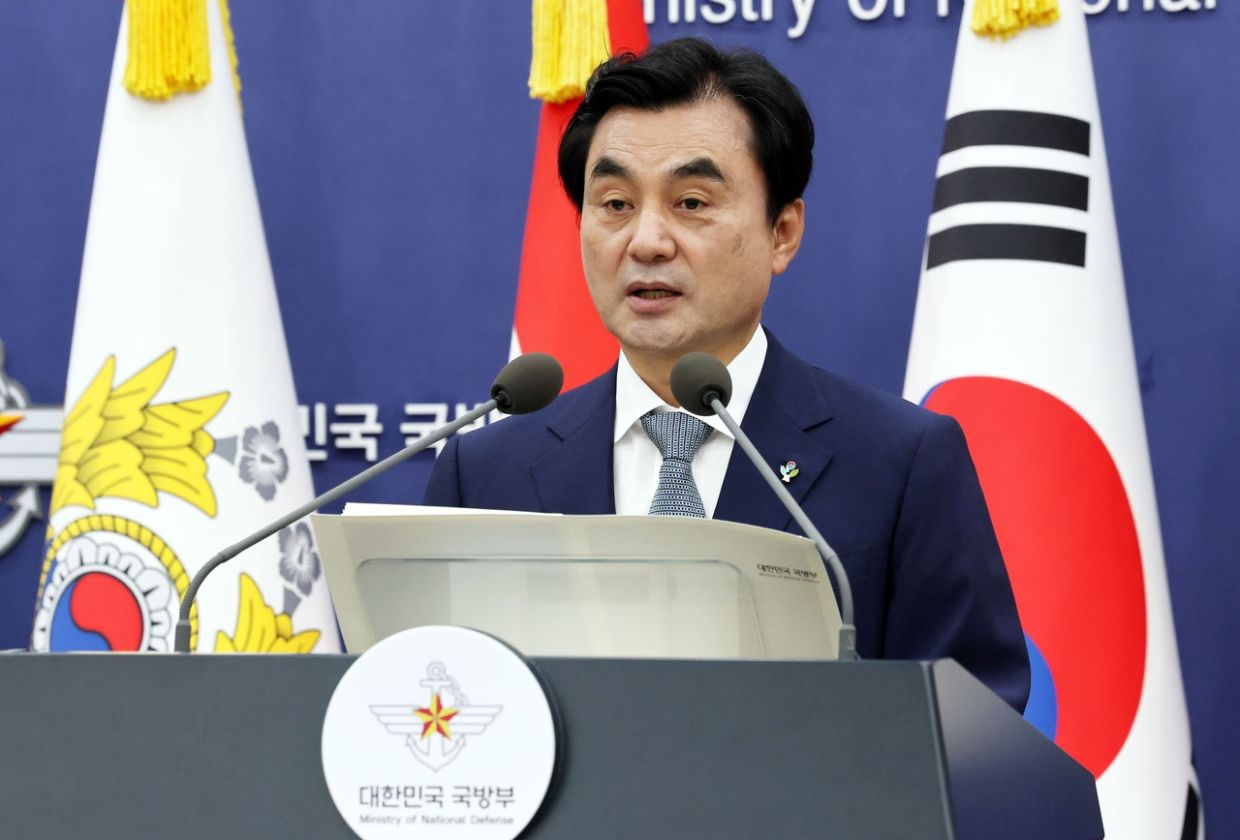
South Korea is fundamentally restructuring its military drone capabilities, announcing plans to acquire more than 20,000 low-cost unmanned systems while accelerating deployment of the K-Lucas, a domestically-developed long-range loitering munition. Defence Minister Ahn Gyu-back outlined the comprehensive overhaul on Friday, framing the shift as essential to counter evolving threats from North Korea and adapt to lessons emerging from contemporary conflicts worldwide.
The initiative reflects a broader global military reassessment triggered by the Ukraine war and recent US-Iran tensions, where budget drones have demonstrated unexpected strategic impact on battlefields previously dominated by expensive conventional platforms. South Korea's approach acknowledges that low-cost, expendable systems now fundamentally alter military calculations, particularly in densely-populated regions where precision and cost-effectiveness matter equally. The ministry explicitly cited North Korea's expanding unmanned capabilities as a primary driver, noting that these systems threaten not only military installations but also critical civilian infrastructure across the peninsula.
The procurement roadmap targets completion by 2030, encompassing short-range reconnaissance drones, small loitering munitions, and next-generation capabilities including artificial intelligence-powered drone swarms. This timeline positions Seoul to operationalise emerging technologies within a decade while building domestic industrial capacity in a sector increasingly vital to regional security. The emphasis on low-cost systems represents a deliberate strategic choice rather than budgetary constraint, allowing Seoul to field numerically superior forces that offset potential North Korean advantages in quantity or surprise deployment.
Counterdrone defences form an equally critical component of the strategy. Starting next year, South Korea will deploy air defence systems specifically designed to counter unmanned threats in forward-deployed positions along the Korean border. Minister Ahn signalled plans to acquire directed-energy weapons such as lasers and high-power microwave systems, technologies that offer cost advantages over traditional air defence by reducing per-engagement expenses. These systems address a fundamental vulnerability: conventional air defence missiles designed for manned aircraft prove economically impractical against swarms of inexpensive drones, creating a dangerous gap in Seoul's defensive posture.
Human capital development accompanies the hardware expansion through an ambitious plan to train 500,000 personnel as drone operators. This extraordinary commitment—essentially treating unmanned systems as a second personal weapon for all service members—indicates that South Korea views drone operations not as a specialised function but as fundamental military competency. Such extensive training reshapes force structure fundamentally, distributing capability across the military rather than concentrating it in specialist units. This approach mirrors lessons from Ukraine, where decentralised drone operations proved more resilient and adaptable than hierarchical command structures.
Procurement reform addresses a critical vulnerability in South Korea's defence acquisition system: traditional approval timelines cannot match technological advancement in unmanned systems. Deputy Minister Kim Hong-cheol emphasised that the rapid pace of drone development and counterdrone evolution has outpaced conventional military procurement, which typically requires years to evaluate, certify, and field new systems. The proposed legislation would allow commercially-available technologies to undergo military evaluation and receive accelerated certification, enabling rapid fielding of proven commercial platforms. This regulatory flexibility recognises that competitive civilian drone markets now innovate faster than traditional defence contractors.
Organisational restructuring will dissolve the Drone Operations Command as an operational entity, transforming it into the National Defence Drone Headquarters focused purely on policy, capability development, and procurement coordination. Operational responsibilities transfer to the Army, Navy, Air Force, and Marine Corps, allowing each service branch to develop doctrine tailored to its specific missions rather than implementing unified approaches that may prove suboptimal for divergent operational environments. This decentralisation reflects recognition that naval drone operations differ fundamentally from air force or army applications, requiring customised tactics and training.
The reorganisation carries significant political undertones, emerging from months of controversy surrounding alleged drone incursions into Pyongyang in October 2024. The Drone Operations Command faced investigation for potentially executing operations intended to justify martial law declared by former President Yoon Suk Yeol in December 2024. Personnel allegedly destroyed evidence by deleting flight logs and disposing of equipment after martial law's declaration. Despite these controversies threatening the command's existence, the Defence Ministry determined that strategic importance of drone technology in modern warfare necessitates retaining a centralized policy organisation, even while removing operational authority.
Regional implications of South Korea's drone expansion extend beyond immediate security concerns with North Korea. As Southeast Asian nations monitor military modernisation across Northeast Asia, Seoul's emphasis on low-cost, distributed drone capabilities presents a strategic model that emerging military powers may adopt. The defence technology gap between wealthy and resource-constrained nations narrows when drone swarms prove tactically superior to traditional platforms, potentially disrupting regional military balances in Southeast Asia. Malaysian and other regional defence planners will likely follow Seoul's technical choices and procurement timelines as indicators of emerging threat profiles.
The integration of artificial intelligence into drone swarms represents the strategic frontier that occupies Seoul's medium-term planning. Autonomous decision-making capabilities amplify force multiplier effects, allowing smaller forces to accomplish objectives previously requiring larger deployments. However, such autonomy raises escalation risks in a peninsula where miscalculation carries existential consequences. South Korea's approach to AI governance in military unmanned systems will potentially influence regional and international norms regarding autonomous weapons, making its technical choices relevant far beyond Korean security concerns.
Simultaneously, President Lee Jae Myung scheduled a separate policy meeting focused on fostering security innovation companies, signalling that drone expansion forms part of broader defence and space industry modernisation. This coordinated approach treats military modernisation and commercial industrial development as complementary objectives, seeking to build sustained competitive advantage in emerging defence technologies. The strategy anticipates that commercial drone markets will eventually provide training grounds for technologies later adapted to military applications, creating synergies between civilian and military sectors.
South Korea's comprehensive drone strategy addresses the fundamental challenge confronting modern militaries: adapting force structure, procurement processes, and doctrine to technologies advancing faster than traditional military planning cycles. By deliberately embracing low-cost systems, distributing operational capability across service members, reforming acquisition procedures, and decentralising command authority, Seoul crafts a response proportionate to threats emanating from both North Korea and the evolving character of contemporary warfare demonstrated in Ukraine and the Middle East.

