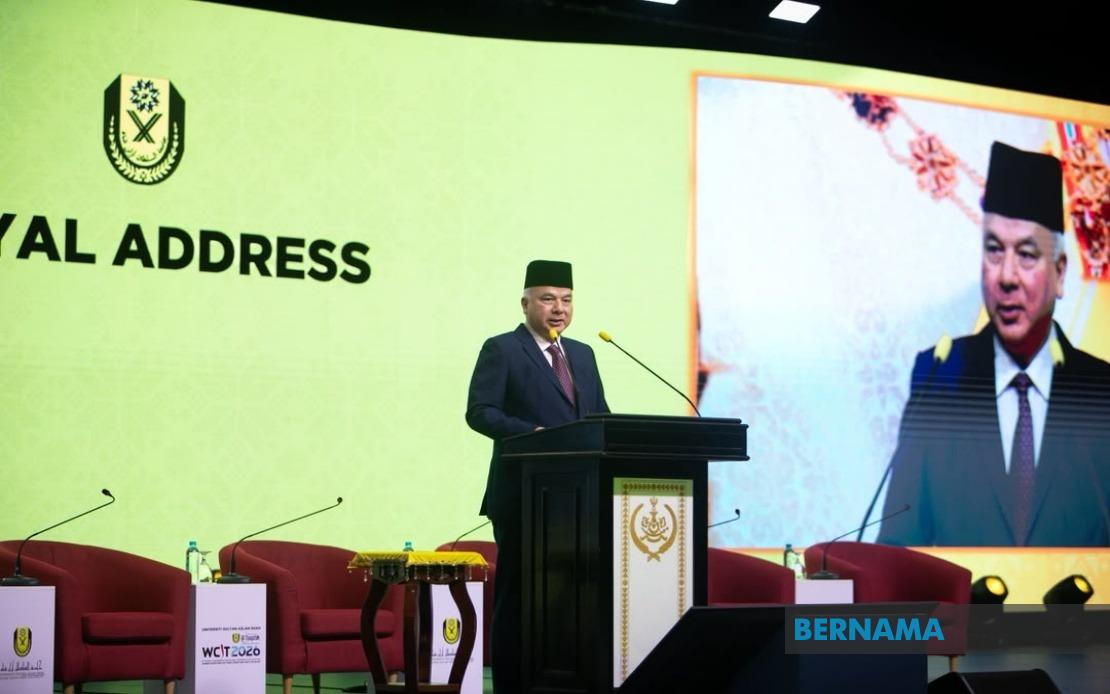
At the 8th World Conference on Islamic Thought and Civilisation in Ipoh, Sultan Nazrin Shah, the Sultan of Perak, delivered a challenging proposition to Malaysia's leadership and the broader Muslim world: that the most resilient safeguard for any nation lies not in fortified borders or advanced cyber defences, but in the bonds that unite its citizens. While traditional security mechanisms—military strength, counterterrorism operations, and digital protections—remain necessary components of national defence, His Royal Highness argued they pale in comparison to the foundational stability that emerges when populations feel genuinely invested in their country's trajectory and future prosperity.
The Sultan's remarks, made in the presence of Deputy Prime Minister Datuk Seri Fadillah Yusof, Perak Menteri Besar Datuk Seri Saarani Mohamad, and Higher Education Minister Datuk Seri Dr Zambry Abd Kadir, struck at a persistent tension within multicultural democracies across Southeast Asia. He pointed out that the deliberate manipulation of religious conviction to serve narrow political agendas represents a profound threat to national cohesion. This exploitation—framing faith as a tool for division rather than unity, for exclusion rather than the inclusive principles that modern plural societies demand—corrodes the social fabric more insidiously than external adversaries ever could.
For Malaysia specifically, this message carries particular weight. A nation's integrity cannot be divorced from its security posture, Sultan Nazrin emphasized. A country that successfully repels external threats while simultaneously suffering internal decay—corruption festering within institutions, injustice embedded in systems, opportunities distributed unequally across ethnic and religious lines—has not truly secured itself. It has merely deferred an inevitable reckoning. The Sultan articulated a vision in which security and integrity are inseparable concepts, each strengthening the other.
Central to his argument was the observation that genuine national unity does not spring from enforced uniformity or the suppression of dissenting voices. Rather, it emerges when every community within a nation observes itself reflected fairly in the country's legal frameworks, economic opportunities, educational institutions, and corridors of power. Citizens must genuinely perceive themselves as equal stakeholders in the national enterprise, not as tolerated minorities or subordinate groups whose concerns are peripheral to the main narrative.
The Sultan distinguished between two fundamentally different forms of unity. Cohesion achieved through coercion—whether through authoritarian control, surveillance, or intimidation—remains brittle, prone to fracture when external pressures mount or internal resistance strengthens. By contrast, unity constructed on the bedrock of genuine shared belonging, where people comprehend themselves as valued participants in a collective endeavour, possesses inherent resilience. This distinction matters enormously for Southeast Asian democracies grappling with questions of national identity and the proper relationship between state and citizen.
Turning to education, Sultan Nazrin positioned human capital development as the decisive factor in preparing Malaysia for converging global challenges. The technological disruption accompanying automation, the existential pressures posed by climate change, and the structural demands of a knowledge-driven economy cannot be met by conventional approaches to schooling and workforce development. The Sultan called for an educational philosophy that transcends the false binary between technical and humanistic learning, insisting that nations must simultaneously strengthen mathematical and scientific instruction while safeguarding robust investment in humanities and artistic disciplines.
The Sultan's observations about digital literacy versus foundational reading and reasoning habits address a genuine tension within modern educational systems. As information becomes instantly retrievable and nearly costless, the pedagogical value of rote memorisation and standardised testing—models that served industrial economies adequately—evaporates. Educational institutions must instead cultivate the distinctly human capacities that artificial intelligence cannot replicate: sophisticated critical thinking, ethical reasoning grounded in moral frameworks, creative problem-solving, and adaptive capacity in the face of unforeseen circumstances.
Particulary significant was His Royal Highness's assertion that properly conceived Islamic education, drawing simultaneously on revealed knowledge and rational inquiry, has historically equipped students with precisely these capacities. This framing rejects the notion that Islamic learning stands apart from or in tension with contemporary intellectual needs. Instead, it positions Islamic educational traditions as repositories of pedagogical wisdom aligned with demands for human flourishing in an AI-inflected world. The message resonates beyond Malaysia, offering intellectual resources to Muslim-majority societies throughout Southeast Asia navigating similar educational transformations.
The Sultan emphasised that technical and vocational pathways require equal dignity, investment, and social valorisation as academic trajectories. A young person who aspires to become a skilled tradesperson deserves recognition and opportunity commensurate with someone pursuing medicine or engineering. This egalitarian stance addresses labour market realities while affirming human dignity across occupational categories. For Malaysia, where skills shortages and demographic challenges will intensify workforce demands, this inclusive vision of educational worth holds practical importance beyond its moral dimensions.
Implicit throughout Sultan Nazrin's address is recognition that security conceived narrowly—as the absence of external military threat—provides insufficient foundation for national flourishing. Malaysian policymakers, he suggested, must understand that citizens' sense of belonging, their perception of fair treatment, and their confidence in shared prosperity constitute the actual infrastructure upon which enduring stability rests. This represents a significant reframing of how national leaders should approach governance, suggesting that policies addressing economic inequality, educational access, and political inclusion deserve the same urgency typically reserved for defence spending and counterterrorism operations.
The conference setting—focused on Islamic thought and civilisation—afforded the Sultan an opportunity to articulate how religious wisdom traditions, properly understood, support rather than undermine pluralistic national projects. His argument that religious sentiment should never be weaponised for political division, and that authentic faith calls adherents toward inclusion and mutual respect, offers important counter-narratives to extremist ideologies that have plagued the region. For Malaysia and other Southeast Asian nations with substantial Muslim populations, this intervention from a revered traditional authority carries symbolic significance beyond the conference venue.

