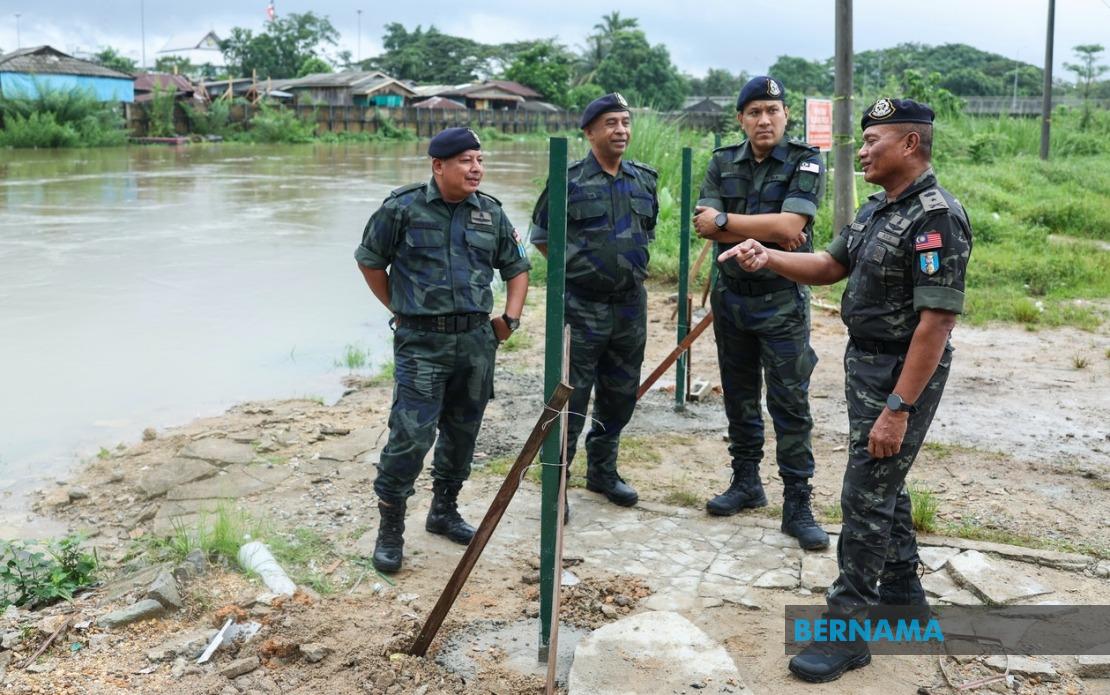
Human trafficking networks operating across Malaysia's northern border have fundamentally altered their approach to moving undocumented migrants into the country, replacing bulk transportation with a distributed model designed to overwhelm security checkpoints. The shift in operational tactics emerged during an enforcement sweep in Kelantan on June 27, when the General Operations Force's 8th Battalion, working alongside the Criminal Investigation Division, detained 13 Myanmar nationals at Kampung Banggol Kemian in Pasir Mas. The operation, dubbed Operasi Taring Wawasan Kelantan, revealed how smugglers now deliberately stage arrivals in fragmented waves across forested terrain to reduce the visibility of any single movement.
Commander SAC Ahmad Radzi Hussain of the GOF's Southeast Brigade explained that the enforcement team initially spotted an irregularly-behaving Proton Exora moving through the area around 3:30 am. Upon detecting the presence of GOF officers, the driver immediately abandoned the vehicle and fled into the forest, successfully evading capture despite intensive pursuit efforts. The four Myanmar men found seated in the rear of the vehicle possessed no legitimate travel documentation and were immediately apprehended. However, the real scope of the operation became apparent when forest searches within the following hour uncovered an additional nine Myanmar nationals who had recently crossed into Malaysian territory through illicit pathways.
According to the detainees' accounts during questioning, the smuggling operation had deliberately separated them from larger groups in Thailand before orchestrating individual crossings at different times across the Golok River. This choreographed dispersal strategy contrasts sharply with traditional human trafficking methods that typically moved dozens of migrants in single convoys, a practice that presented obvious targets for monitoring patrols. By fracturing arrivals into smaller clusters dropped progressively through the forest over extended periods, the syndicate significantly reduced each group's detection footprint while maintaining the overall volume of movement. The individuals apprehended—ranging in age from 20 to 37 years old, including five women—indicated they had been destined for employment opportunities in the Kuala Lumpur metropolitan region.
The tactical evolution reflects how organised migrant smuggling has adapted to counteract regional enforcement capacity. Malaysian security forces, despite significant resource deployment, face inherent limitations in monitoring sprawling jungle terrain along the Thailand-Malaysia frontier. When migrants travel as single large contingents, they create temporal and spatial concentration points vulnerable to interception. Fragmenting operations into smaller parties distributed across multiple routes and extended timelines essentially forces authorities to either massively scale their patrols—an economically unfeasible proposition—or accept higher rates of successful infiltration. The sophistication of this approach suggests these criminal organisations have studied enforcement patterns and vulnerabilities with considerable analytical depth.
The seized Proton Exora, valued at approximately RM30,000, represents significant infrastructure investment that syndicates embed into their operations. These vehicles serve multiple functions beyond mere transportation: they provide mobile staging points for distribution, create plausible civilian cover on roads, and enable rapid repositioning when enforcement pressure intensifies. The willingness to sacrifice such assets indicates the profitability margins these operations maintain, even accounting for periodic losses to authorities. Smuggling fees charged to migrants typically range from several hundred to several thousand Malaysian ringgit per person, meaning a single successful convoy movement can generate sufficient revenue to replace confiscated vehicles while maintaining substantial profit margins.
The border region's geography creates persistent vulnerability to such operations. The Golok River forms a porous boundary where local communities have established informal crossing points through decades of trading activity. Distinguishing between legitimate commerce and human trafficking movement requires intensive intelligence gathering and coordination between Malaysian and Thai authorities, a challenge amplified by the river's accessibility and the dense vegetation protecting approach routes. Communities residing near crossing points frequently possess knowledge of smuggling operations but face complex incentives—some members may benefit economically, while others fear reprisal or distrust law enforcement capacity to protect witnesses.
For Malaysia's immigration enforcement apparatus, this operational shift demands strategic recalibration. The General Operations Force and police CID must now develop counter-tactics appropriate to dispersed arrival patterns. This might include enhancing real-time intelligence networks, increasing forest patrol density during specific seasonal windows, establishing additional checkpoint layering on routes to employment destinations, and improving coordination mechanisms to rapidly mobilize forces in response to credible smuggling intelligence. The traditional checkpoint model, effective against concentrated movements, becomes progressively less efficient against distributed arrivals, forcing agencies toward more resource-intensive approaches.
The detention of these 13 individuals falls under Section 6(1)(c) of the Immigration Act 1959/63, the standard charge applied to undocumented migrants. Beyond immediate prosecutorial proceedings, their cases provide valuable intelligence regarding smuggling networks, fee structures, recruitment methods in Myanmar, and onward employment facilitation. Police and GOF investigators typically conduct extensive debriefing to construct network maps identifying key organisers, documentation forgers, transport coordinators, and employment placement intermediaries. Such intelligence gathering, when systematically analysed across multiple apprehensions, can gradually reveal network structures and vulnerabilities.
The broader context encompasses Malaysia's complex migration landscape, where substantial communities from Myanmar, Bangladesh, Indonesia, and other regional nations fill labour shortages in manufacturing, construction, agriculture, and domestic service sectors. The legal migration pathway, while theoretically accessible, involves bureaucratic requirements and expense levels that disadvantage workers from impoverished communities. This gap between labour demand and legal supply capacity creates exactly the conditions enabling smuggling syndicates to flourish. Undocumented workers accept dangerous journeys because employment prospects through formal channels remain prohibitively distant.
Regional security implications extend beyond bilateral Malaysian-Thai border management. The transformation of migrant movement patterns reflects how criminal organisations adapt operational models in response to enforcement escalation, a principle applicable across multiple forms of trafficking and smuggling. Understanding these tactical adaptations—and their underlying logic—provides valuable insights for improving enforcement effectiveness across Southeast Asia's complex border environments where similar operations transcend individual national jurisdictions.
Moving forward, enforcement success requires not merely apprehending migrants and seizing vehicles, but systematically dismantling the organisational infrastructure enabling these operations. This demands sustained intelligence operations targeting facilitators within both Thailand and Malaysia, international cooperation transcending border formalities, and consistent pressure on employment sectors utilising undocumented labour. Without addressing underlying demand factors driving irregular migration, enforcement operations, however sophisticated, can only manage rather than resolve the fundamental dynamics generating human trafficking flows through Malaysia's porous frontiers.

