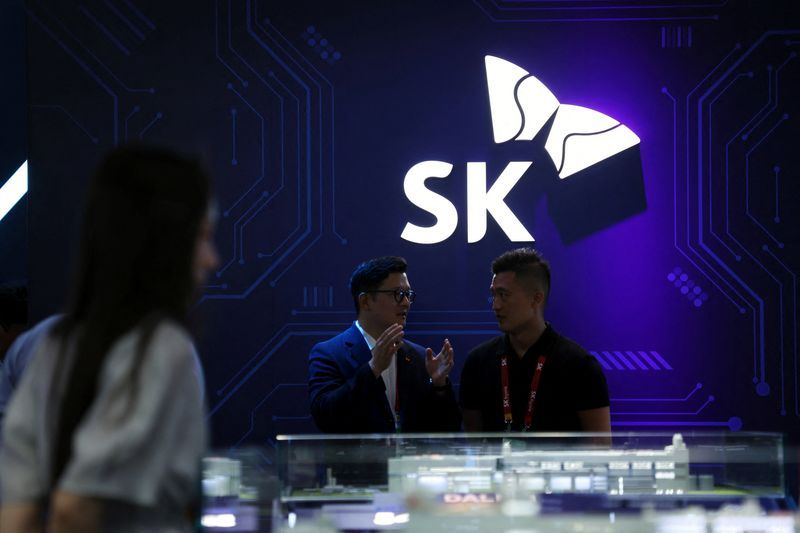
South Korea's SK Hynix is preparing to raise as much as 45.45 trillion won ($29.43 billion) through a landmark American Depositary Receipt listing on Nasdaq, underlining the extraordinary value investors now place on chipmakers positioned at the forefront of artificial intelligence expansion. The company disclosed its intention in a regulatory filing on June 24, signalling its determination to capitalize on its strategic position as a leading supplier of memory chips essential to powering AI systems worldwide.
The proposed offering represents far more than a simple fundraising exercise for SK Hynix. By tapping American capital markets through ADRs—financial instruments that allow overseas companies to trade on U.S. exchanges while maintaining South Korean incorporation—the manufacturer is deliberately broadening its shareholder base beyond traditional Korean and Asian investors. This geographic diversification of ownership reflects management's confidence that long-term institutional money from the United States will view the company as a multi-year beneficiary of the AI revolution, rather than a cyclical semiconductor play vulnerable to inventory corrections or demand fluctuations.
The listing, scheduled for July 10 on the Nasdaq exchange, will involve the issuance of 17.79 million new shares to back the ADR offering, with the exchange rate set at 10 ADRs equivalent to one common share. While the fundraising target could shift after the bookbuilding process—the period when underwriters gauge demand from institutional investors—the company has already secured a heavyweight syndicate including BofA Securities, Citigroup Global Markets, Goldman Sachs, and JP Morgan Securities to manage the offering.
Should the offering succeed at the upper end of the indicated price range, SK Hynix would eclipse Alibaba's 2014 New York debut, which raised $21.8 billion and previously held the record for the largest ADR offering. This distinction carries symbolic importance for South Korea's technology sector, demonstrating that Korean semiconductor manufacturers can command valuations and investor enthusiasm comparable to—or exceeding—that of established Chinese internet giants. For Malaysian investors and businesses operating within Southeast Asia's technology ecosystem, the success of this listing will have ripple effects across regional supply chains and technology partnerships.
The capital raised will finance three strategic projects designed to reinforce SK Hynix's manufacturing dominance. The company plans to construct a new chip factory in Yongin, establish an advanced packaging fabrication facility in Cheongju, and acquire sophisticated chipmaking equipment including Extreme Ultraviolet Scanners—the cutting-edge lithography tools that represent the technological frontier of semiconductor production. These investments directly address the production bottlenecks that have constrained supply of high-bandwidth memory chips as global demand for AI computing infrastructure has exploded.
SK Hynix has emerged as one of the primary winners of the current AI boom, particularly through its dominance in high-bandwidth memory chips that power AI accelerators and data centre processing systems. Major customers including Nvidia and Alphabet's Google have become increasingly dependent on SK Hynix's supply chain, a dynamic that has transformed the company from a traditional cyclical chipmaker into an essential infrastructure supplier for the digital economy's most transformative technology. This strategic positioning has created a remarkable financial outcome: SK Hynix only recently surpassed Samsung Electronics to become South Korea's most valuable company by market capitalization—a historic shift in the balance of power between Korea's two technology titans that underscores how thoroughly AI has reshaped global semiconductor economics.
The timing of this ADR offering reflects management's assessment that the AI demand cycle remains in early innings, with years of sustained growth ahead as enterprises worldwide deploy generative AI systems, build out data centres, and integrate artificial intelligence into operational infrastructure. By raising capital now, SK Hynix is positioning itself to meet demand that competitors may struggle to fulfill, effectively converting near-term cash flows from AI-driven revenue into longer-term productive capacity that will sustain competitive advantages for years to come.
For Southeast Asian economies including Malaysia, which host semiconductor manufacturing operations and aspire to develop regional chip production capabilities, SK Hynix's massive investment signals where global technology capital is concentrating. The company's commitment to expanding production capacity reveals investor confidence that AI-related semiconductor demand will remain robust and growing, a development that validates the region's focus on developing semiconductor ecosystems and workforce capabilities. Malaysia's own semiconductor manufacturing sector, which includes operations by companies like Penang's integrated circuit producers, will benefit from increased demand for packaging, assembly, and testing services as SK Hynix and other manufacturers ramp up production.
The regulatory environment surrounding this listing also carries significance for how emerging markets engage with international capital formation. SK Hynix's decision to pursue an ADR offering rather than converting to a primary U.S. listing demonstrates that major global corporations can maintain their regulatory domicile and corporate governance frameworks while still accessing deep American investment capital pools. This approach has become increasingly attractive for large Asian technology companies seeking to raise capital without surrendering control or relocating legal headquarters—a balance that allows SK Hynix to remain firmly embedded in South Korea's technology ecosystem while benefiting from global capital market access.
The success or failure of this offering will provide crucial signals about investor appetite for semiconductor manufacturing capital intensity in the current economic environment. If the offering attracts strong demand, it will validate the thesis that AI-driven demand justifies massive investments in production facilities with multi-year payback periods. Conversely, if demand proves tepid, it may suggest that investors harbour concerns about the sustainability of current AI spending growth rates or the ability of any single manufacturer to maintain pricing power and market share against competition from Samsung, Intel, and others investing in similar capacity. The June 10 listing date will therefore represent not merely a corporate financing milestone, but a referendum on the investment community's long-term confidence in semiconductor demand growth driven by artificial intelligence deployment.