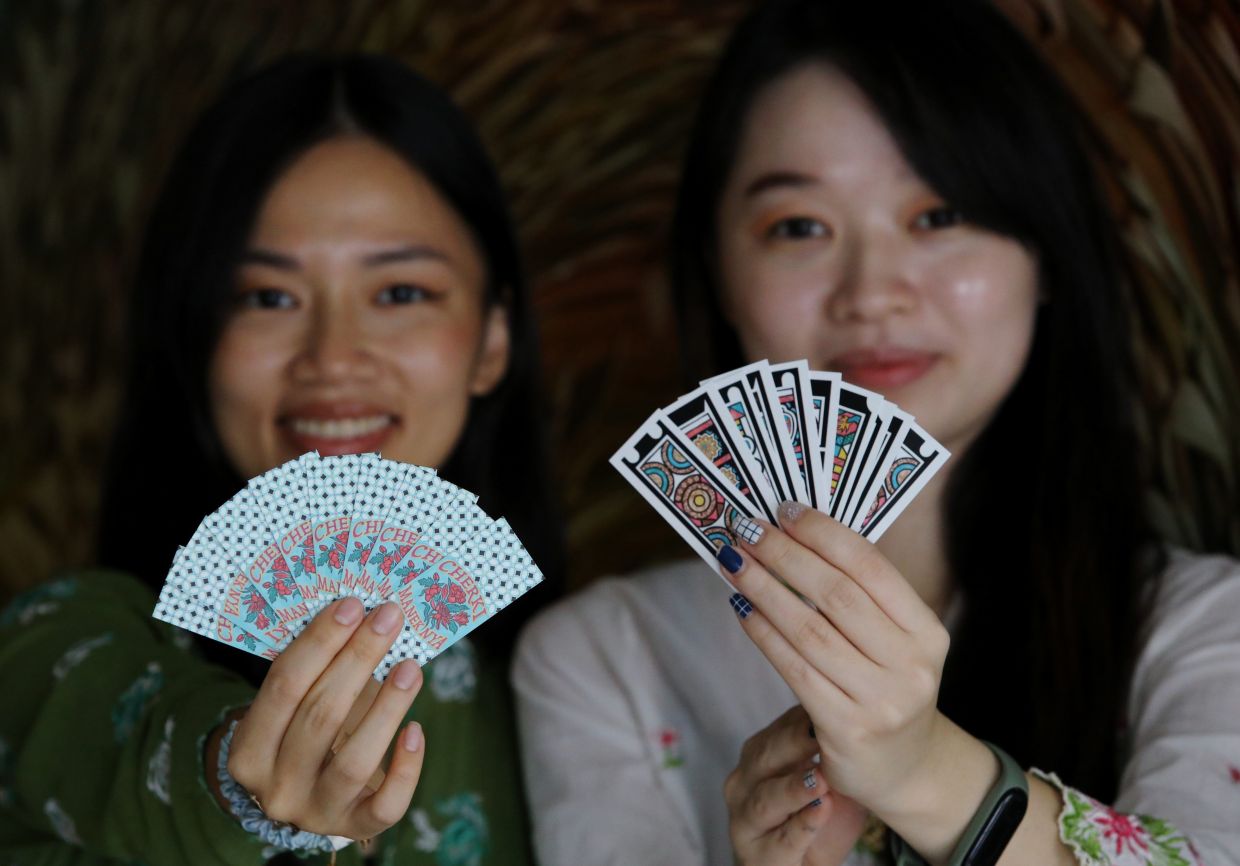
Sisters Lee Swee Lin and Lee Swee May are undertaking a cultural revival project that speaks to a growing anxiety within Malaysia's Peranakan community: the erosion of traditional practices among younger generations. The pair, aged 32 and 31 respectively, have reimagined Cherki, a traditional card game once central to Baba Nyonya household life, infusing it with vibrant colours and contemporary design language while preserving its historical essence. Their effort signals a broader recognition that heritage preservation must evolve to remain relevant in an age of digital entertainment and fractured family structures.
Cherki occupies a peculiar place in Peranakan cultural memory. Unlike the more visible markers of Peranakan identity – the ornate beaded slippers, the intricate baju kebaya, the distinctive hand-painted tiles, or the celebrated culinary traditions of dishes such as ayam buah keluak and Nyonya laksa – this card game has faded into relative obscurity even among those with direct ancestral connections. The traditional version featured austere black-and-white designs, two decks of 60 cards organised into three suits (coins, strings, and myriads) with values ranging from one to nine, alongside three special cards representing white flower, red flower, and old thousand. The game's structure parallels mahjong and was historically known by various names across the Southeast Asian region: Ceki, Chi Kee, Koa, or in Malay, daun ceki, literally "leaf cards."
The genesis of the Lee sisters' project lies in personal loss and reflection. Their paternal grandmother, Deo Yeok Kim, served as the primary custodian of Peranakan traditions within the family. Growing up in their grandmother's Melaka household, the sisters absorbed not merely the mechanics of cultural practices but their underlying meanings – transmitted through food preparation, storytelling, linguistic nuance, and the daily rituals through which tradition perpetuates itself. Following their grandmother's recent passing, they experienced the characteristic shock of generational transition: the sudden realisation that vast repositories of cultural knowledge exist in individual memory rather than institutional practice. This recognition catalysed their decision to intervene in Cherki's decline, transforming what could have remained a personal family loss into a broader cultural initiative.
The sisters' background in Peranakan beaded footwear and decorative pieces provided both practical expertise and philosophical alignment for this venture. Their existing business, headquartered in Kuala Lumpur, already functioned as a vehicle for heritage expression and cultural entrepreneurship. Moving into card game design represented a natural expansion rather than a departure, allowing them to leverage existing design capabilities and cultural knowledge. Beginning their Cherki research and development in 2024, they assembled a small design team and employed digital tools – Procreate and Adobe Illustrator – to accomplish what might have seemed contradictory: modernising while authenticating.
The visual transformation represents more than aesthetic enhancement. Each value card now incorporates distinct Peranakan symbols laden with cultural resonance. The kantan, a fragrant flower central to Nyonya culinary tradition, appears alongside chupu, the porcelain jars historically employed for serving food in formal settings. The kerongsang, the ornamental brooch used to fasten kebaya blouses, features alongside gelang, the bracelets worn by Nyonya women as markers of status and identity. This iconographic integration transforms the cards from abstract gaming implements into educational artefacts, each shuffle introducing players to the material culture of their heritage. Furthermore, the sisters expanded the traditional two-deck structure to four decks, maintaining the 30 distinct patterns while increasing gameplay flexibility, and renamed the special cards butterfly, dragon, and phoenix – symbols of greater immediate resonance to contemporary players than the more obscure original terminology.
The broader context amplifying the urgency of such projects involves measurable cultural disengagement among younger Peranakans. A 2022 comparative study examining cultural material knowledge between original and new-generation Baba Nyonya descendants in Malacca documented how younger community members face increasing exposure to globalised pop culture alongside reduced intergenerational transmission of traditional knowledge. According to Lee Yuen Thien, deputy president of Persatuan Peranakan Baba Nyonya Malaysia (PPBNM), the association maintaining 3,000 members nationwide estimates total Peranakan population at 10,000 to 15,000 individuals. These figures reflect not merely modest community size but profound fragmentation, with geographic dispersal from historical centres in Melaka and Penang undermining the localised networks through which cultural practices traditionally passed between generations.
Multiple structural factors explain this disengagement. Contemporary lifestyles prioritise career advancement and digital entertainment over what many younger people perceive as culturally marginal activities. Migration patterns, changing marriage demographics within and outside the community, and the absorption of families into broader Malaysian society have reshaped Peranakan identity from a comprehensive cultural system into a weekend pursuit, if that. Lee Yuen Thien, who serves as manager of the Baba & Nyonya Heritage Museum in Melaka, acknowledges that reduced family-based cultural transmission has severed the primary mechanism through which communities historically maintained continuity. These are not nostalgic observations but structural realities confronting cultural practitioners attempting to sustain living traditions within contemporary urban Malaysian contexts.
The historical trajectory of Cherki itself underscores how cultural practices travel and transform. Card games originated in China, with documented references to a "leaf game" appearing in Tang Dynasty records from the ninth century. Trading networks subsequently diffused card games westward, with European adoption occurring by the fourteenth century. The Peranakan adaptation represents one layer within this long history of cultural diffusion and localisation. By the colonial period, Cherki had become sufficiently embedded in Baba Nyonya household life to warrant sustained play across the region – Singapore, Malaysia, Indonesia, and Thailand all maintained Cherki traditions. Yet this very embeddedness created vulnerability; when the family structures supporting such games fractured under modernisation pressures, the practice rapidly disappeared from public consciousness, surviving only among elderly players with diminishing audiences.
The design philosophy underlying the revitalised Cherki balances accessibility with authenticity in ways that merit examination. Swee May emphasises that the objective involved making Cherki feel contemporary and immediately appealing rather than consigning it to historical display. Introducing colour and modern illustration served this aim. Simultaneously, the sisters deliberately retained traditional patterns and symbols to preserve genealogical connection to games their grandparents would have recognised. This dual commitment reflects a particular understanding of heritage: not as static museum piece but as living practice capable of evolution while maintaining recognisable continuity. The clearer instructional materials accompanying the new cards further lower entry barriers for players unfamiliar with the traditional game, potentially expanding the player base beyond those with familial transmission of gaming knowledge.
The initiative gains additional significance when situated within broader Southeast Asian conversations about cultural preservation in contexts of rapid modernisation. Malaysia's multicultural framework theoretically provides institutional support for community cultural maintenance, yet practical mechanisms for intervening in heritage decline remain underdeveloped. The Lee sisters' model – combining commercial viability with cultural mission, leveraging existing business infrastructure for heritage purposes, and designing products that function simultaneously as games and educational tools – suggests how younger-generation Peranakans might assume custodianship roles previously held by elders. Their approach implicitly rejects both the false choice between "authentic" historical preservation and necessary cultural evolution, instead positing that heritage survives through creative adaptation.
Lee Yuen Thien argues that cultural continuity depends upon deliberately cultivating awareness of ancestry among younger generations, connecting genealogical identity with living cultural practice. The assumption underlying such interventions holds that interest, once sparked, generates commitment and willingness to invest time in cultural activities. This optimism faces real structural headwinds. Career pressure, urban dispersal, digital entertainment, and competing identity options remain formidable obstacles to cultural engagement. Yet the commercial success of heritage-oriented products across Southeast Asia – from luxury fashion incorporating traditional textiles to tourism experiences centred on cultural authenticity – suggests that market mechanisms might complement family transmission in sustaining practices.
The Cherki revival also reflects emerging patterns whereby second-generation heritage entrepreneurs, often educated abroad and digitally proficient, assume leadership in cultural preservation previously associated with traditional community elders. This generational transition potentially democratises heritage stewardship, distributing responsibility across younger cohorts rather than concentrating it among institutional gatekeepers. Whether such initiatives achieve meaningful cultural persistence remains uncertain; initial market success provides no guarantee of deep engagement with heritage meanings. Yet the very act of making Cherki visually arresting, commercially viable, and accessible to new players represents a philosophical commitment that Peranakan culture merits contemporary expression and continued evolution.
As the Lee sisters' redesigned Cherki cards begin circulating among Malaysian players, they embody a particular response to heritage decline rooted in neither nostalgia nor resignation. The project acknowledges genuine cultural loss while refusing to treat it as inevitable. Whether younger Peranakans will engage with reimagined Cherki at rates meaningful for cultural continuity remains to be determined. What seems clear is that such initiatives, multiplied across communities and domains, increasingly shape how Malaysian heritage survives and transforms in coming decades.

