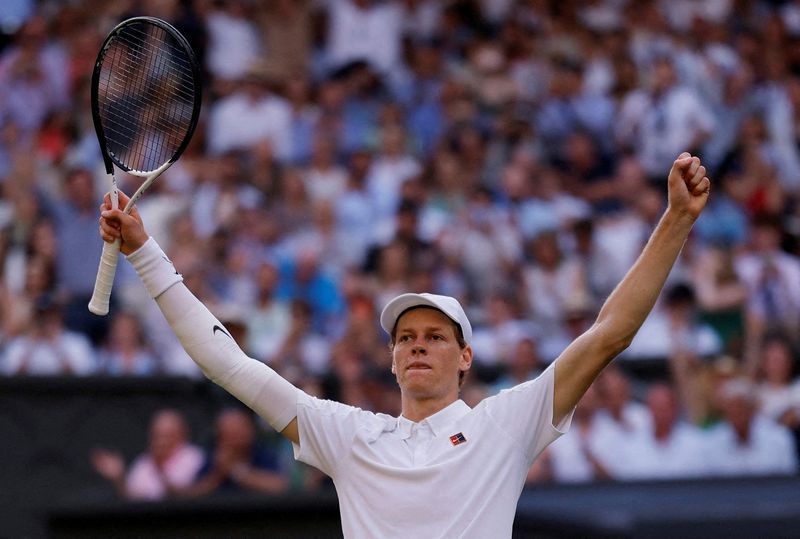
Jannik Sinner's arrival at Wimbledon as defending champion carries a very different complexion this year. The Italian world number one, who had been playing with near-imperious consistency on the clay circuit, stumbled badly at Roland Garros last month, his 30-match winning streak collapsing in the second round. That unexpected exit has fundamentally shifted the narrative surrounding his quest to retain the All England Club title, and rivals sensing vulnerability will be circling as the tournament begins on Monday.
The defending champion's struggles in Paris were not attributable to tactical deficiency or superior opposition, but rather to a physical toll that accumulated during an intensive two-month build-up to the French Open. According to former world champion Mats Wilander, Sinner simply ran out of gas—his body depleted after minimal recovery time and restricted training opportunities between tournaments. The 24-year-old Italian now enters Wimbledon having deliberately skipped the customary warm-up events before major championships, instead opting for rest in an attempt to restore both physical and mental equilibrium.
Wilander, a seven-time Grand Slam victor himself, believes Sinner's enforced break has merit despite the timing concerns. He told La Gazzetta dello Sport that the Italian should arrive on grass in considerably better condition than he was in Paris, where fatigue clearly compromised his performance. However, the veteran also cautioned that grass presents its own particular complexities. Unlike clay, which rewards grinding consistency, the fastest Grand Slam surface demands explosive movement, anticipation, and the ability to abbreviate points through aggressive play—qualities that require sharp physical conditioning to execute effectively.
The immediate threat to Sinner's title defense comes from an increasingly formidable Novak Djokovic, whose grass-court credentials remain formidable despite his 39 years. The Serbian champion reaches Wimbledon chasing dual imperatives: an eighth title at the All England Club that would match Roger Federer's record, and the elusive standalone 25th Grand Slam trophy that represents the last major milestone in his legendary career. Though Djokovic also exited Roland Garros early, his exit carries less significance than Sinner's, operating from a position of relative confidence rather than alarm.
Andy Roddick, the three-times Wimbledon finalist and now respected podcast commentator, articulated the mentality Djokovic carries into the tournament. The Serb's view of the landscape has shifted markedly—with Sinner vulnerable and Carlos Alcaraz sidelined by injury, Djokovic sees genuine opportunity to reclaim the championship he last won four years ago. Roddick suggested that Djokovic would be justifiably emboldened by circumstances, convinced that his unparalleled movement and returning prowess on grass represent a legitimate pathway to title glory despite the late stage of his career.
Perhaps the most consequential challenger to both Sinner and Djokovic is Alexander Zverev, whose French Open victory last month marked the breakthrough Grand Slam triumph that had eluded him throughout his career. The 29-year-old German's newfound status as a major champion carries psychological momentum that cannot be overlooked, and his transition onto grass will be closely scrutinized by observers seeking to determine whether his breakthrough was concentrated clay-specific excellence or evidence of genuine elite development.
Boris Becker, the six-times major champion and fellow German analyst, has openly positioned Zverev as the favorite for the Wimbledon title. Becker's reasoning is straightforward: with Alcaraz absent and Sinner's condition uncertain, the field has fractured into a more distributed competitive hierarchy. Zverev possesses the flat, powerful serve that functions as the foundation for grasscourt success—a weapon so effective that Becker suggested it essentially provides entry to the tournament's semifinal stages. While adaptation to the faster surface remains necessary, Becker contends that Zverev has developed the complete skillset required to prevail.
Alcaraz's injury-enforced absence represents perhaps the most underrated factor reshaping Wimbledon's competitive dynamics. The Spanish champion won consecutive titles in 2023 and 2024, establishing himself as arguably the only player capable of dominating the grass surface with the same comprehensive authority he displays elsewhere. His removal from contention eliminates not merely one rival but an entire category of threat—a player whose all-court mastery transcended surface specialization.
This vacancy has expanded the field beyond the traditional elite triumvirate, creating space for secondary challengers to mount credible campaigns. American Ben Shelton possesses the explosive athleticism and serve power characteristic of successful grass-court players, while his compatriots Taylor Fritz and Frances Tiafoe bring complementary aggressive toolkits to their respective draws. Flavio Cobolli, the 22-year-old Italian who reached the French Open final as runner-up, represents the next wave of ambitious challengers seeking to capitalize on the opportunity Alcaraz's absence provides.
Sinner's task, therefore, involves not merely defending his title but reasserting the dominance that characterized his pre-Paris trajectory. His decision to skip tune-up tournaments and prioritize recovery suggests strategic confidence in his ability to perform at the highest level when it matters most. Yet Wimbledon's unique surface presents genuine variables that clay specialists cannot fully predict or control, regardless of physical preparation. For Sinner, this tournament represents a critical juncture—confirmation of elite status or evidence that last month's collapse signals something more systemic than temporary fatigue.
The interplay between these competing narratives—Sinner's vulnerability, Djokovic's calculated opportunism, Zverev's breakthrough momentum, and Alcaraz's conspicuous absence—has created genuinely open competitive conditions. Malaysian followers of tennis will recognize that Wimbledon 2024 presents the most unpredictable landscape in recent memory, with multiple legitimate title contenders rather than the usual dominant personality. For the Southeast Asian viewing audience, this unpredictability enhances the tournament's appeal precisely because the outcome remains genuinely uncertain.
The All England Club begins on Monday with Sinner seeking redemption after Paris, Djokovic hunting legacy-defining achievement, and Zverev attempting to prove his French Open triumph was merely the beginning of sustained elite performance. Few observers would have predicted such uncertainty at this juncture, yet circumstances have combined to fracture what appeared to be Sinner's fortress.

