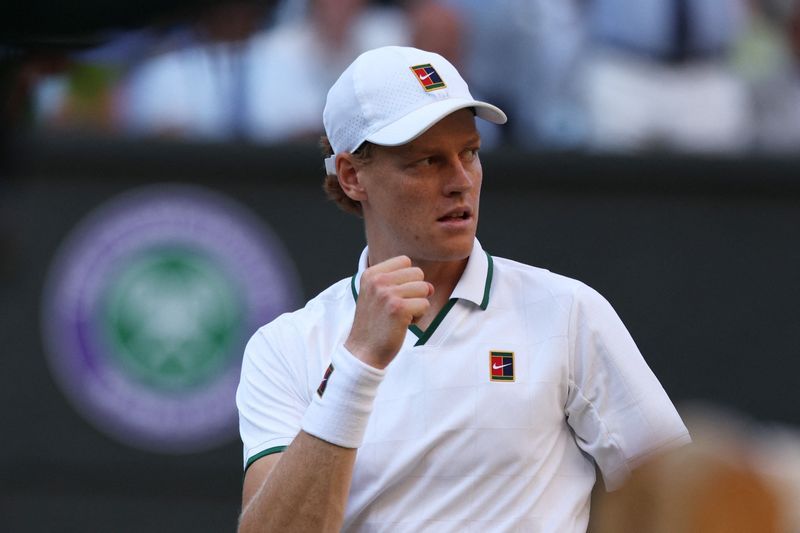
Jannik Sinner has reinforced his position among tennis's elite by successfully retaining the Wimbledon Championship, subduing Alexander Zverev in a hard-fought final contested on Sunday at the All England Club. The Italian's 6-7(7) 7-6(2) 6-3 6-4 victory delivered his fifth major title whilst simultaneously marking his tenth consecutive victory over the German competitor, a remarkable testament to the Italian's current dominance on the sport's biggest stage.
The triumph elevates Sinner into an exclusive historical bracket—he becomes the tenth player in the modern professional era to accomplish the challenging feat of defending a Wimbledon championship. This accomplishment substantially strengthens his credentials as one of the generation's most dominant forces, particularly as he pursues Carlos Alcaraz's collection of seven major titles. With five Grand Slams now secured by his twenty-fourth year, Sinner has already established himself among the sport's most successful active competitors.
In the immediate aftermath of his victory, Sinner reflected on the significance of succeeding at Wimbledon, the sport's most revered tournament venue. Speaking whilst holding the distinctive pineapple-topped trophy, he articulated the profound emotional weight of performing at the storied grass-court championship. He acknowledged the anxiety that accompanies such high-stakes competition, describing the experience of awakening on finals day with full awareness of the magnitude of the occasion. His gratitude extended explicitly to the spectators whose presence throughout the fortnight had generated an atmosphere unmatched in professional tennis.
The final itself unfolded as a compelling examination of both competitors' technical and mental fortitude. The opening set proved particularly absorbing, with both finalists sustaining elevated intensity across twelve games whilst battling beneath warm, blustery conditions characteristic of English summer weather. Zverev subsequently demonstrated improved form, executing a powerful forehand stroke that secured him the opening set's tiebreak, celebrating with visible emotion as the crowd acknowledged the quality of his performance.
However, Sinner's response proved characteristic of his temperament under pressure. Following the initial setback, the Italian elevated his own standard during the second set, particularly during the tiebreak where cleaner ball-striking and superior positioning established his dominance. Meanwhile, Zverev's frustration mounted visibly as Sinner's momentum gathered, culminating in the German's tiebreak capitulation that levelled the match.
The pivotal moment arrived during the third set when circumstances shifted dramatically in Sinner's favour. After more than two and a half hours of sustained competition, Zverev presented his first genuine break-point opportunity at the midway stage of the set. However, his attempt to capitalise proved catastrophic when a Sinner drop shot successfully wrong-footed the German, causing him to slip and fall heavily onto the Centre Court surface. The immediate aftermath saw Zverev writhing on his back whilst clutching his right knee, prompting audible concern from the assembled spectators who recognised the gravity of the injury.
Despite the evident discomfort, Zverev demonstrated considerable determination by continuing play rather than retiring. Yet his momentum had unequivocally shifted. In the subsequent game, Sinner capitalised opportunistically to secure the break, accelerating towards a 5-3 advantage. Zverev's frustration boiled over into observable displays of anguish, whilst Sinner maintained his focus to consolidate the third set victory after nearly three hours of exhausting competition.
The fourth and final set witnessed Sinner's technical superiority become increasingly apparent. Breaking once more for a 4-3 lead, the Italian navigated the remainder of the set with assured precision whilst Zverev's physical and mental reserves appeared depleted. Sinner's capacity to sustain performance levels throughout extended matches has become his defining characteristic, enabling him to outlast opponents when conditioning and concentration prove decisive. Upon securing the final point, Sinner collapsed to the grass in an outpouring of emotion that reflected both the magnitude of the achievement and the physical demands of the preceding hours.
For Zverev, the result represented a fourth Grand Slam final defeat, an increasingly frustrating statistic that highlighted his continued inability to capture his maiden major championship despite multiple opportunities. His post-match remarks combined genuine admiration for Sinner's superiority with wry humour regarding the relentless nature of his losing streak. Zverev's acknowledgment that Sinner possessed the credentials to claim the sport's top ranking whilst himself securing consecutive defeats underscored the widening gulf between the world's pre-eminent players and the remainder of the elite contingent.
For Malaysian and Southeast Asian tennis enthusiasts, Sinner's sustained excellence provides compelling evidence that the sport's competitive landscape continues evolving. The Italian's emergence as a consistent major winner alongside Alcaraz demonstrates that tennis remains dominated by a small cohort of players capable of delivering performances at the sport's grandest venues. Their trajectory suggests that such dominance may persist through the remainder of the decade, with major championships increasingly difficult for other competitors to breach.
Sinner's particular trajectory merits attention from regional sports observers, as his success represents a broader pattern within tennis where developing nations produce technically accomplished players through systematic talent development and investment in infrastructure. His pathway from Italian regional competitions to global dominance illustrates how modern professional tennis increasingly rewards rigorous preparation and technical excellence rather than relying upon inherited privilege or geographic accident.
The defending champion's performance at Wimbledon simultaneously raises intriguing questions regarding the sport's competitive future. Should Sinner and Alcaraz continue competing at current levels whilst younger players struggle to establish themselves, the familiar pattern of dominance by a privileged few may accelerate. Conversely, continued emergence of technically accomplished competitors from non-traditional tennis nations might eventually challenge the existing hierarchy, though such transformation typically requires sustained institutional commitment across multiple decades.

