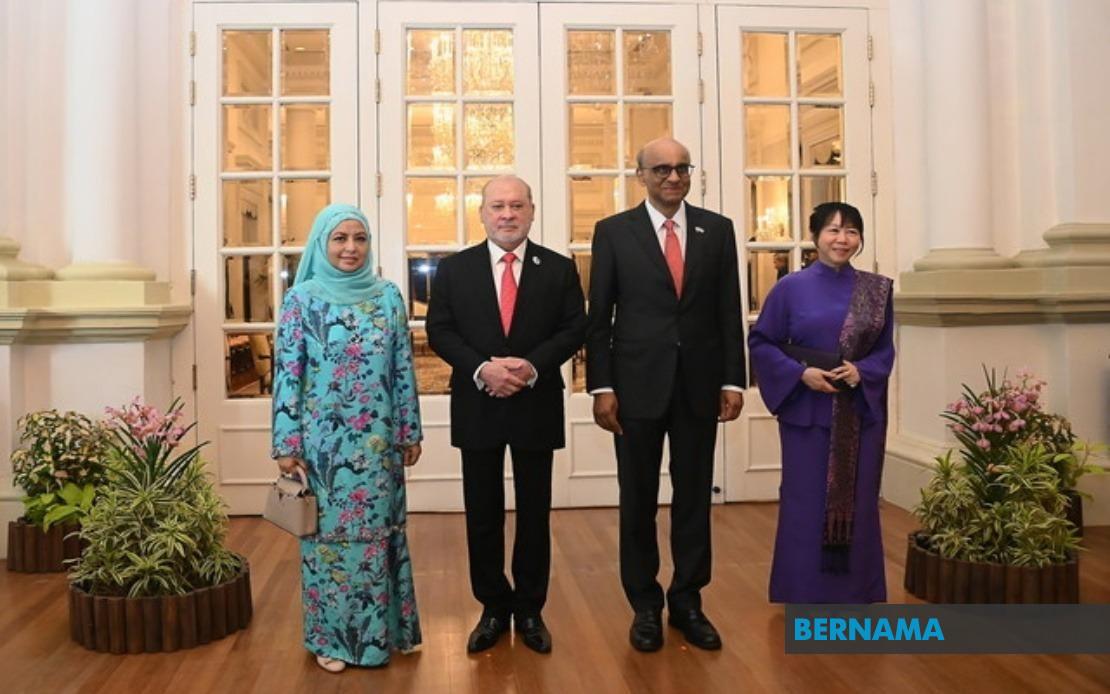
Singapore President Tharman Shanmugaratnam arrives in Malaysia this week for a three-day state visit, reaffirming that the city-state's relationship with its neighbour rests on foundations far deeper than trade statistics or infrastructure projects. Speaking ahead of the visit at the invitation of His Majesty Sultan Ibrahim, King of Malaysia, President Tharman characterised the partnership as uniquely substantial—built across six decades on shared history, mutual respect and a demonstrated commitment to dialogue that has weathered occasional disagreements without fracturing the broader bond.
The Singapore leader's perspective offers timely reassurance during an era of regional strain. He emphasised that while the two nations inevitably clash on specific issues, as any close neighbours must, the accumulated trust and goodwill forged over 60 years provides the resilience to manage such disputes through calm, respectful negotiation grounded in international law. This approach, he suggested, holds lessons for ASEAN and the wider world—demonstrating that regional stability need not depend on the absence of conflict, but rather on the discipline and maturity to address it responsibly.
President Tharman painted a vivid picture of the civilisational ties binding both nations. He cited recent joint successes in cultural preservation, including the UNESCO inscription of the kebaya alongside Brunei, Indonesia and Thailand, and ongoing efforts to secure recognition for Chingay, the colourful street procession that embodies the evolving multicultural character of both societies. These endeavours, he argued, represent more than ceremonial gestures—they are deliberate mechanisms for transmitting shared traditions to younger generations, ensuring that the cultural bedrock underpinning political ties remains alive and resonant.
At the economic level, President Tharman outlined an ambitious vision for deepening integration that goes significantly beyond existing cooperation frameworks. He acknowledged that the fracturing of the global trading system and intensifying great-power competition necessitate a strategic recalibration: Singapore and Malaysia must increase their combined value proposition to the world by integrating their markets more closely, building greater energy and supply chain resilience through partnership, and pioneering collaboration in emerging sectors such as renewable energy, the digital economy and green technology development. The Johor-Singapore Special Economic Zone exemplifies this philosophy—a joint investment designed to harness each nation's respective strengths for mutual benefit.
The Rapid Transit System Link, connecting Johor Bahru and Singapore, represents a particularly tangible symbol of this deepening partnership. By streamlining daily commutes for hundreds of thousands of Malaysians and Singaporeans who regularly cross the Johor-Singapore Causeway—the world's busiest land border crossing—the RTS Link addresses a practical reality that affects ordinary citizens rather than merely government or corporate elites. This human dimension reflects a conscious shift in how both countries frame their bilateral relationship: not as an elite-driven negotiation, but as a partnership that must demonstrably improve the lives of people on both sides.
Climate change and energy transition present another frontier for cooperation. As tropical nations sharing similar environmental vulnerabilities, Singapore and Malaysia face a complex constellation of sustainability challenges. Both have announced ambitious energy transition and decarbonisation targets, creating natural opportunities for collaboration in renewable energy development and carbon credit markets. President Tharman's framing suggests that such cooperation is not merely an environmental imperative but an economic opportunity—a chance to position both nations as leaders in the green economy transition that will define regional competition in coming decades.
At the regional level, President Tharman stressed the importance of Singapore and Malaysia working in tandem to strengthen ASEAN's centralised role in the regional order. He commended Malaysia's 2025 ASEAN Chairmanship under Prime Minister Datuk Seri Anwar Ibrahim, noting its successful navigation of complex geopolitical conditions and its achievement of significant milestones including Timor-Leste's accession as the bloc's 11th member. With Singapore assuming the Chair in 2027, the two countries have an opportunity to maintain momentum on ASEAN integration initiatives, particularly the Digital Economy Framework Agreement—a measure whose implementation could potentially double ASEAN's digital economy from its projected US$1 trillion baseline in 2030 to US$2 trillion.
Perhaps most significantly, President Tharman prioritised people-to-people engagement as critical infrastructure for the bilateral relationship's long-term resilience. He observed that the regular interaction and familial connections that characterised earlier decades cannot be assumed to occur naturally among younger generations. This recognition prompted a call for deliberate expansion of exchange programmes, joint internships, youth leadership forums and collaborative community projects—mechanisms designed to ensure that friendships and understanding across the border remain actively cultivated rather than passively inherited.
This emphasis on younger generations reflects a perceptive understanding of a genuine vulnerability in the Singapore-Malaysia relationship. Demographic change, urbanisation, and the migration of social interaction to digital platforms mean that spontaneous cross-border encounters that once bound families and communities together have become less frequent for many young Singaporeans and Malaysians. Without proactive intervention, this generational transition risks eroding the interpersonal relationships that have historically cushioned bilateral disagreements and facilitated pragmatic problem-solving.
President Tharman's language throughout his remarks carries an unusual warmth and philosophical depth for official diplomatic discourse. His repeated invocation of heart-to-heart connection—captured in his characterisation of letting "our hearts shake hands"—signals an attempt to transcend the transactional framing that often dominates bilateral relations. This rhetorical choice may reflect recognition that in an increasingly fractious world, the trust and familiarity accumulated between Singapore and Malaysia represent genuine strategic assets that require consistent renewal and reinforcement at emotional as well as institutional levels.
The timing of the state visit carries additional significance given regional geopolitical tensions. With great-power competition intensifying and the regional order facing strains from multiple directions, the visible commitment of Singapore's presidency to Malaysia, endorsed through ceremonial state visit protocols, amounts to a public signal of stability within Southeast Asia's core. For Malaysian readers, it underscores that despite occasional bilateral friction on specific issues—whether related to maritime boundaries, water arrangements, or other sensitive matters—the fundamental relationship remains robust enough to weather such disagreements.
Looking forward, President Tharman's vision maps a course toward what might be termed "qualitative deepening" of the Singapore-Malaysia relationship. Rather than pursuing expansive new mega-projects alone, the emphasis falls on enriching the density of existing cooperation across multiple dimensions—cultural, economic, environmental, and interpersonal. This approach recognises that the relationship's most valuable asset is not any single infrastructure project or trade agreement, but the accumulated reservoir of trust, understanding and mutual interest that permits both nations to navigate shared challenges as partners rather than competitors.

