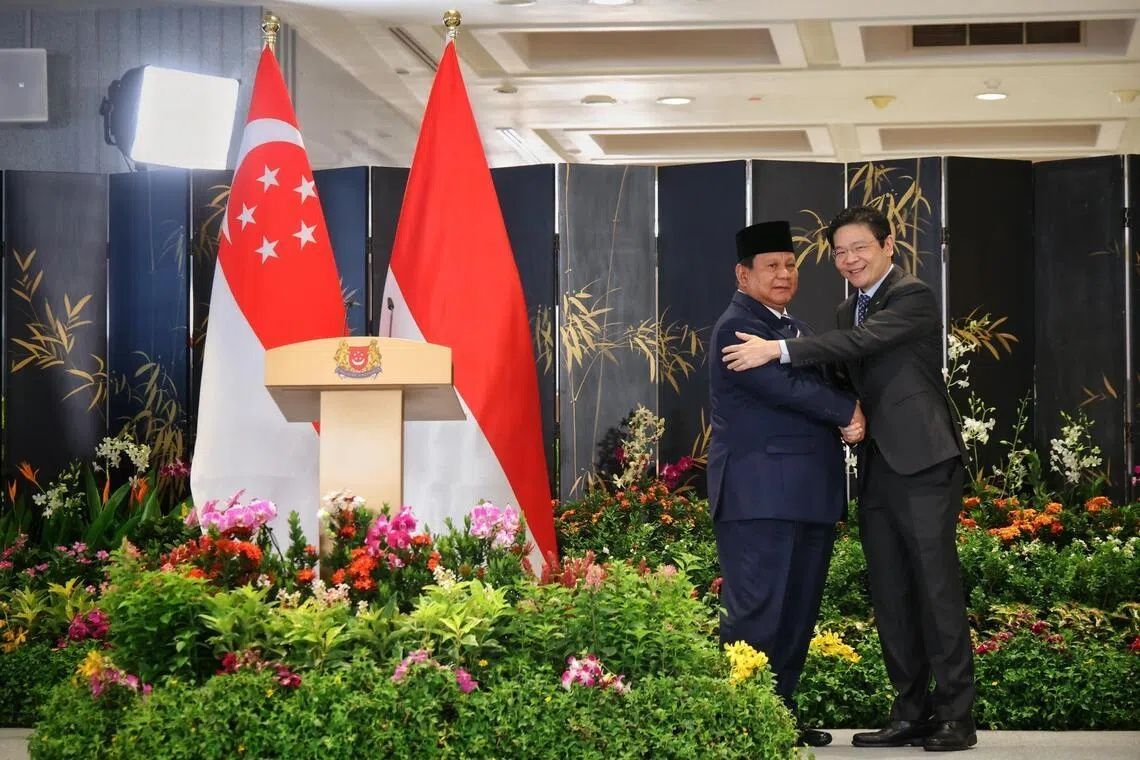
Prime Minister Lawrence Wong will arrive in Jakarta on Monday, July 6, to participate in the Singapore-Indonesia Leaders' Retreat, a high-level diplomatic engagement that underscores the strategic importance both governments place on their bilateral relationship. The retreat, hosted by President Prabowo Subianto, represents the second such formal meeting between the two nations' top executives and serves as the premier platform for reviewing and advancing cooperation across all sectors of mutual concern.
The Leaders' Retreat format has become the cornerstone mechanism through which Singapore and Indonesia conduct their most consequential discussions on matters of state. By bringing together the prime minister and president alongside senior cabinet ministers from both sides, the retreat ensures that complex cross-border issues receive high-level attention and that decisions reached carry the full weight of governmental commitment. This institutional regularity demonstrates how both nations have moved beyond occasional exchanges to structured engagement that keeps pace with evolving regional circumstances.
According to the Prime Minister's Office statement released on July 5, the two leaders will use this occasion to reaffirm their commitment to deepening bilateral cooperation and to review the trajectory of partnership established during their previous retreat held in Singapore in June 2025. The annual cadence of these meetings ensures continuity in strategic dialogue while allowing each side to assess progress on agreed initiatives and recalibrate approaches where necessary.
During the retreat, Wong and Prabowo are expected to examine bilateral projects undertaken since their last meeting and discuss fresh avenues for strengthening collaboration in areas of mutual interest. This forward-looking dimension of the talks reflects how the two countries are actively seeking to expand their partnership beyond conventional domains. Significantly, both leaders will also exchange perspectives on broader regional and global developments, positioning the retreat as an opportunity to coordinate positions on issues affecting not just Singapore and Indonesia but the wider Southeast Asian community.
The expansion of Singapore-Indonesia cooperation into emerging sectors reveals shifting priorities in how the two nations view their relationship. While trade, investment, and defence have historically formed the backbone of their engagement, both governments now recognize the imperative to collaborate on green economy initiatives, cross-border electricity trade arrangements, carbon capture and storage technologies, artificial intelligence applications, and digital infrastructure development. This sectoral diversification reflects shared recognition that twenty-first century challenges and opportunities demand partnerships that transcend traditional frameworks.
Indonesia's role as Singapore's leading source of foreign direct investment underscores the robustness of their economic relationship. In 2025, Singapore channelled US$17.4 billion—equivalent to S$22.4 billion—into Indonesian ventures, demonstrating sustained confidence in the investment climate and economic prospects of the archipelago nation. This substantial capital flow creates interdependent economic ties that serve as ballast for political and strategic engagement, particularly important given the historical complexities that have occasionally strained bilateral relations.
Wong will lead a substantial delegation comprising several of Singapore's most senior ministers. Gan Kim Yong, serving as Deputy Prime Minister and Minister for Trade and Industry, will coordinate economic and commercial aspects of the discussions. Chan Chun Sing, Coordinating Minister for Public Services and Minister for Defence, brings responsibility for security matters into the delegation. Foreign Minister Vivian Balakrishnan will handle diplomatic protocol and broader international relations dimensions. The inclusion of Masagos Zulkifli, Minister for Social and Family Development, and Tan See Leng, Minister for Manpower and Minister-in-charge of Energy and Science and Technology, signals that discussions will encompass social policy, energy transition, and technological innovation alongside traditional statecraft concerns.
The composition of Singapore's delegation reflects how contemporary bilateral engagement spans traditional diplomacy and defence considerations to encompass economic strategy, technological advancement, and cross-cutting global challenges. This broad ministerial representation ensures that discussions benefit from specialist expertise and that outcomes can be implemented across multiple government agencies without requiring additional coordination layers.
During Wong's time in Jakarta, Coordinating Minister for National Security and Minister for Home Affairs K. Shanmugam will assume the responsibilities of acting prime minister, ensuring continuity of governance in Singapore. This procedural arrangement allows Wong to participate fully in the retreat discussions without concerns about decision-making gaps, reflecting Singapore's institutionalized approach to executive continuity.
The retreat also carries significance for Malaysia and other Southeast Asian nations watching how the region's two largest economies navigate their relationship. Singapore's role as a financial hub and Indonesia's position as the region's largest economy by population and land area mean that their bilateral dynamics influence broader regional stability and economic prospects. The emphasis on green economy collaboration and energy initiatives takes on particular relevance for Malaysia, which faces similar sustainability pressures and energy transition imperatives. By observing how Singapore and Indonesia coordinate on these emerging challenges, Malaysian policymakers gain insights into potential frameworks for regional cooperation on shared environmental and development goals.
The previous Leaders' Retreat held in Indonesia occurred in April 2024 at the Bogor Presidential Palace, when then-Prime Minister Lee Hsien Loong met then-President Joko Widodo. Wong, then serving as Deputy Prime Minister and Finance Minister, and Prabowo, who held the rank of president-elect at that time, were both present. This historical continuity in participation suggests that both leaders have long invested in nurturing the bilateral relationship, and their continuation of the retreat tradition signals unbroken commitment to bilateral stewardship during their respective tenures.
The timing of this retreat arrives as both nations contemplate their medium-term strategic priorities in an increasingly multipolar international environment. Regional geopolitical shifts, evolving great power competition, and transnational challenges from climate change to cybersecurity threats create an imperative for Southeast Asian nations to strengthen partnerships that enhance resilience and broaden options. The Singapore-Indonesia retreat provides the diplomatic architecture through which two key regional players coordinate responses to these multifaceted pressures while advancing their individual national interests.

