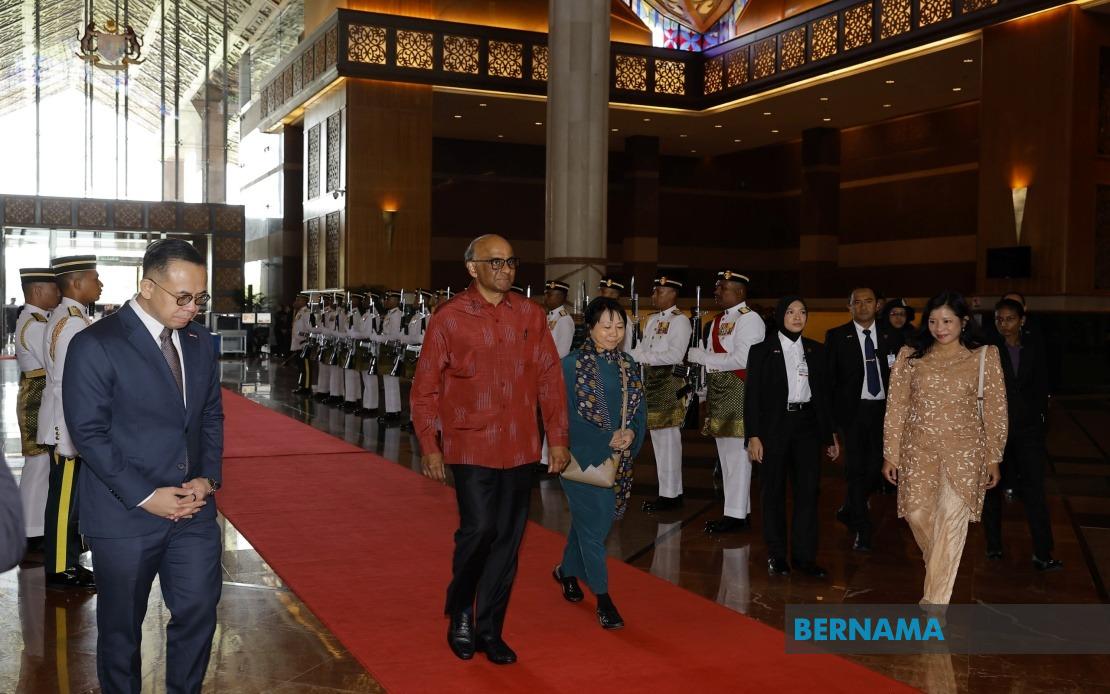
Singapore President Tharman Shanmugaratnam departed Malaysia on Tuesday afternoon, bringing to a close a carefully orchestrated three-day state visit that underscored the enduring diplomatic bonds between the two closely intertwined neighbours. The President, accompanied by his spouse Jane Ittogi and an official delegation, boarded a commercial flight from Kuala Lumpur International Airport's Terminal 1 at 2.20 pm, concluding what constitutes his inaugural state visit to Malaysia since taking office as Singapore's ninth President in September 2023.
The departure from KLIA followed a formal farewell ceremony at the Bunga Raya Complex, where Tharman received a Guard of Honour comprising two officers and 26 personnel drawn from the First Battalion of the Royal Ranger Regiment under the command of Captain Muhammad Hanafi Ja'afar. Minister of Entrepreneur and Cooperatives Development Steven Sim represented the Malaysian government at the airport to extend official goodbyes to the visiting dignitary and his entourage, underlining the significance Malaysia places on maintaining cordial relations with its northern neighbour.
Tharman's visit, which commenced on Sunday at the formal invitation of His Majesty Sultan Ibrahim, King of Malaysia, carried particular diplomatic weight as a reciprocal gesture. The three-day engagement directly responded to Sultan Ibrahim's own state visit to Singapore in May 2024, demonstrating the commitment both nations share in maintaining high-level political dialogue and reinforcing the fraternal ties that have historically characterised their relationship despite occasional bilateral tensions. Such reciprocal visits between heads of state serve as crucial instruments for sustaining goodwill and addressing shared concerns at the highest levels of government.
The itinerary during Tharman's stay reflected the traditional protocols of state visits while encompassing substantive engagement with Malaysia's senior leadership. On Monday, the visiting President was accorded full ceremonial honours with a state welcoming ceremony, followed immediately by an audience with Sultan Ibrahim at Istana Negara, the official residence of the Malaysian monarch. These formal encounters established the proper diplomatic framework for subsequent discussions on matters of mutual interest to both nations.
Beyond his audience with the King, Tharman received Prime Minister Datuk Seri Anwar Ibrahim in a courtesy call that brought together Malaysia's most senior government figures. The gathering included Foreign Minister Datuk Seri Mohamad Hasan, whose portfolio encompasses bilateral relations; Investment, Trade and Industry Minister Datuk Seri Johari Abdul Ghani, reflecting the economic dimensions of Singapore-Malaysia ties; and Steven Sim, further indicating the breadth of issues addressed during the visit. The composition of this ministerial delegation suggests discussions likely encompassed trade relations, investment frameworks, and regional economic cooperation.
The visit extended beyond the federal capital, demonstrating an effort to engage with Malaysia's constituent states. On the second full day of his visit, the Sultan of Selangor, Sultan Sharafuddin Idris Shah, granted an audience to President Tharman at Istana Alam Shah, the royal palace of Selangor. This inclusion of state-level engagement illustrates how contemporary state visits involve not merely the federal centre but also the constitutional monarchies that form the bedrock of Malaysia's unique political architecture.
For Malaysian observers and policymakers, Tharman's visit carries significance beyond ceremonial protocol. The Singapore President, a respected economist and policymaker, represents Singapore's perspective on economic governance and development strategy. His engagement with Malaysia's investment and trade minister suggests an opportunity to explore deepening economic cooperation between the two nations, particularly given Singapore's role as a financial hub and its proximity to Malaysia's manufacturing and service sectors. Such high-level visits often lay groundwork for subsequent technical negotiations on trade agreements, infrastructure projects, and cross-border initiatives.
The timing and nature of this visit also reflect broader regional dynamics. Southeast Asia continues to navigate geopolitical complexities, and the strength of Singapore-Malaysia relations carries implications for regional stability and ASEAN cohesion. Both nations remain central to ASEAN's functioning and to the various regional mechanisms through which Southeast Asian states coordinate on security, economic, and social matters. Demonstrating robust diplomatic engagement through state visits signals to the broader international community that these two key regional players maintain stable, functioning relationships.
From a Malaysian perspective, such visits reinforce the country's position as a significant diplomatic player in Southeast Asia. Despite the population and land area differences favouring Malaysia, Singapore's economic weight and strategic importance mean that high-level engagement from Malaysian leadership remains valuable for regional balance. The reciprocal nature of these visits, with Sultan Ibrahim having travelled to Singapore months earlier, demonstrates mutual respect and commitment to sustained dialogue rather than any hierarchy in the relationship.
Looking forward, the success of Tharman's state visit likely sets a positive tone for subsequent diplomatic engagements and technical discussions between the two governments. State visits, while inherently ceremonial, serve as catalysts for deeper bureaucratic and technical cooperation. The relationships built and reaffirmed during such occasions frequently translate into concrete agreements on matters ranging from water supply agreements to labour mobility frameworks that directly affect the daily lives of citizens on both sides of the causeway. Both nations will undoubtedly build upon the foundation established during this visit to address contemporary challenges in maritime security, climate change, and economic transformation that define their shared interests.

