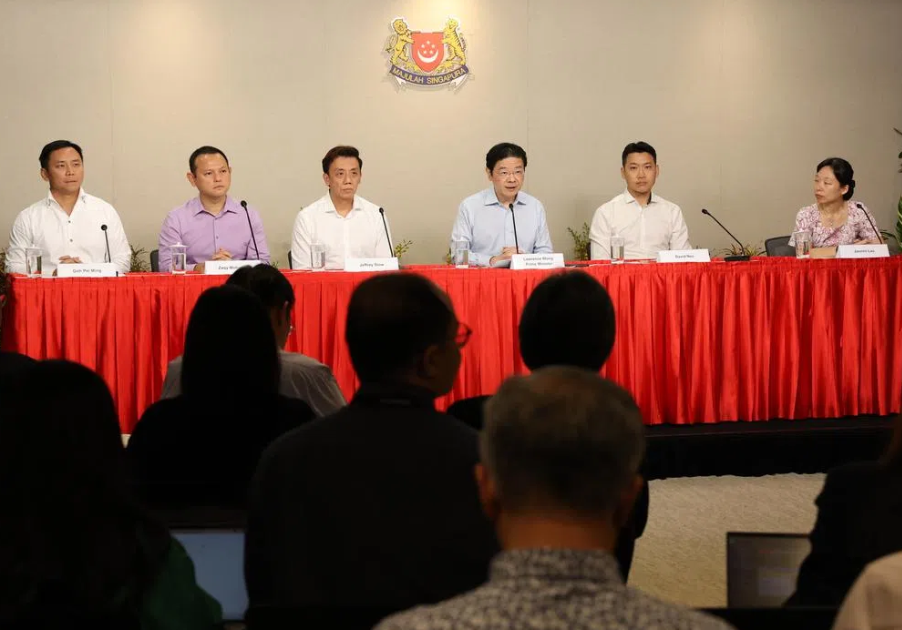
Singapore's leadership hierarchy shifted significantly on July 22 when Prime Minister Lawrence Wong announced a comprehensive Cabinet reshuffle designed to accelerate the advancement of first-term politicians while retaining the guidance of senior figures. The restructuring marks another step in the ruling administration's carefully choreographed succession planning, particularly following recent unexpected departures from the political ranks that have created urgency in building what the Prime Minister described as a "strong pipeline" of talent.
Two General Election 2025 newcomers have been elevated to full ministerial rank in the shuffle. Jeffrey Siow, who has served as Acting Transport Minister since May 2025, and David Neo, who held the Acting Minister for Culture, Community and Youth portfolio, will now occupy these positions on a permanent basis while retaining their existing portfolios. Their promotions represent a significant vote of confidence in the abilities of first-term parliamentarians and suggest the administration believes they have demonstrated sufficient competence and earned the trust of both political colleagues and the civil service apparatus.
Sim Ann, another first-term politician, has been appointed Second Minister for Foreign Affairs and Home Affairs, expanding her responsibilities and positioning her within two critical ministerial domains. Meanwhile, Jasmin Lau will assume the role of acting minister for the Manpower Ministry, taking over from Tan See Leng, who transitions to become Minister for Trade and Industry with a specific focus on energy and industrial matters. This movement demonstrates a deliberate strategy to widen the experience base of younger politicians across multiple sectors of government.
The reshuffle also brings Ng Chee Meng, the labour union chief, back into Cabinet as Minister in the Prime Minister's Office, restoring him to a centralized position within the senior leadership structure. Equally significant is the elevation of K. Shanmugam to Senior Minister status, recognising him as one of the two most experienced members of Cabinet alongside Lee Hsien Loong. Two backbench members—Foo Cexiang and Shawn Loh—transition from the parliamentary backbenches to ministerial positions as Ministers of State, continuing a pattern of promoting accomplished first-term MPs into the executive branch.
Prime Minister Wong articulated the philosophical underpinning of these changes during a press conference at the National Press Centre, emphasizing that Singapore requires both stabilizing force from seasoned administrators and the dynamism of emerging talent. He specifically noted that those promoted "have settled into their roles well, earned the confidence of their colleagues and of the civil servants they work with, and show that they are ready for greater responsibilities." This language suggests a gradual apprenticeship model wherein political newcomers prove themselves through acting positions before securing permanent appointments.
The timing of the reshuffle reflects reactive as well as proactive governance. Two significant political departures in 2026 precipitated the restructuring. Acting Minister-in-charge of Muslim Affairs Faishal Ibrahim resigned on July 20 following what he characterized as a "lapse of judgment" in managing his personal interactions with a woman while simultaneously serving as Senior Minister of State for Home Affairs. This resignation followed an earlier departure in June when senior minister of state Koh Poh Koon stepped down citing family reasons. These unexpected losses of experienced personnel necessitated accelerated promotion of ready successors, making the timing of the broader renewal exercise somewhat opportunistic.
Prime Minister Wong defended the Cabinet's structural continuity regarding the number of deputy prime ministers, noting that a single deputy—Gan Kim Yong—alongside the current arrangement of three Coordinating Ministers provides appropriate senior leadership capacity. He indicated, however, that this configuration remains subject to evolution as the generational transition deepens. K. Shanmugam serves as Coordinating Minister for National Security, whilst Chan Chun Sing and Ong Ye Kung oversee other governmental domains, creating a distributed leadership model that extends responsibility beyond the immediate deputy prime ministerial tier.
For Malaysian observers, Singapore's approach to leadership succession offers instructive parallels. Both nations grapple with the challenge of transitioning from founding-generation politicians to successors, managing the preservation of institutional knowledge whilst creating space for fresh perspectives. Singapore's strategy of gradual elevation through acting positions allows rigorous vetting before permanent advancement, contrasting with some regional alternatives that rely on more abrupt transitions. The explicit acknowledgment that individuals "develop at different paces" suggests patience with the renewal process rather than arbitrary timelines.
The reshuffle's emphasis on retaining senior figures in advisory and mentoring capacities rather than removing them entirely from influence merits attention. By promoting Shanmugam to Senior Minister while Lee Hsien Loong retains similar status, Singapore keeps two of its most experienced administrators positioned to guide younger colleagues. This model differs from approaches in some other systems where retirement or marginalization of predecessors creates vacuum conditions. Prime Minister Wong described this as "the Singapore way of leadership renewal," positioning it as a distinctive characteristic of the administration's approach.
Perhaps most revealing is Wong's candid acknowledgment that he continues his search for a successor in the Finance Ministry, a portfolio he has held since 2021. His characterization of this search as "a work in progress" suggests no artificial deadline or predetermined candidate. This transparency about succession planning in critical economic roles provides unusual insight into how senior leaders evaluate readiness across different individuals and portfolios. Wong's emphasis on matching people "to positions where they can best contribute" rather than forcing predetermined career trajectories indicates a flexibility in planning that adapts to both institutional needs and individual development.
The structural implementation of changes, rolling out progressively from July 27 with some adjustments occurring later, demonstrates a managed approach to transition that avoids disruptive simultaneity. This graduated implementation allows for administrative stability whilst establishing new reporting relationships and ministerial responsibilities. For regional governments observing Singapore's methods, such phased approaches to significant organizational changes offer templates for minimizing operational disruption whilst effecting substantive leadership renewal.
As these promotions take effect, Singapore's Cabinet will feature an increasingly mixed cohort of first-term politicians in substantive roles alongside veterans, creating a hybrid leadership structure. The success of this reshuffle will likely be measured not only by the competence of individual ministers but by their ability to collaborate effectively across generational lines. Wong's vision of continuous renewal as "the Singapore way" suggests that further iterations of this pattern should be anticipated, with each cycle attempting to deepen the bench strength whilst maintaining institutional continuity through experienced guidance.

