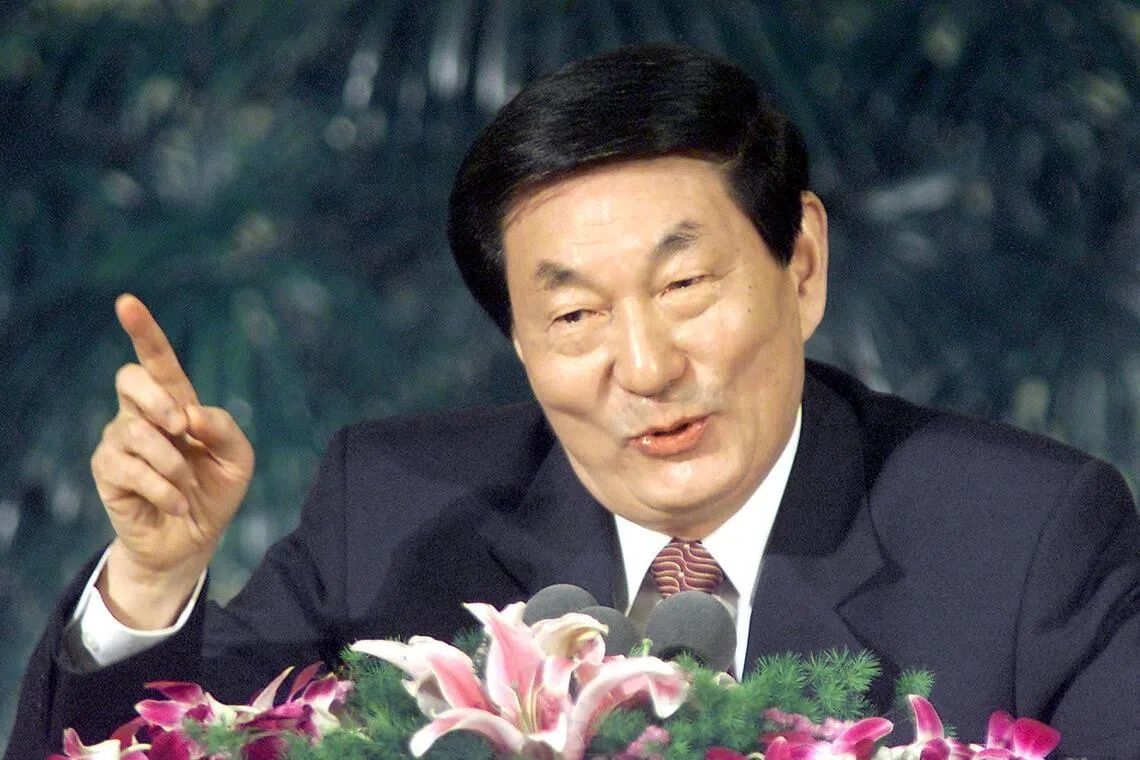
Singapore's Prime Minister Lawrence Wong has conveyed his condolences to Chinese Premier Li Qiang following the passing of former Premier Zhu Rongji, who died in Beijing on Wednesday, August 12, at the age of 97. The death of Zhu, who served as China's premier during a transformative period in the country's economic history, marks the end of an era for one of the architects of modern Chinese policy who left an indelible mark on regional relations across Asia.
In a formal letter dated August 13, PM Wong acknowledged Zhu's extraordinary career spanning decades of public service, during which he championed some of China's most consequential economic reforms. As premier, Zhu navigated China through a period of profound structural change, guiding the nation's accession to the World Trade Organization in 2001—a milestone that fundamentally altered global trade dynamics and positioned China as a central player in international commerce. His stewardship during these formative years established the institutional and policy frameworks that would eventually propel China to become the world's second-largest economy.
PM Wong characterised Zhu as an "old friend of Singapore," underscoring the personal diplomatic relationships that transcended the formal mechanisms of state-to-state engagement. The letter notes that Zhu maintained regular contact with Singapore's former prime ministers Lee Kuan Yew and Goh Chok Tong across multiple meetings over the years, reflecting a continuity of bilateral relationship-building at the highest levels. These personal connections, built through sustained engagement and mutual respect, became the foundation upon which modern Singapore-China relations would develop and strengthen over subsequent decades.
A particularly significant moment in Zhu's relationship with Singapore occurred in 1999, when he became the first Chinese leader to deliver the Singapore Lecture, a prestigious annual address organised by the ISEAS – Yusof Ishak Institute. This platform, which hosts globally prominent leaders and intellectual figures to discuss matters of international consequence, gave Zhu the opportunity to articulate his vision for China's role in the regional and global economy. His address during that historic occasion went beyond merely outlining economic policy; it represented a deliberate statement of intent regarding China's intentions towards Asia and the broader international community during a pivotal moment in the post-Cold War era.
The substance of Zhu's 1999 lecture proved remarkably prescient. He articulated a strategic conception wherein China's own economic development would generate mutual benefits for the broader Asian region and the world at large. More concretely, he proposed the creation of a free trade arrangement between the Association of Southeast Asian Nations and China—a proposal that appeared ambitious at the time but has since become reality. The ASEAN-China Free Trade Agreement, formally implemented years later, transformed regional commerce and deepened the economic interdependencies between China and Southeast Asian nations, validating Zhu's forward-thinking approach to regional economic integration.
PM Wong emphasised that Zhu's strategic vision has been thoroughly vindicated by subsequent developments. China has indeed evolved into a principal economic partner for Singapore and other regional countries, with bilateral trade volumes and investment flows dramatically expanding since Zhu's era. The Southeast Asian region has benefited substantially from this deepening economic relationship, which has created employment opportunities, facilitated technology transfer, and generated shared prosperity across multiple sectors. Singapore, positioned as a crucial hub for regional commerce, finance, and logistics, has been particularly well-positioned to leverage these opportunities.
Beyond the macro-level economic relationship, PM Wong highlighted Zhu's direct contributions to specific bilateral development projects. The China-Singapore Suzhou Industrial Park stands as perhaps the most tangible legacy of Zhu's support for collaborative ventures between the two countries. This government-to-government initiative, established during Zhu's tenure, transformed a parcel of land near Shanghai into a thriving economic zone that has generated billions in investment and created tens of thousands of jobs. The park represents not merely a commercial venture but a model of successful regional cooperation that continues to attract businesses and investors seeking entry into Chinese markets.
During his earlier career as mayor of Shanghai, Zhu demonstrated a consistent commitment to facilitating institutional connections between that major Chinese city and Singapore. He encouraged official exchanges and knowledge-sharing between administrators and policymakers from both jurisdictions, recognising that such interpersonal and professional networks accelerate mutual understanding and create pathways for future collaboration. These grassroots efforts, conducted at the municipal level, accumulated into the comprehensive and multifaceted bilateral relationship that Singapore and China enjoy in the contemporary period.
The institutional and personal foundations laid during Zhu's leadership have proven remarkably durable. Two decades after his tenure as premier, the mechanisms he helped establish—whether formal trade agreements, joint development projects, or official exchange programmes—continue to facilitate cooperation between Singapore and China. The depth and breadth of current bilateral engagement across trade, investment, cultural, educational, and security domains represent a maturation of seeds planted during Zhu's era. PM Wong's tribute acknowledges this continuity while recognising that Zhu's vision extended beyond immediate commercial interests to encompass a more profound recalibration of regional relationships in the post-Cold War world order.

