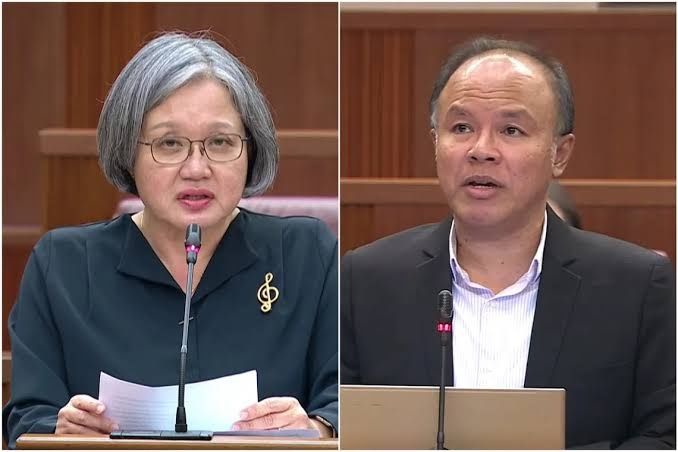
Singapore's parliament has formally closed its investigation into Workers' Party leaders Sylvia Lim and Faisal Manap over their dishonest testimony to a parliamentary committee, with the government confirming that legal deadlines have now rendered any disciplinary action impossible. Leader of the House Indranee Rajah announced on July 7 that no further proceedings would be initiated, effectively ending a long-running constitutional controversy that has preoccupied Singapore's political establishment for years.
The case originated from an elaborate deception in 2021 involving former Sengkong GRC member Raeesah Khan, who fabricated an anecdote about police conduct during a parliamentary speech. When investigators from Parliament's Committee of Privileges began probing the matter, three senior Workers' Party figures—Pritam Singh, Sylvia Lim, and Faisal Manap—were found to have provided false or misleading information to the committee. Pritam Singh, the party leader, faced the most serious allegations after evidence suggested he instructed Khan to conceal her false testimony. Lim and Manap, both then representing Aljunied GRC, denied knowledge of discussions concerning Khan's dishonesty despite being present at a critical August 2021 meeting.
The legal pathway to resolution became complicated by parliamentary procedure and the deliberate choice to await criminal proceedings against Pritam Singh before addressing his subordinates. Parliament referred Singh's case to prosecutors for independent investigation and potential criminal prosecution, a course justified partly on fairness grounds—allowing him full legal representation and the opportunity to defend himself in court. However, this postponement created an unintended consequence: it allowed the statutory time limits governing parliamentary discipline to expire before action could be taken against Lim and Manap. Indranee acknowledged this timing problem directly, noting that "had the timelines been different, I would have proposed a different course of action."
Singapore's Parliament (Privileges, Immunities and Powers) Act contains strict provisions limiting the window for imposing parliamentary penalties. Under Section 22 of the legislation, the House can only punish offences committed during the immediately preceding session or the final session of the preceding Parliament. When Pritam Singh's criminal case eventually reached conclusion—a District Court conviction in February 2025 subsequently upheld by the High Court in December 2025—the 14th Parliament had already been dissolved following Singapore's 2025 general election. The newly constituted 15th Parliament, which commenced in September 2025, inherited a legal constraint: it could address only offences from the current session or the final session of its predecessor. Since Lim and Manap's original deception occurred during the first session of the 14th Parliament, the time bar had definitively expired.
This procedural outcome reveals tension between substantive accountability and formal legal architecture. The High Court's judgment confirming Singh's conviction simultaneously validated the Committee of Privileges' earlier finding that Lim and Manap had indeed lied under oath. Yet Indranee made clear that Parliament's hands were legally tied despite moral certainty about their misconduct. She stated plainly that "even though the Committee's findings have now been effectively confirmed by the High Court Judgement, the law, in this case the time bar provisions of PPIPA, must be observed." The formulation underscores how technical legal rules can shield individuals from consequences despite substantive wrongdoing being established.
The government's decision to prioritise prosecuting Pritam Singh separately rather than pursuing all three offenders together, while defensible on fairness grounds, inadvertently created this time-bar problem. Indranee justified the original delay by noting that Parliament had "decided to give Ms Lim and Mr Faisal the benefit of the doubt for the time being," treating their lesser culpability as justification for deferred action. However, indefinite deferral transformed into permanent immunity once parliamentary terms changed. The government acknowledged it retained technical options—Parliament could pass a motion expressing displeasure—but determined this unnecessary given an earlier January motion declaring Pritam Singh unsuitable as Opposition Leader had already registered the House's strong disapproval of lying to Parliament or its committees.
Sylvia Lim accepted the government's position without protest, clarifying that she was not objecting to Indranee's ministerial statement. She reiterated her earlier defence, noting that references to her in Pritam Singh's appeal judgment relied solely on prosecution evidence and that she had never been called as a witness in his criminal trial, thus lacking opportunity to present her account to the court. This asymmetry—being held to account through others' testimony without direct participation in judicial proceedings—reflects a genuine difficulty in parliamentary contempt cases involving multiple actors with different degrees of culpability.
For Malaysian observers, this episode illustrates how parliamentary systems navigate the tension between maintaining institutional integrity through discipline and observing procedural fairness. Malaysia's own Parliament operates under the Standing Orders and Constitutional conventions that create similar temporal limitations on disciplinary action, though these mechanisms rarely receive public scrutiny. The Singapore case demonstrates that even sophisticated constitutional frameworks can produce outcomes where substantive wrongdoing escapes sanction due to technical timing. It also raises questions about whether Parliament should retain discretionary authority to extend time bars in exceptional circumstances, or whether rigid deadlines serve the salutary purpose of ensuring finality and preventing indefinite hanging of disciplinary proceedings over members' heads.
The Workers' Party's internal handling of the controversy arguably vindicated the government's restraint in some respects. Just weeks before Parliament's announcement, party cadres voted to retain Pritam Singh as leader despite his conviction, suggesting that internal party discipline and voter judgment might accomplish what formal parliamentary sanctions could not. Singh's criminal conviction remains intact and will define his political record, even if the parliamentary process failed to reach its formal conclusion. The cumulative effect—criminal conviction, loss of Opposition Leader status, and sustained public scrutiny—constitutes substantial political consequence despite the absence of parliamentary contempt findings against Lim and Manap.
Indranee's closing of the matter carries symbolic weight within Singapore's political system. By announcing that Parliament would "bring this matter to a close," the government signalled that further recrimination was neither warranted nor productive. This pragmatic acceptance of an unsatisfying technical outcome reflects broader institutional maturity, acknowledging that legal systems sometimes produce results inconsistent with substantive justice. For Southeast Asian democracies grappling with parliamentary integrity, the Singapore precedent suggests that time-limited disciplinary powers, while perhaps appearing to protect members, can paradoxically undermine accountability when delayed proceedings extend beyond parliamentary terms. The question remains whether this was a one-off artifact of unfortunate timing or symptomatic of deeper design flaws in parliamentary discipline mechanisms across the region.

