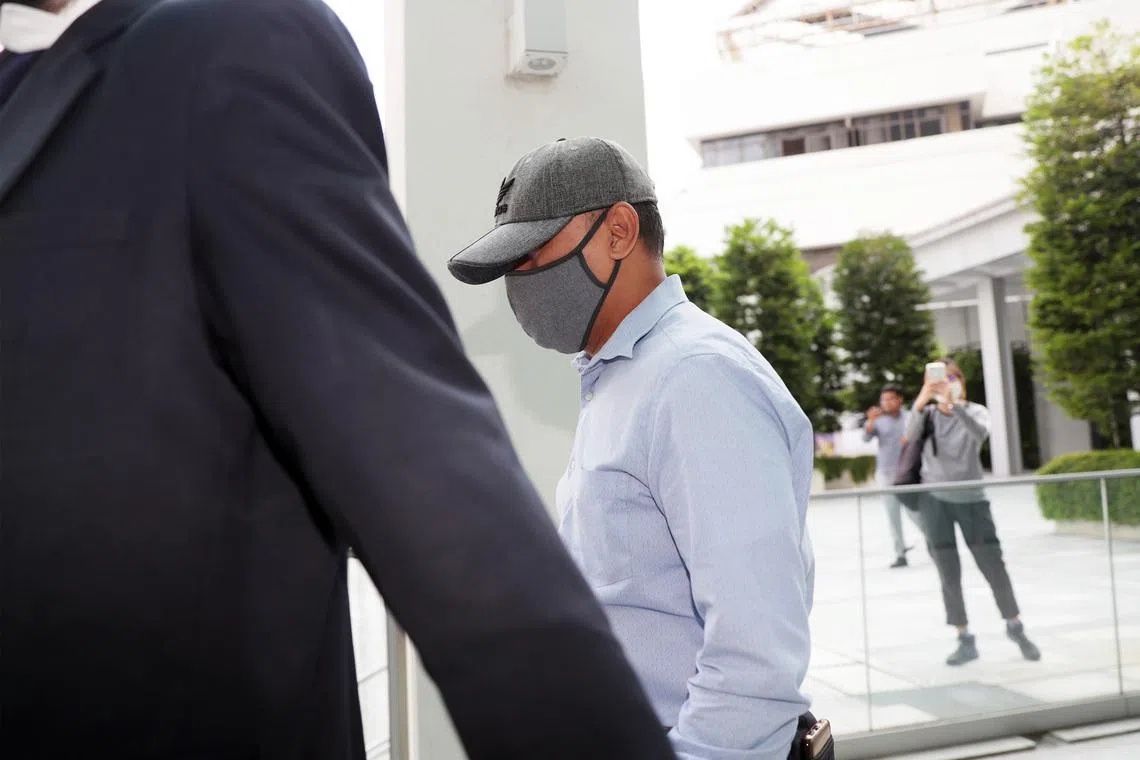
A senior official at two prominent Singapore mosques has begun serving a 14-month prison term following his conviction on corruption charges linked to construction contracts worth S$223,000. Abdul Rahim Mawasi, 59, held the position of executive chairman at both Darul Aman Mosque on Jalan Eunos and Sallim Mattar Mosque in MacPherson, whilst simultaneously serving as a senior officer with the Islamic Religious Council of Singapore (MUIS), to which he had been seconded. His conviction in April represents a significant breach of trust in the management of religious institutions, raising questions about governance oversight in Singapore's faith-based organisations.
The corruption scheme centred on Abdul Rahim's arrangement with his long-time acquaintance Mohd Mustaqim Kam, known also as Kam Hock Beng, who directed the construction firm Zeal-Con Engineering. According to court proceedings, the two men reached an agreement in July 2018 that involved establishing a travel company for pilgrimage trips, with Kam's construction profits earmarked as capital investment. Crucially, Abdul Rahim was to contribute no initial funds to the venture, instead leveraging his position at the two mosques to steer lucrative construction jobs towards Zeal-Con. This arrangement essentially transformed Abdul Rahim's official position into a commodity for personal enrichment, fundamentally compromising the institutional integrity he was entrusted to uphold.
The mechanics of the scheme reveal the sophistication with which Abdul Rahim manipulated the tender process. When Darul Aman Mosque sought vendors for yard construction work in 2018, Zeal-Con submitted two competing quotes. The first, dated August 20, stipulated S$128,600, but a revised quotation issued on September 12 reduced the price to S$118,000. Deputy Public Prosecutor Bryan Wong highlighted that this revised figure undercut the nearest rival bid of S$125,500 submitted by another contractor. Critically, the mosque's management board remained unaware that Abdul Rahim had engaged in extensive discussions with Kam regarding the precise bid amount, providing insider guidance that directly influenced Zeal-Con's competitive positioning. The contract was awarded to Zeal-Con on September 26, 2018, for the lower amount.
A similar pattern of corruption emerged in contracts with Sallim Mattar Mosque. In September 2018, Zeal-Con quoted S$115,700 for renovation works affecting the roof and reception facilities. By July 2019, the company had substantially reduced its quote to S$105,000 for identical work. Evidence presented during trial demonstrated that Abdul Rahim had actively counselled Kam to lower Zeal-Con's pricing to ensure contract acquisition. The mosque subsequently issued letters of award linked to this reduced figure in August 2019. The deliberate price manipulation, orchestrated from within the mosque leadership, effectively excluded legitimate competitors and artificially inflated Zeal-Con's profit margins at the institutions' expense.
To obscure the corrupt relationship and financial benefit, Abdul Rahim employed his son as a proxy shareholder in the newly established travel venture. In November 2019, Kam converted an existing shell company into Amal Travel and Tour (ATT), establishing a paid-up capital of S$100,000 through increased shareholding. He then allocated 25,000 ATT shares, valued at S$1 each, to Abdul Rahim's son, ensuring the senior official maintained a concealed financial interest whilst maintaining plausible deniability. During trial, Abdul Rahim denied any involvement in ATT and accurately noted he held no registered shares—a technical truth masking the beneficial ownership arrangement through his son's proxy holding. This layering of financial structures demonstrates deliberate attempt to evade regulatory detection by MUIS.
Abdul Rahim's breach of fiduciary duty extended beyond the construction contracts themselves. As a senior MUIS officer seconded to manage mosque operations, he occupied a position of considerable trust within Singapore's Islamic institutional framework. His failure to disclose his financial interest in Amal Travel and Tour to MUIS constituted a material concealment of information material to his employment and conflict of interest assessment. The prosecution emphasised that this represented serious public sector corruption undertaken for personal financial gain, irrespective of whether the mosques themselves sustained measurable economic losses from the arrangement. The courts determined that the integrity of the procurement process and the faithfulness of public officials carried paramount significance.
Interestingly, the court record notes that Zeal-Con satisfactorily completed the construction works in question, meaning neither mosque experienced defective workmanship or service failures. This factual finding provided no mitigation for Abdul Rahim's culpability, as corruption law prosecutes the compromised process rather than adverse outcomes alone. A contractor delivering quality work whilst benefiting from insider assistance has not earned that advantage through legitimate competition, and the integrity concern persists regardless of final quality. This distinction carries importance for Malaysia's own procurement oversight, particularly in religious and faith-based institution governance where similar schemes might otherwise escape notice if performance standards were superficially met.
Abdul Rahim's accomplice, Mohd Mustaqim Kam, received a reduced sentence of six months' imprisonment in February 2025, reflecting his status as recipient rather than facilitator of the corruption. Kam, aged 66 at sentencing, bore responsibility for accepting the offered advantage but played no formal institutional role. The disparity in sentences appropriately reflects Abdul Rahim's position of greater authority and his abuse of institutional trust, establishing a precedent that senior officials face enhanced culpability for corruption schemes involving their own organisations. The 14-month sentence also significantly exceeded the six-month term sought by Abdul Rahim's defence counsel, signalling judicial determination to impose deterrent penalties for white-collar breaches involving religious institutions.
For Malaysian observers, this case illuminates vulnerabilities in institutional governance that transcend national boundaries. Singapore's experience with mosque management corruption suggests that similar risks may exist within Malaysia's own network of religious institutions, wakaf (endowment) bodies, and faith-based organisations. The scheme's reliance on long-standing personal relationships between decision-makers and external parties reflects a pattern observable across Southeast Asia's complex institutional landscape. Malaysian regulators overseeing Islamic institutions, particularly state religious councils and mosque administrations, might usefully implement enhanced procurement transparency protocols, mandatory conflict-of-interest declarations, and audit procedures specifically designed to detect the pattern of bid manipulation evident in Abdul Rahim's scheme.
Abdul Rahim's case also demonstrates how proxy shareholding and use of family members as financial intermediaries can obscure corrupt arrangements. This technique, widely deployed in cross-border schemes throughout the region, creates enforcement challenges for regulatory bodies lacking sophisticated financial surveillance capabilities. Malaysian authorities investigating potential corruption within religious organisations should prioritise tracing beneficial ownership of companies, examining family shareholding patterns, and scrutinising personal relationships between institutional officials and external contractors. The complexity of the scheme—spanning multiple institutions, revised quotations, timing delays between corrupt discussions and formal awards, and intentional use of proxy structures—provides a detailed blueprint of tactics requiring specific investigative focus.
Abdul Rahim has been granted bail set at S$30,000 pending commencement of his sentence on July 10, allowing time for potential appeals or administrative matters. His case, prosecuted under Singapore's Prevention of Corruption Act, stands as recent jurisprudence on public sector corruption involving religious institutions. The conviction removes him from his mosque leadership positions, though residual reputational and professional consequences will extend far beyond the imprisonment term. For Singapore's Muslim community, the prosecution reaffirms institutional commitment to accountability irrespective of religious context, whilst simultaneously raising uncomfortable questions about the adequacy of pre-existing governance safeguards that permitted such deception to proceed undetected for extended periods across two major mosques under unified leadership.

