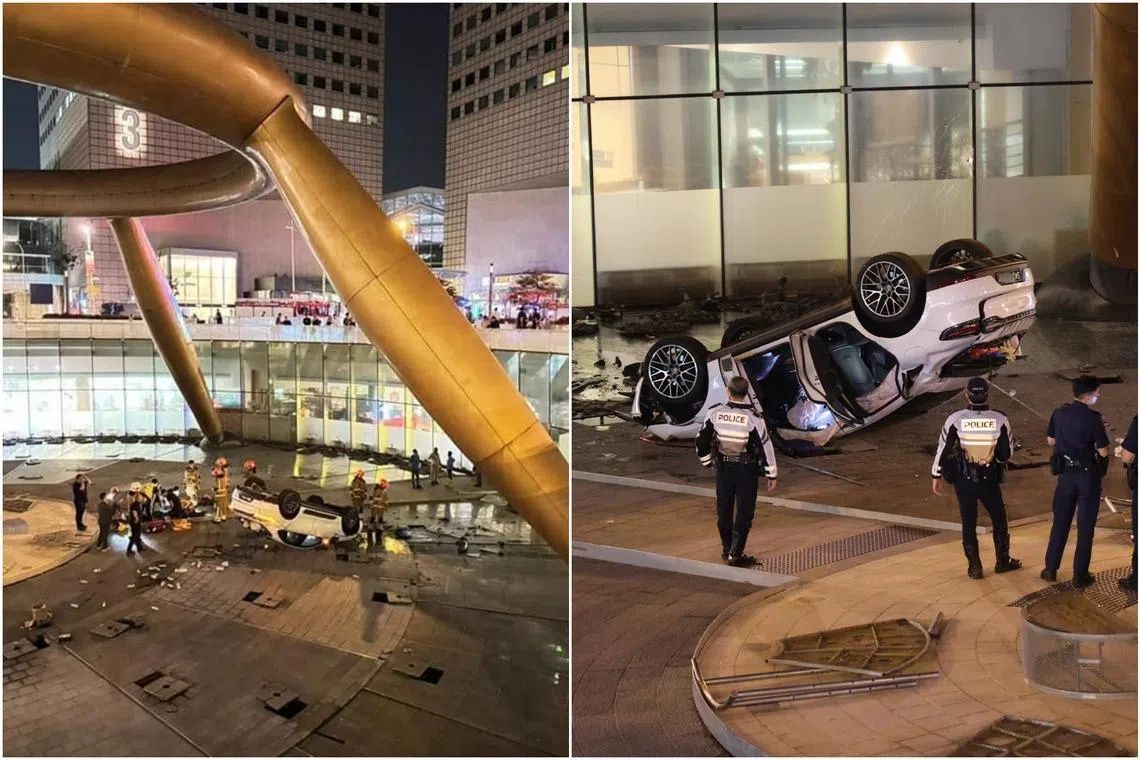
A Singaporean man who consumed approximately one litre of beer before losing control of his vehicle and crashing it into the iconic Fountain of Wealth at Suntec City has been handed a five-week jail sentence. Then Shing Chong, 58, pleaded guilty on Tuesday to driving in a dangerous manner following the incident on July 13, 2024, which caused nearly S$64,600 in damage to the fountain's structure. The court also imposed a 2.5-year driving ban effective from his release, reflecting the serious nature of his reckless conduct.
Accounting for the sequence of events that led to the accident provides crucial context for understanding how the situation unfolded. Then left his residence around 5pm on July 12 before travelling to Suntec City to meet a friend for what would become an extended drinking session. Upon arriving at the shopping mall approximately one hour later, he parked his vehicle in the basement level and proceeded to a bar within the complex. Between 6.15pm and midnight—a span of nearly six hours—he consumed roughly one litre of beer while socialising. Before departing from the bar and returning to his vehicle, he reportedly informed the Institute of Mental Health that he had taken either an antihistamine or a sleeping pill earlier in the day, a detail that would later feature in his defence arguments regarding culpability.
The events immediately preceding the collision reveal the progression of his impaired judgment. While exiting the carpark, his vehicle remained stationary for approximately ten seconds following the gantry barrier's activation. Once the barrier lifted, Then drove out onto Temasek Boulevard, where his concentration began to deteriorate noticeably. As he approached a critical juncture requiring a left turn into a roundabout, directional signage clearly indicated the required course of action. However, instead of following these instructions, he maintained a straight trajectory, steering directly across three lanes of traffic before striking the protective barricade surrounding the fountain's perimeter.
The severity of the incident was magnified by the fortunate absence of casualties among those working at the site. Three construction workers were actively engaged in renovation work within the fountain's basement level when Then's vehicle plunged through the decorative barrier and crashed down into the lower section. All three workers managed to evacuate the immediate impact zone without sustaining injuries. The Deputy Public Prosecutor emphasised during sentencing that the outcome could have been catastrophically different had the workers been positioned directly beneath the point of impact, potentially resulting in multiple fatalities or serious injuries. A mobile crane was subsequently deployed to extract the submerged vehicle from the fountain before it could be towed away for disposal.
The legal proceedings reflected a significant debate regarding the appropriate response to drink-driving offences that occur alongside mental health considerations. Then's defence team, comprising lawyers from Invictus Law Corporation, presented evidence from the Institute of Mental Health documenting that their client was experiencing major depressive disorder at the time of the accident. They petitioned the district judge to commission a comprehensive assessment report evaluating Then's suitability for a Mandatory Treatment Order, a sentencing option in Singapore's criminal justice system that permits offenders to undergo psychiatric or medical treatment as an alternative to incarceration. The defence argued that a direct causal relationship existed between his documented psychiatric condition and the commission of the offence itself.
The prosecution mounted a vigorous counterargument to the defence's position on sentencing considerations. Deputy Public Prosecutor Gladys Lim explicitly objected to the commissioning of an assessment report for the Mandatory Treatment Order evaluation, contending instead that principles of general and specific deterrence necessitated a custodial sentence. She stressed that drink-driving represents an exceptionally irresponsible form of behaviour that endangers not only the perpetrator but innocent members of the public and bystanders. The prosecutor argued that the magnitude of property damage sustained, combined with the high probability that the incident could have resulted in loss of life, warranted a punitive approach rather than a rehabilitative alternative.
District Judge Koo Zhi Xuan ultimately sided with the prosecution's argument, rejecting the defence submission for a treatment order assessment and instead imposing the custodial sentence. The judge explicitly acknowledged that drink-driving constitutes conduct of the highest irresponsibility and expressed concern about the substantial property damage that resulted from Then's actions, coupled with the clear potential for serious injury or death to other individuals. This decision reflects Singapore's increasingly stringent approach to road safety matters, where judicial sentencing has shifted toward prioritising deterrence and public protection over rehabilitative alternatives, particularly in cases involving substance impairment.
For Malaysian readers and observers of Southeast Asian road safety policy, this case underscores the region's broader struggle with drink-driving enforcement and public education. Notably, the critical absence of breath or blood alcohol content testing immediately following the accident represents a procedural gap that complicated the prosecution's case, relying instead on circumstantial evidence of impairment. While Then was rushed to Tan Tock Seng Hospital's emergency department with injuries including a lacerated scalp, the immediate medical intervention took priority over forensic testing. This sequence of events highlights challenges in evidential gathering that law enforcement agencies across Southeast Asia continue to grapple with in their respective jurisdictions.
The incident at Suntec City's Fountain of Wealth, one of Singapore's most recognisable landmarks, carried particular symbolic weight given the public prominence of the location. The fountain, situated in the heart of the island's central business district, regularly draws tourists and becomes the backdrop for countless photographs and social media posts. The collision and its aftermath generated substantial local media attention precisely because of this visibility and the property damage inflicted on a cherished civic amenity. The requirement that Then make full restitution for the nearly S$64,600 in repairs demonstrates the financial consequences accompanying criminal liability, though this obligation alone proved insufficient in the eyes of the court to preclude imprisonment.
The broader implications of this case extend to conversations about mental health, criminal responsibility, and public safety intersections that are increasingly prominent across Asian jurisdictions. While the defence's arguments regarding Then's depression appear medically reasonable, the court's rejection of a treatment-focused sentencing alternative reflects judicial concern that mental health circumstances, while potentially relevant to culpability assessment, cannot supersede the paramount need to protect the public from dangers posed by intoxicated driving. This position aligns with sentencing trends across Singapore and other developed Asian economies, where mental health considerations are generally viewed as mitigating factors rather than grounds for complete avoidance of custodial consequences.
Looking forward, the case serves as a cautionary narrative for drivers throughout Southeast Asia regarding the compounding risks associated with combining alcohol consumption with operation of motor vehicles, particularly when medical or pharmaceutical factors may further compromise cognitive function and reaction times. The fortunate survival of the construction workers in this instance cannot be replicated in future scenarios, and the severity of the sentence imposed reflects judicial awareness that each such incident represents a statistical abnormality narrowly avoiding a human tragedy. As road safety remains a persistent public health challenge across the region, incidents like the Suntec fountain collision continue to inform evolving legal and policy responses to impaired driving enforcement.

