A 22-year-old Singapore resident has been sentenced to 17 months' imprisonment after pleading guilty to using a chair as a weapon during a street altercation that resulted in a death. Pradave Shashi Kumar's conviction on Tuesday marked the first judicial resolution in a case that has exposed the dangers of nightlife-related violence in the city-state, with three other men still facing more serious charges related to the incident.
The victim, Dhinessh Vasie, was 25 years old when he died from stab wounds inflicted during the brawl that erupted along Kitchener Road on September 22, 2024. According to court proceedings, Dhinessh sustained a fatal injury to the heart during the violent confrontation. His death has prompted scrutiny of how spontaneous street fights can escalate rapidly and fatally, particularly in urban entertainment districts where alcohol consumption and late-night activity converge.
The sequence of events began when Pradave, along with two other men and two women, left a nightclub in Golden Mile Tower intending to continue drinking at another establishment. Around 4 in the morning, the group arrived at a pub located on Sam Leong Road and began walking through nearby alleyways. During this walk, they encountered a separate gathering of eight men engaged in a heated argument with three women. This chance meeting would trigger a cascade of violence that would ultimately prove fatal.
The altercation appears to have ignited when one of Pradave's group, identified as Satish Jason Prabhas, exchanged verbal insults with someone from the eight-man gathering before escalating to physical blows. This initial exchange drew others into the fray, and a broader fight broke out involving multiple participants from both groups. The situation deteriorated when Dhinessh's group attempted to retreat by moving toward the back alley in the direction of Verdun Road, seeking to disengage from the violence.
During the retreat, witnesses observed Muhammad Sajid Saleem, aged 24, wielding a small knife with a 7.5-centimetre blade held downward in his right hand. Recognizing the weapon, Dhinessh and his companions fled, but their pursuers—Pradave, Sajid, Satish, and Kirrthik Roshan Prem Ananth—chased after them. The prosecutor's account indicates that during this pursuit, Sajid slashed multiple members of Dhinessh's group with the blade even as they attempted to escape. This detail underscores how weapons can transform a brawl into a lethal encounter within seconds.
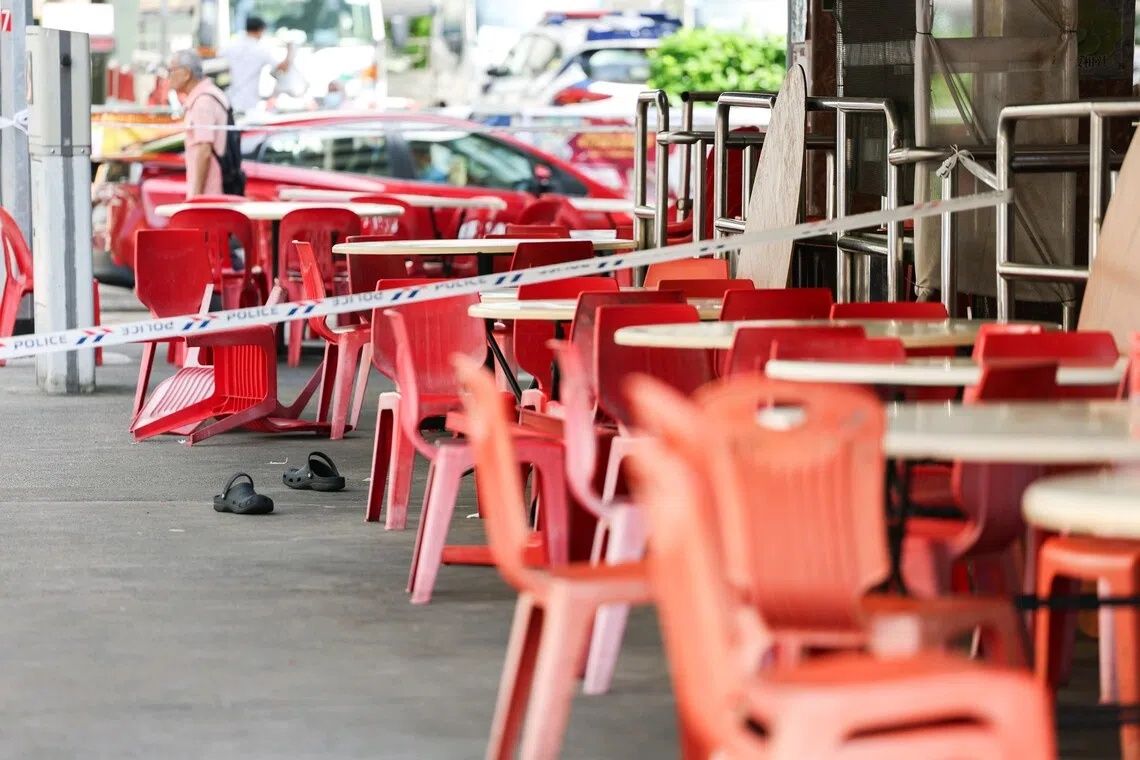
As Dhinessh neared a coffee shop at the intersection of Verdun Road and Sam Leong Road, he began to slow down, eventually coming to a stop. This momentary halt allowed Sajid to catch up, and he then allegedly drove the knife into Dhinessh's upper back. At that critical juncture, Kirrthik seized a chair from the coffee shop and repeatedly struck the wounded man with it. Pradave, observing the assault, obtained another chair and forcefully struck Dhinessh twice—once on the head and once on the chest.
What compounds the gravity of Pradave's actions is that during this sustained assault, Dhinessh was slumped over and completely unable to defend himself or retaliate. He was already severely wounded from the knife attack when the chair blows were inflicted. Deputy Public Prosecutor Jonathan Tan highlighted this vulnerability in presenting the case, emphasizing that Pradave's actions contributed to the assault on an incapacitated victim. The viciousness of the incident is underscored by the fact that ordinary furniture became an instrument of violence against a man who could no longer fight back.
Following the attack, the group departed the scene and walked toward City Square Mall. Police and emergency paramedics arrived soon after, but Dhinessh could not be saved. Pradave was arrested approximately one hour and 15 minutes after the incident occurred, at around 5:15 in the morning. The relatively swift arrest suggests that investigators had eyewitness accounts or security footage that quickly identified him as a participant.
Pradave is one of four individuals facing charges in connection with the incident, each culpable for different aspects of the violence. Muhammad Sajid Saleem, the alleged knife wielder, faces the most serious charge of murder. Satish Jason Prabhas and Kirrthik Roshan Prem Ananth are both charged with rioting, an offense that carries significant penalties in Singapore's legal framework for group violence. The separation of charges reflects the gradations of responsibility, with the person who wielded the lethal weapon facing the gravest accusation.
Under Singapore law, voluntarily causing hurt using a dangerous weapon carries a maximum penalty of seven years' imprisonment, a fine, caning, or any combination thereof. Pradave's 17-month sentence sits well within this statutory range, suggesting the court considered both mitigating factors and the gravity of his actions. The length of his sentence reflects the reality that even though he did not wield the knife, his participation in the assault on a wounded man constitutes a serious offense.
This case illustrates the unpredictability of nightlife violence in urban centers. What began as a random encounter between two groups of revelers at 4 in the morning escalated within moments into a fatal altercation. For Malaysian readers, the case underscores how quickly social friction can become deadly when weapons are introduced and multiple parties become engaged. The involvement of four separate accused persons demonstrates how group dynamics can amplify individual culpability, with each participant bearing responsibility for their specific actions within the broader violence.
The remaining cases against Sajid, Satish, and Kirrthik are expected to proceed through Singapore's courts, likely with more complex legal proceedings given the murder and rioting charges. These cases will ultimately shape how Singapore's judiciary views culpability in gang-related violence and will provide further clarity on the legal consequences for participating in street brawls that result in fatalities. For now, Pradave's conviction stands as a stark reminder of how decisions made in moments of violent impulse carry consequences measured in years of incarceration.

