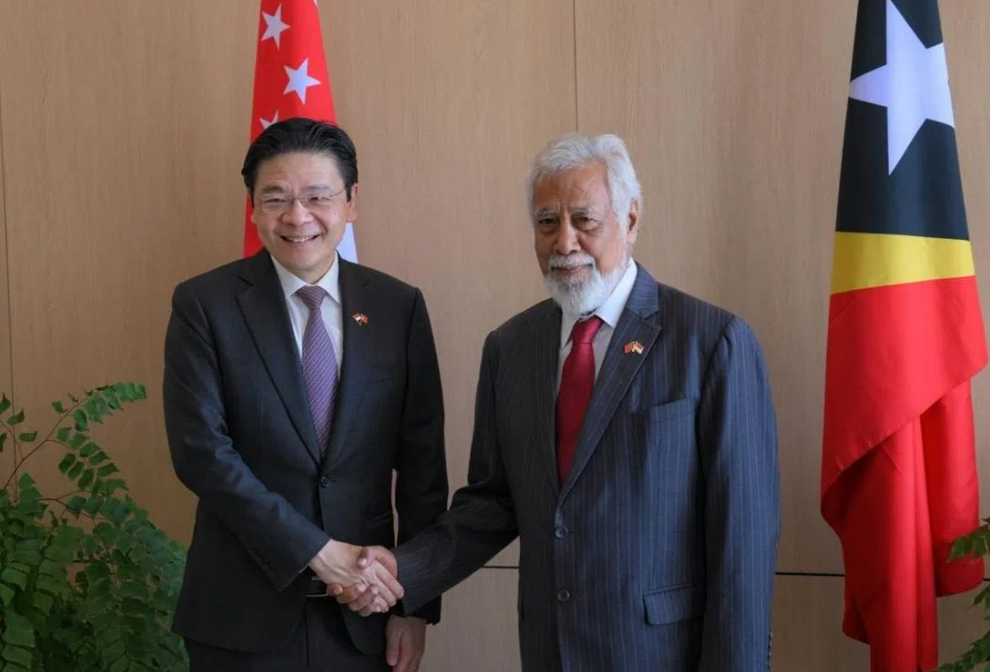
Prime Minister Lawrence Wong's first visit to Timor-Leste as Singapore's leader marks a significant milestone in cementing ties between the city-state and Southeast Asia's youngest nation. During his two-day engagement in Dili, Wong and Timor-Leste Prime Minister Xanana Gusmao oversaw the signing of a comprehensive bilateral cooperation framework on July 3, designed to expand collaboration across multiple sectors and deepen the institutional relationship between their governments. The agreement, witnessed at the Government Palace ahead of a joint press conference, establishes mechanisms for regular foreign ministry consultations that will encompass not merely bilateral matters but also regional and strategic developments affecting both nations.
The diplomatic visit reflects Singapore's strategic commitment to supporting Timor-Leste's consolidation as a stable Southeast Asian state, particularly following its admission as Asean's 11th member in October 2025. By establishing a structured consultation platform, Singapore and Timor-Leste create a foundation for coordinated governance on issues ranging from shared security concerns to economic opportunities. Wong emphasised that despite both nations' modest size, their shared philosophy—that destiny is shaped through determination and partnership rather than geographic constraints—provides philosophical alignment for deepening cooperation. Timor-Leste's leadership, represented by PM Gusmao, reciprocated this sentiment, characterising Singapore as a trustworthy partner whose institutional support has been instrumental in facilitating the nation's path to regional integration.
On the economic dimension, Singapore has already established itself as one of Timor-Leste's principal foreign investors, with companies operating across diverse sectors ranging from wholesale commerce to renewable energy infrastructure. Wong highlighted that these investments signal growing market confidence in Timor-Leste's development trajectory and creation of business-friendly conditions. By collaborating on economic diversification, both nations aim to unlock sustainable growth opportunities that transcend extractive industries traditionally associated with the smaller economy. The initiative signals to regional and international investors that Timor-Leste, under current leadership, presents viable pathways for profitable long-term engagement.
A particularly consequential development announced during the visit involves Singapore's commitment to open selected occupational categories and sectors to Timorese workers beginning in 2027. Timor-Leste will be incorporated into Singapore's non-traditional labour source framework, permitting construction, marine shipyard, and related industries to hire Timorese work permit holders. This initiative, commencing in the second half of 2027, addresses Singapore's ongoing labour requirements while simultaneously generating employment and skills-transfer opportunities for Timorese citizens. Singapore's Ministry of Manpower acknowledged preliminary interest from local firms, particularly in construction, suggesting genuine demand for diversified labour pools beyond traditional source countries. For Timorese workers, this access to Singapore's labour market offers competitive wages and professional development unavailable domestically, potentially creating remittance flows that strengthen household incomes across Timor-Leste.
The healthcare collaboration represents a strategic investment in Timor-Leste's institutional capacity and public health infrastructure. Singapore's National University Hospital and Timor-Leste's Ministry of Health are positioned to execute a formal agreement later in July, establishing a five-year framework encompassing health workforce development, training systems enhancement, public health capability strengthening, and broader health systems reform. This partnership acknowledges that Timor-Leste's healthcare sector requires targeted support in critical areas including emergency medicine, pre-hospital care, paediatric services, ophthalmology, obstetrics and gynaecology, and foundational supportive care. By embedding professional knowledge transfer and institutional capacity building, Singapore assists Timor-Leste in developing autonomous healthcare delivery systems that can eventually operate independently of external support while maintaining quality standards.
Education represents a second pillar of capacity-building cooperation, with Singapore committing resources to strengthen Timor-Leste's teacher training institutes and professional development systems. Wong articulated that supporting educational leadership development facilitates long-term human capital advancement essential for generational progress. Singapore's approach emphasises institution-building rather than temporary assistance, enabling Timorese educational professionals to cultivate pedagogical excellence and institutional governance capabilities that will sustain improvements across decades. This educational partnership acknowledges that sustainable development requires cultivating intellectual capital and professional competencies within local institutions rather than relying perpetually on external expertise.
Singapore's expanded Asean readiness support programming reflects strategic foresight regarding Timor-Leste's forthcoming chairmanship responsibilities in 2029. The original Stars package, launched in December 2022, provided practical training enabling Timorese officials to participate effectively in Asean mechanisms. Following July 2025 enhancements, Singapore further expanded the initiative on July 3 to incorporate specialised workshops addressing chairmanship obligations and protocols. Critically, Singapore will facilitate attachments allowing Timorese officials to observe Singapore's 2027 Asean chairmanship operations firsthand, creating experiential learning opportunities that cannot be replicated through classroom instruction. This mentorship approach ensures Timor-Leste approaches its 2029 chairmanship with practical knowledge of logistical, diplomatic, and procedural dimensions.
Timor-Leste's Asean integration carries profound implications for regional architecture and Southeast Asian cohesion. PM Gusmao characterised membership as realisation of national aspirations, representing alignment with geographically proximate Southeast Asian neighbours after decades of international isolation and nation-building challenges. Timor-Leste's inclusion strengthens Asean's geographic contiguity, extends the bloc's membership to territories previously outside formal regional structures, and integrates a maritime state with substantial maritime economic zones into regional frameworks governing maritime governance and resource management. Singapore's systematic support for this integration—through training programmes, institutional partnerships, and labour market access—constitutes strategic investment in regional stability and the success of Asean's expansionist vision.
Wong's receipt of the Order of Timor-Leste (Grand Collar) from President Jose Ramos-Horta underscores recognition of Singapore's institutional contribution to Timorese development. In accepting the honour, Wong appropriately redirected credit toward Singapore's officials and development practitioners who have conducted training, transferred technical knowledge, and worked alongside Timorese counterparts in nation-building endeavours. This framing emphasises that bilateral partnerships are fundamentally constructed through interactions between professional practitioners and institutional personnel rather than merely high-level political declarations. The gesture reflects Timorese gratitude for Singapore's sustained engagement beyond ceremonial diplomacy, encompassing genuine capacity-building and technical assistance that has materially advanced institutional capabilities.
For Malaysian observers and policymakers, Singapore's strategic approach toward Timor-Leste offers instructive lessons regarding engagement with emerging Southeast Asian economies. Singapore has leveraged its institutional maturity, technical expertise, and economic capabilities to establish structural partnerships addressing governance capacity, healthcare systems, educational infrastructure, and labour market integration. Rather than pursuing extractive economic relationships or exercising political dominance, Singapore positions itself as a developmental partner whose success is contingent upon Timorese institutional strengthening. Malaysia, similarly positioned as a regional economic power with substantial institutional capabilities, might consider comparable systematic engagement frameworks that strengthen regional economies while creating mutual benefits through trade, investment, and professional knowledge exchange.
The bilateral framework between Singapore and Timor-Leste also demonstrates how smaller nations can effectively exercise regional diplomacy through strategic partnership construction and selective issue-area cooperation. Rather than attempting comprehensive influence across all domains, both parties have identified complementary strengths—Singapore's institutional maturity and economic capabilities paired with Timor-Leste's geographic positioning and growing Asean influence—to construct mutually advantageous arrangements. This approach mirrors broader Southeast Asian partnership patterns wherein nations leverage asymmetric capabilities to generate positive-sum outcomes benefiting multiple stakeholders. As Timor-Leste consolidates its Asean membership and approaches the responsibility of regional chairmanship, systematic support from established partners like Singapore enhances institutional readiness and regional confidence in the nation's capacity for effective leadership roles.

