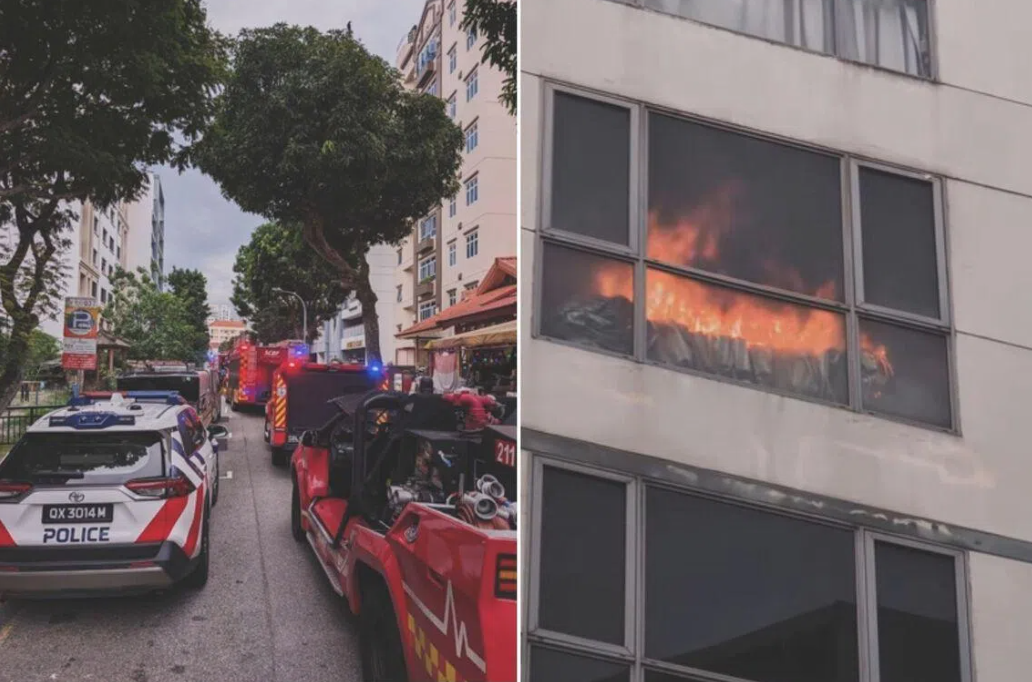
A fire sparked by an unattended power-assisted bicycle battery in a Singapore condominium on Sunday afternoon has reignited official concerns about the hazardous charging practices surrounding e-mobility devices in densely populated residential settings. The Singapore Civil Defence Force was summoned to 9 Lorong 26 Geylang, identified as Casa Aerata condominium, at 5.35pm on June 21 after the battery caught fire in a seventh-floor unit's living room. The blaze, though quickly contained, prompted authorities to evacuate five residents from neighbouring units as a precautionary step, though fortunately no one suffered injuries in the incident.
Firefighters deployed a hosereel and compressed air foam backpack to extinguish the flames, bringing the situation under control within a short timeframe. However, the intensity of the heat proved sufficient to shatter the unit's window, an occurrence that drew the immediate attention of Member of Parliament Cai Yinzhou, who represents Bishan-Toa Payoh GRC. The politician, alerted by smoke and sirens, rushed to the scene and took it upon himself to clear the area beneath the affected unit, anticipating potential danger from falling debris as the window gave way under the thermal stress.
Preliminary investigations by the SCDF have confirmed that the fire originated from electrical faults within the power-assisted bicycle battery itself. This determination underscores a growing pattern of battery-related fire incidents across Singapore's residential landscape, where the convenience of e-mobility devices has created a corresponding spike in fire risks. The incident at Casa Aerata serves as a stark reminder of the dangers posed when users ignore fundamental safety protocols that manufacturers and authorities have consistently emphasized.
In response to this latest incident, Singapore's civil defence authorities have reiterated their public safety advisories regarding the use and charging of active mobility devices, which encompass a broad category of electrically powered personal transport including power-assisted bicycles, personal mobility devices, and personal mobility aids. The SCDF has specifically cautioned residents against purchasing or installing non-original batteries as replacements for the devices' power systems. Counterfeit or third-party batteries frequently lack the safety certifications and thermal management systems built into manufacturer-approved components, making them substantially more prone to overheating and combustion.
The charging practices surrounding these batteries also warrant particular attention. Authorities have stressed that users should avoid charging their devices for extended periods or throughout overnight hours, when unattended batteries are more likely to malfunction without immediate human intervention. The incident in Geylang exemplifies precisely the scenario authorities seek to prevent: a charging battery left unsupervised in a residential unit, where fires can spread rapidly through confined spaces and endanger multiple households.
Statistical data from the SCDF reveals the scope of this emerging residential safety challenge. Throughout 2025, electrical fires in residential premises have occurred at a concerning frequency, with 304 documented cases nationwide. Of these, active mobility device batteries have been implicated in 34 fires, demonstrating that while these devices represent only a fraction of residential electrical fire incidents, their concentration in multi-unit residential buildings amplifies their risk to community safety.
The trend shows some nuance upon closer examination. The absolute number of active mobility device fires decreased from 67 cases in 2024 to 49 in 2025, suggesting that awareness campaigns and regulatory measures may be gaining traction among users. However, this overall decline masks a concerning shift within the category itself. Personal mobility device fires—which typically involve powered stand-up scooters—increased from 25 cases to 31 cases year-over-year, indicating that different device categories present evolving hazard profiles requiring targeted interventions.
For Malaysian readers and policymakers, the Singapore experience carries immediate relevance. Malaysia's urban centres, particularly in the Klang Valley and George Town, have witnessed similar proliferation of e-mobility devices in recent years. The regulatory frameworks governing battery safety standards, product certification requirements, and consumer awareness campaigns in Malaysia remain less stringent than Singapore's approach, creating potential vulnerability to similar incidents.
The Casa Aerata fire also highlights the particular vulnerability of high-rise residential complexes, which dominate the housing landscape across major Malaysian cities. In such environments, a battery fire in one unit can quickly transform into a multi-unit emergency, with smoke inhalation and evacuation challenges compounded by vertical evacuation routes and shared ventilation systems. The evacuation of five neighbouring units in a single incident demonstrates how rapidly a seemingly localized electrical fire can necessitate community-wide responses.
Beyond immediate fire risks, the proliferation of non-original batteries in the e-mobility market reflects broader product safety challenges in Southeast Asia. Many users, motivated by cost considerations or product unavailability, turn to aftermarket batteries without understanding the safety implications. Educational campaigns addressing the false economy of purchasing inferior power systems must emphasise that manufacturer-approved batteries, though more expensive initially, incorporate redundant safety mechanisms designed to prevent precisely the thermal runaway conditions that triggered the Geylang incident.
The role of residential building management also emerges as crucial from this incident. Condominium management committees and maintenance teams require clear protocols for identifying and addressing potentially hazardous charging practices among residents. Some progressive developments have begun implementing designated charging stations with integrated fire suppression systems, though such infrastructure remains uncommon across the region.
Looking forward, the Singapore fire serves as an important data point in the ongoing debate about balancing convenient last-mile transport solutions with residential safety imperatives. As e-mobility adoption accelerates throughout Southeast Asia, regulatory bodies, manufacturers, and building authorities must collaborate to establish baseline safety standards that can be consistently enforced and monitored. The evacuation of five innocent residents—whose only misfortune was residing near a neighbour's negligent charging practice—underscores why such coordination cannot be deferred.

%22%2F%3E%3C%2Fpattern%3E%3C%2Fdefs%3E%3Crect%20width%3D%22100%25%22%20height%3D%22100%25%22%20fill%3D%22url(%23ph27kaag)%22%2F%3E%3Crect%20width%3D%22100%25%22%20height%3D%22100%25%22%20fill%3D%22url(%23ph27kaap)%22%2F%3E%3Ctext%20x%3D%2250%25%22%20y%3D%2250%25%22%20text-anchor%3D%22middle%22%20dominant-baseline%3D%22central%22%20fill%3D%22rgba(255%2C255%2C255%2C0.95)%22%20font-family%3D%22Georgia%2C%20'Times%20New%20Roman'%2C%20serif%22%20font-weight%3D%22700%22%20font-size%3D%22320%22%20letter-spacing%3D%22-0.02em%22%3EPM%3C%2Ftext%3E%3C%2Fsvg%3E)
%22%2F%3E%3C%2Fpattern%3E%3C%2Fdefs%3E%3Crect%20width%3D%22100%25%22%20height%3D%22100%25%22%20fill%3D%22url(%23ph19gl2g)%22%2F%3E%3Crect%20width%3D%22100%25%22%20height%3D%22100%25%22%20fill%3D%22url(%23ph19gl2p)%22%2F%3E%3Ctext%20x%3D%2250%25%22%20y%3D%2250%25%22%20text-anchor%3D%22middle%22%20dominant-baseline%3D%22central%22%20fill%3D%22rgba(255%2C255%2C255%2C0.95)%22%20font-family%3D%22Georgia%2C%20'Times%20New%20Roman'%2C%20serif%22%20font-weight%3D%22700%22%20font-size%3D%22151%22%20letter-spacing%3D%22-0.02em%22%3EMuhyiddin%3C%2Ftext%3E%3C%2Fsvg%3E)